Episode Details
Back to Episodes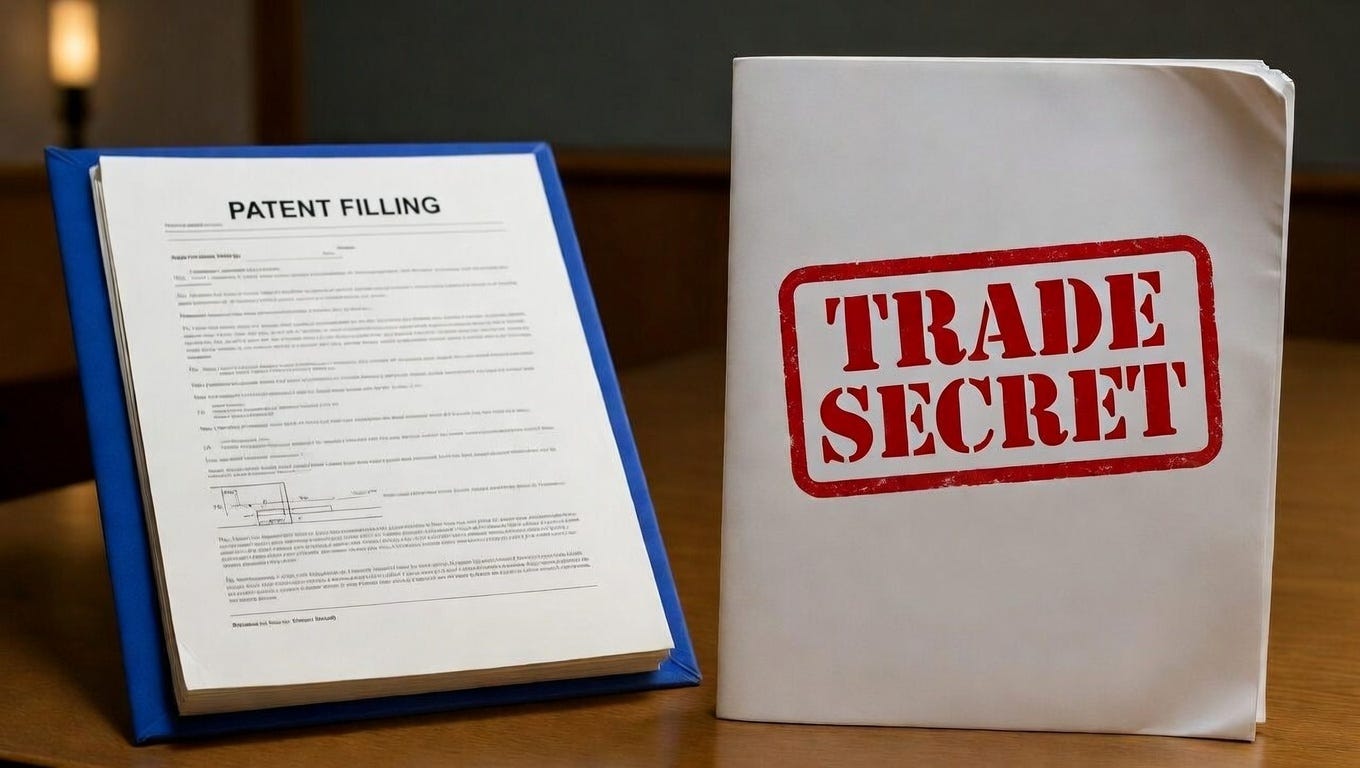
Trade Secrets Vs. Patents: Strategic IP Protection For Technology Companies
Description
A Case Study of the SpaceX Dual-Track Intellectual Property Model
Prepared by The Innovation Attorney | March 2026
In 2012, the chief executive of a company that had just become the first private firm to dock a spacecraft with the International Space Station announced that his company had essentially no patents. He was not describing a failure. He was describing a strategy. Over a decade later, that company, SpaceX, holds 416 patents and counting, almost none of which cover rockets.
The apparent contradiction dissolves when you understand the architecture of the decision. SpaceX’s patent portfolio, which GreyB analytics data places at 416 patents across 125 unique families globally as of early 2026, is concentrated almost entirely in satellite communications technology for the Starlink constellation: phased-array antenna systems, beamforming calibration, handover protocols, adaptive modulation and coding schemes. The Merlin and Raptor engines, the reusable booster landing systems, the carbon fiber composite structures, the propellant management systems: none of these appear in SpaceX’s public patent filings. They are protected as trade secrets.
This bifurcation is not accidental. It reflects a precise analysis of what the law can and cannot do for you in different competitive environments, and it contains lessons that most companies, large and small, have not absorbed.
The Patent Bargain and Its Hidden Cost
The United States patent system rests on a constitutional bargain: a twenty-year government-backed monopoly in exchange for full public disclosure of how the invention works. 35 U.S.C. Section 154 defines the grant; 35 U.S.C. Sections 101, 102, and 103 define the price of admission. Novelty. Non-obviousness. Statutory subject matter. An invention that clears those hurdles earns a right to exclude enforceable in federal court against anyone who makes, uses, or sells the patented technology, including a party who independently invented the same thing.
The disclosure requirement is not a technicality. It is the mechanism by which the patent system produces the public benefit that justifies the private monopoly. A patent enables competitors to read the specification, understand the invention, and engineer around it or wait for the term to expire and then practice it freely. For many companies operating in markets where competitors are domestic, subject to United States law, and capable of reverse-engineering a product anyway, this is an acceptable trade. The patent at least gives you a remedy.
For SpaceX, operating in a global aerospace market where its most dangerous potential competitors are agencies and enterprises in jurisdictions that do not reliably enforce foreign intellectual property rights, the disclosure was the problem. Filing a patent on a Merlin engine combustion cycle would have meant teaching the world how to build it in exchange for a right that might be unenforceable against the parties most likely to copy it. The trade secret alternative offered no formal monopoly but also required no disclosure: protection conditioned entirely on keeping the information secret rather than on the government’s willingness to enforce a right.
The Federal Law That Changed the Calculus
The passage of the Defend Trade Secrets Act of 2016, Pub. L. No. 114-153, created a federal civil cause of action for trade secret misappropriation for the first time in United States history. Before the DTSA, companies relying on trade secret protection were largely confined to state court actions under the Uniform Trade Secrets Act, a model law adopted in varying forms by 48 states. State courts offered inconsistent standards, varying statutes of limitations, and no nationwide service of process.
The DTSA changed this. It created federal jurisdiction over trade secret claims, authorized ex parte seizure orders in extraordinary circumstances, and established exemp