Episode Details
Back to Episodes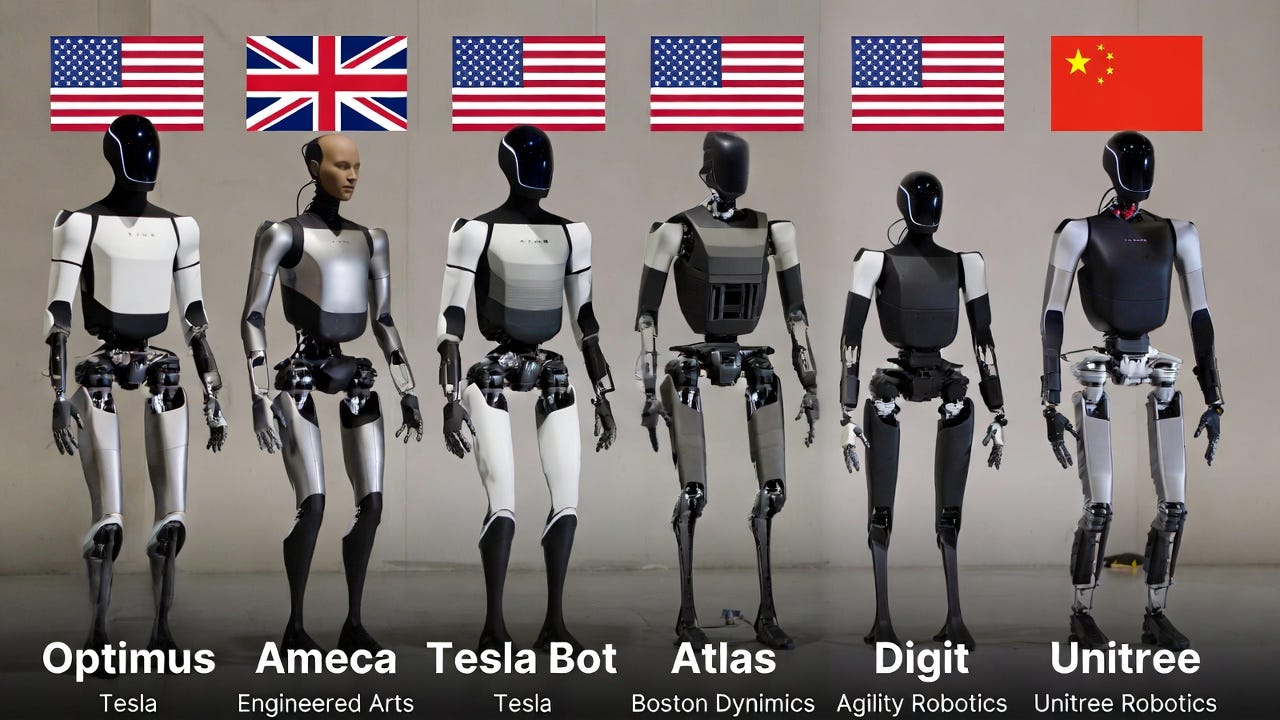
The Development of Humanoid Robots
Description
Research Report | March 2026 | The Innovation Attorney
A. Executive Summary
The rapid development of humanoid robots represents one of the most consequential commercial transitions of the 21st century. Combining advanced artificial intelligence with biomechanical engineering, humanoid robots are moving from research laboratories into real commercial deployments across manufacturing, logistics, and healthcare settings. The global market, valued at approximately 2.92 to 3.14 billion dollars in 2025, is projected to expand at a compound annual growth rate exceeding 39 percent through 2030, with some analysts forecasting a market exceeding 80 billion dollars by 2035.
Leading technology companies, including Tesla (Optimus Gen 3), Boston Dynamics (Electric Atlas), Figure AI (Figure 03), and a dense constellation of Chinese manufacturers, are competing to establish commercial footholds. The artificial intelligence infrastructure powering these systems is advancing at an extraordinary pace. NVIDIA released Isaac GR00T N1, the world’s first open foundation model for generalized humanoid robot skills, enabling robots to understand natural language, observe and replicate human movements, and generalize across entirely novel tasks and environments.
Three sequential waves of commercial adoption are projected: the first spanning 2025 to 2030 focuses on industrial manufacturing and logistics at price points of 80,000 to 250,000 dollars per unit; the second from 2027 to 2033 targets consumer, developer, and education markets at dramatically lower price points of 5,000 to 25,000 dollars; and the third beginning around 2030 addresses healthcare and elder care, which analysts identify as the largest long term societal opportunity. Cumulative industry funding exceeded 9.8 billion dollars during 2025, with capital continuing to accelerate.
Key commercial challenges include the high cost of hardware development, battery and power management constraints, the difficulty of navigating unstructured real world environments, and the pace of workforce adoption. North America currently leads with a 52.2 percent revenue share, while the Asia Pacific region, driven primarily by aggressive Chinese government investment and manufacturing capacity, is the fastest growing market globally.
B. Detailed Findings
1. Technical Development and Platform Capabilities
1.1 Platform Architecture and Sensing
Contemporary humanoid robots share a common architectural model: a central compute unit running large language model and vision systems for high level reasoning, a lower level motion control stack for real time locomotion and manipulation, and a sensor array providing environmental awareness. The industry has largely converged on camera based vision rather than LiDAR or radar, citing cost reduction and the superior pattern recognition capabilities of convolutional neural networks trained on large image datasets.
Tesla’s Optimus Gen 3 integrates xAI’s Grok large language model for natural language interaction with a computer vision stack derived from Tesla’s Full Self Driving neural networks. The platform uses eight autopilot cameras providing 360 degree awareness, stereo depth estimation, object recognition, real time mapping, and foot force and torque sensors for dynamic balance. As of February 2026, Gen 3 production has commenced at Tesla’s Fremont, California facility, with deployed units currently engaged in supervised learning and data collection tasks. Consumer pricing is projected at 20,000 to 30,000 dollars per unit at scale.
Boston Dynamics unveiled its fully electric Atlas platform at CES 2026. The new design replaces hydraulic actuators of prior versions with electric motors, reflecting an industry wide trend toward cleaner and more energy efficient drive systems. Initial commercial deployments at an estimated unit price of 140,000 to 150,000 dollars are directed to Hyundai’s Robotics Metapl