Episode Details
Back to Episodes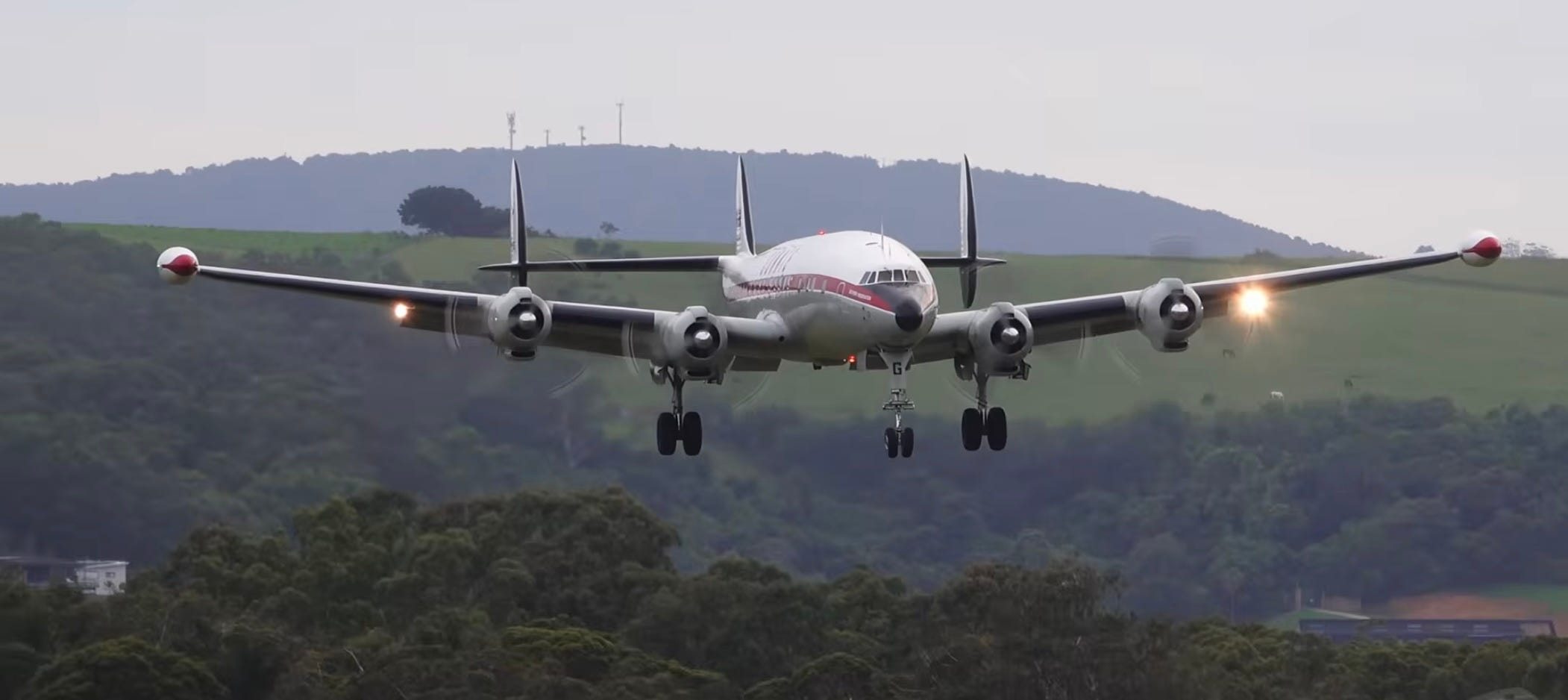
The Lockheed Constellation
Description
The Innovation Attorney | March 2026
Executive Summary
The Lockheed Constellation, affectionately called “Connie” by the aviation community, stands as one of the most consequential aircraft in the history of commercial and military aviation. Conceived in 1939 at the instigation of Howard Hughes and Transcontinental and Western Air, designed under the leadership of Lockheed engineers Kelly Johnson and Hall Hibbard, and first flown on January 9, 1943, the Constellation represented a quantum leap in propeller-driven airliner design. Its distinctive triple-fin tail, dolphin-shaped pressurized fuselage, and wing technology derived from Lockheed’s P-38 fighter established new standards for speed, range, passenger comfort, and operational reliability.
Produced in four main civil variants spanning from the original L-049 through the L-749, L-1049 Super Constellation, and the ultimate L-1649 Starliner, the type grew from a 44-passenger domestic carrier into a 95-passenger intercontinental airliner capable of nonstop transatlantic service. Military derivatives, collectively designated C-121, served the United States Army Air Forces, the United States Air Force, and the United States Navy in transport, VIP shuttle, and electronic surveillance roles for nearly four decades. The EC-121 Warning Star variant, equipped with advanced airborne radar and signal intelligence systems, formed a critical link in the Cold War air defense architecture protecting North American airspace against Soviet bomber intrusion.
A total of 856 Constellations were produced between 1943 and 1958 at Lockheed’s Burbank, California plant. Commercial operations began with TWA in February 1946 and the type powered the golden age of propeller-driven air travel throughout the 1950s before being displaced by jet airliners beginning in 1958. The aircraft’s engineering legacy, particularly its contributions to pressurized cabin design, hydraulically boosted flight controls, and airborne electronics integration, shaped the trajectory of both civil aviation and military airborne surveillance systems for generations. This report provides a comprehensive technical and operational account of the Constellation’s development, variants, and service history.
Detailed Findings
I. Origins and Conception (1937 to 1942)
Lockheed’s path to the Constellation began with a prior design effort designated the L-044 Excalibur, a four-engined pressurized airliner concept that the company had been developing internally since 1937. The Excalibur, while technically interesting, lacked the range and passenger capacity to meet the emerging demands of transcontinental scheduled air service. It was the intervention of Howard Hughes, who held a controlling interest in Transcontinental and Western Air (later renamed Trans World Airlines, or TWA), that transformed this preliminary work into the aircraft the world would come to know.
In 1939, Hughes and TWA president Jack Frye issued a formal set of performance requirements to Lockheed that were, by the standards of the era, extraordinarily ambitious. The airline demanded a pressurized airliner capable of carrying at least 40 passengers over a range of 3,500 miles at cruising speeds approaching 300 miles per hour. These specifications demanded an aircraft capable of nonstop transcontinental service from Los Angeles to New York, a feat no airliner of the period could accomplish reliably. Hughes further stipulated that the aircraft must be deliverable within 24 months, which placed extraordinary pressure on Lockheed’s engineering team.
Robert Gross, Lockheed’s president, assembled a design team under chief engineer Hall Hibbard and chief research engineer Kelly Johnson. Johnson, already celebrated within Lockheed for his aerodynamic brilliance and his leading role in the P-38 Lightning fighter program, became the principal technical architect of the new design. The team designated the project the L-04