Episode Details
Back to Episodes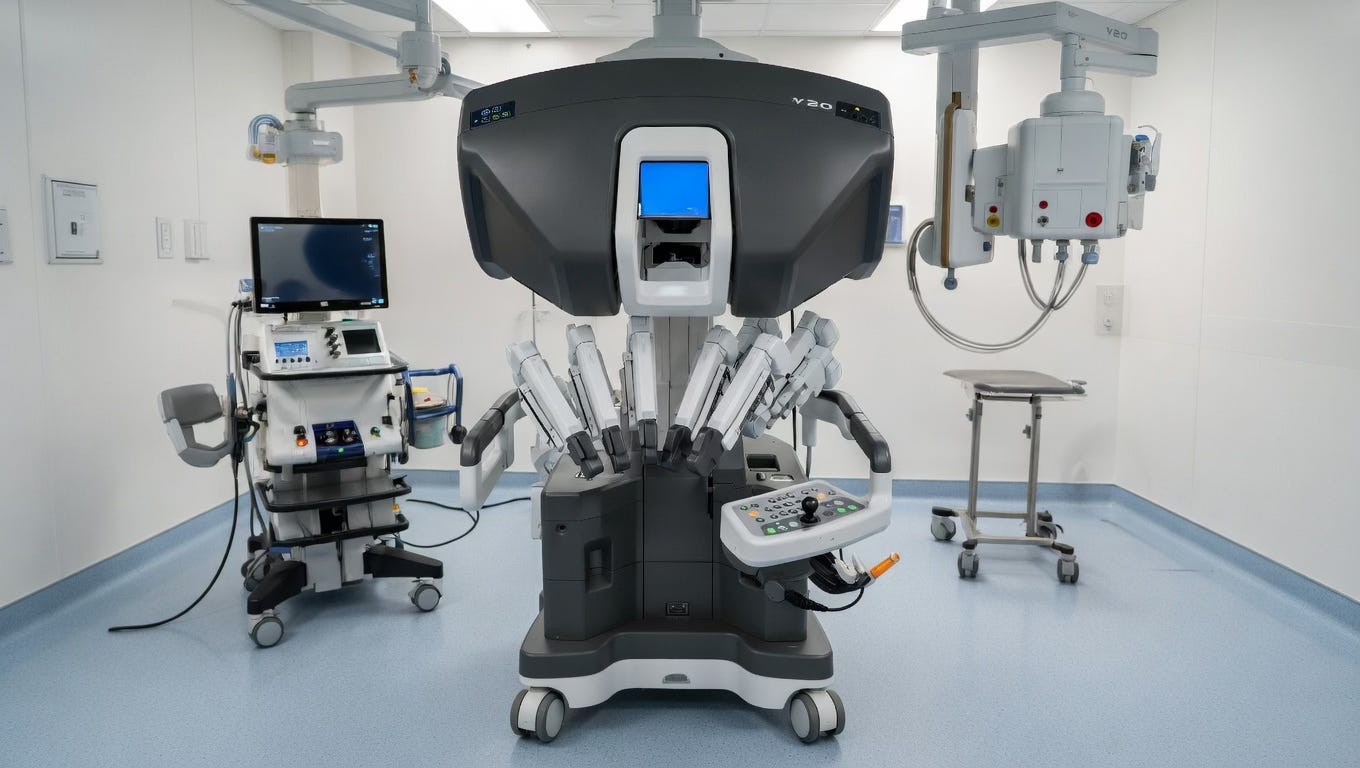
The da Vinci Machine
Description
A Project Health Research Report by The Innovation Attorney
March 2026
A. Executive Summary
The da Vinci Surgical System, manufactured by Intuitive Surgical, Inc., is the dominant platform in robotic-assisted minimally invasive surgery worldwide. Introduced in the late 1990s and first cleared by the U.S. Food and Drug Administration in 2000, the system now spans multiple generations, most recently the da Vinci 5, which the FDA cleared via 510(k) in March 2024. Intuitive holds approximately 60 percent of the global surgical robotics market, generated $8.35 billion in revenue in 2024, and facilitated approximately 2.68 million procedures that year. The company operates a vertically integrated business model in which hospitals that purchase or lease a da Vinci system are also contractually bound to purchase proprietary instruments and service agreements, a practice at the center of high-stakes antitrust litigation now proceeding in the Northern District of California.
The da Vinci 5 represents a generational advance: it introduces force feedback technology for the first time in the product line, enabling surgeons to sense tissue tension during procedures, which early data suggests reduces applied force by up to 40 percent. The system has received multiple new FDA clearances in 2024 and 2025, expanding its approved indications to include colorectal, hernia repair, cholecystectomy, and cardiac procedures.
The legal landscape is as significant as the clinical one. A federal antitrust class action brought by hospital purchasers was certified on March 21, 2025, covering purchases from 2017 to 2021. A parallel suit by a surgical instrument servicer was dismissed in January 2025 after the court applied the Epic v. Apple aftermarket doctrine. The most pressing regulatory issue is that Medicare and Medicaid do not separately reimburse for robotic equipment, meaning the cost of owning and operating a da Vinci system must be absorbed by hospitals within standard surgical procedure reimbursement rates. This tension between the system’s clinical promise, its high capital cost, and the antitrust scrutiny of its consumables model defines the current landscape for any hospital system, insurer, or investor evaluating this technology.
B. Detailed Findings
1. The da Vinci System: Technology and Clinical Applications
The da Vinci Surgical System is a robotic-assisted surgical platform that translates a surgeon’s hand movements, made at a console, into precise movements of miniaturized instruments inside the patient’s body. The surgeon operates from an ergonomic console equipped with a high-definition 3D visualization system; the patient-side cart, which holds three to four robotic arms, performs the actual manipulation of instruments. The system is designed for minimally invasive surgery, meaning procedures performed through small incisions or natural orifices rather than large open cuts.
The current product family includes three primary platforms: the da Vinci Xi, the multi-quadrant workhorse of the line; the da Vinci SP (Single Port), which operates through a single small incision or natural orifice; and the da Vinci 5, the newest and most advanced generation. Cleared by the FDA in March 2024, the da Vinci 5 introduces force feedback capability, a significant clinical advance. Prior da Vinci systems provided no haptic feedback, meaning surgeons could not feel the resistance of tissue during a procedure. The da Vinci 5 addresses this limitation by transmitting tactile sensations back to the surgeon’s hands, and early clinical data indicates this results in up to 40 percent less force applied to tissue during procedures. (Intuitive Surgical, da Vinci 5 Product Page, 2024.)
Approved surgical specialties include urology (radical prostatectomy is among the most performed robotic procedures globally), gynecology, colorectal surgery, thoracic surgery, general surgery, and, with a Dec