Episode Details
Back to Episodes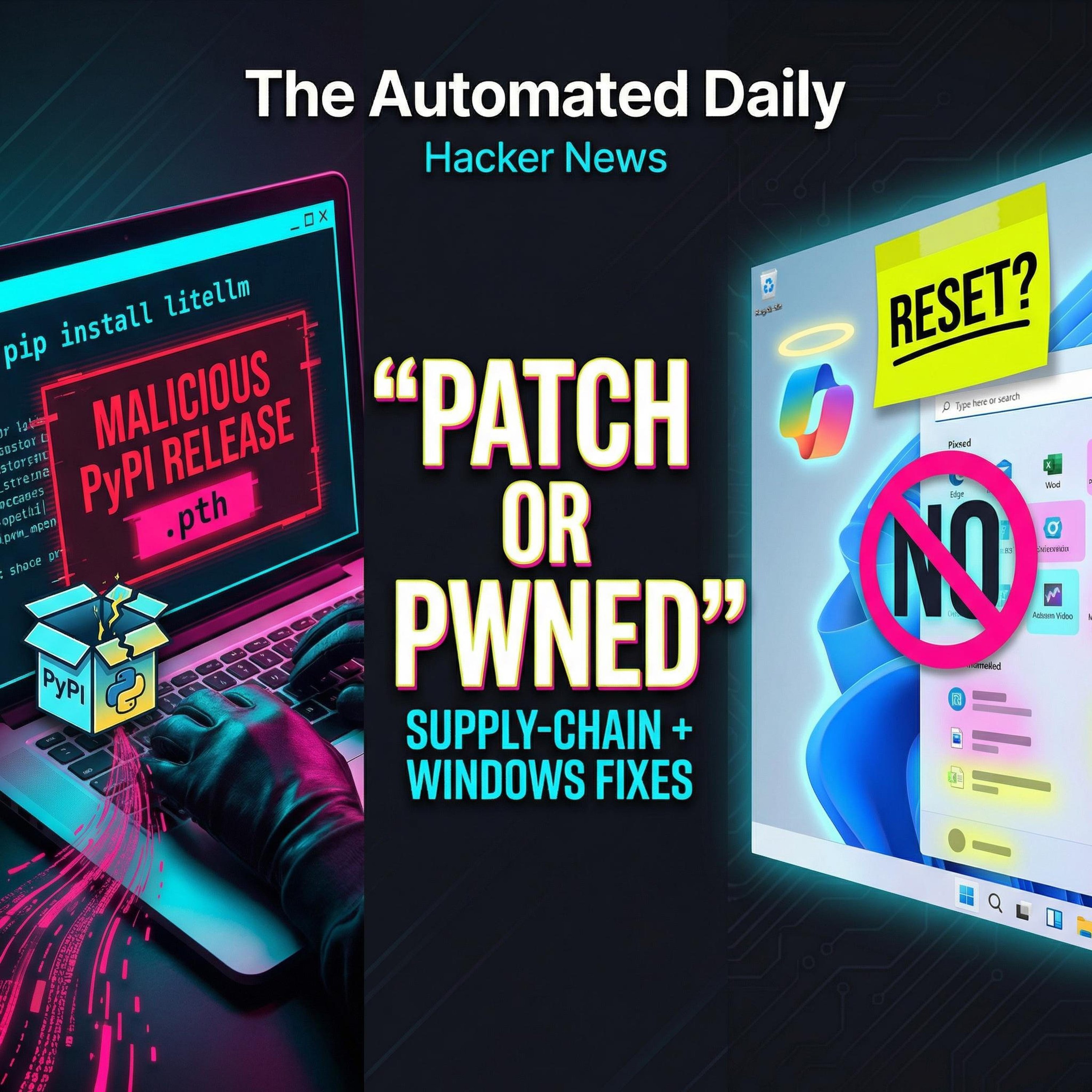
PyPI supply-chain malware scare & Windows 11 usability reset - Hacker News (Mar 24, 2026)
Published 2 months, 4 weeks ago
Description
Please support this podcast by checking out our sponsors:
- Discover the Future of AI Audio with ElevenLabs - https://try.elevenlabs.io/tad
- Consensus: AI for Research. Get a free month - https://get.consensus.app/automated_daily
- Build Any Form, Without Code with Fillout. 50% extra signup credits - https://try.fillout.com/the_automated_daily
Support The Automated Daily directly:
Buy me a coffee: https://buymeacoffee.com/theautomateddaily
-Critics Say Microsoft’s Windows 11 ‘Fix Plan’ Reverses Self-Inflicted Changes, Not Core Privacy Issues
-Litellm PyPI Supply-Chain Attack Allegedly Adds Auto-Executing .pth Credential Stealer
-Why Missile Defense Allocation Is NP-Complete—and Why Sensors Matter More Than Interceptors
-Opera’s Web Rewind Offers an Interactive Timeline of 30 Years of the Web
-Why zswap Usually Beats zram for Compressed Swap on Linux
-Benchmarks Show ripgrep’s Speed Advantage and Why Unicode-Friendly Search Can Still Be Fast
-
- Discover the Future of AI Audio with ElevenLabs - https://try.elevenlabs.io/tad
- Consensus: AI for Research. Get a free month - https://get.consensus.app/automated_daily
- Build Any Form, Without Code with Fillout. 50% extra signup credits - https://try.fillout.com/the_automated_daily
Support The Automated Daily directly:
Buy me a coffee: https://buymeacoffee.com/theautomateddaily
Today's topics:
PyPI supply-chain malware scare - A suspected malicious PyPI release of litellm used a .pth auto-execution trick to steal credentials (AWS/GCP/Azure), SSH keys, and tokens—raising urgent credential-rotation and CI/CD risk concerns.
Windows 11 usability reset - Microsoft’s seven-point Windows 11 “fix” plan targets ads, Copilot clutter, and missing UX basics, but leaves privacy, forced Microsoft account setup, telemetry limits, and OneDrive lock-in largely intact.
Missile defense math meets reality - A new analysis frames missile defense as resource allocation under uncertainty: interceptor inventories, sensor reliability, and decoys can overwhelm even strong optimization, making high-confidence defense hard at scale.
Linux compressed swap: zswap vs zram - Kernel developer commentary argues zswap generally degrades more predictably than zram under pressure, with fewer pathological behaviors and less risk of long stalls—important for servers and desktops alike.
ripgrep benchmark lessons for search - A deep benchmark-and-design write-up on ripgrep highlights why real-world code search hinges on correctness, Unicode handling, and filesystem traversal—not just raw regex speed.
Streaming OS images over network - A Linux imaging post shows the appeal and danger of streaming a disk image straight onto a block device: it’s elegant for deployments, but unsafe if you overwrite the disk you’re running from.
Apartment gate hacked the simple way - A DoorKing gate outage led residents to bypass the “smart” layers and trigger the lock at the wiring level, then wrap it in a standards-based smart-home control—showing physical security realities.
Terminal log analysis with lnav - lnav demonstrates how far a local terminal tool can go for log triage—searching, filtering, and making noisy logs readable without standing up heavyweight logging infrastructure.
-Critics Say Microsoft’s Windows 11 ‘Fix Plan’ Reverses Self-Inflicted Changes, Not Core Privacy Issues
-Litellm PyPI Supply-Chain Attack Allegedly Adds Auto-Executing .pth Credential Stealer
-Why Missile Defense Allocation Is NP-Complete—and Why Sensors Matter More Than Interceptors
-Opera’s Web Rewind Offers an Interactive Timeline of 30 Years of the Web
-Why zswap Usually Beats zram for Compressed Swap on Linux
-Benchmarks Show ripgrep’s Speed Advantage and Why Unicode-Friendly Search Can Still Be Fast
-
Listen Now
Love PodBriefly?
If you like Podbriefly.com, please consider donating to support the ongoing development.
Support Us