Episode Details
Back to Episodes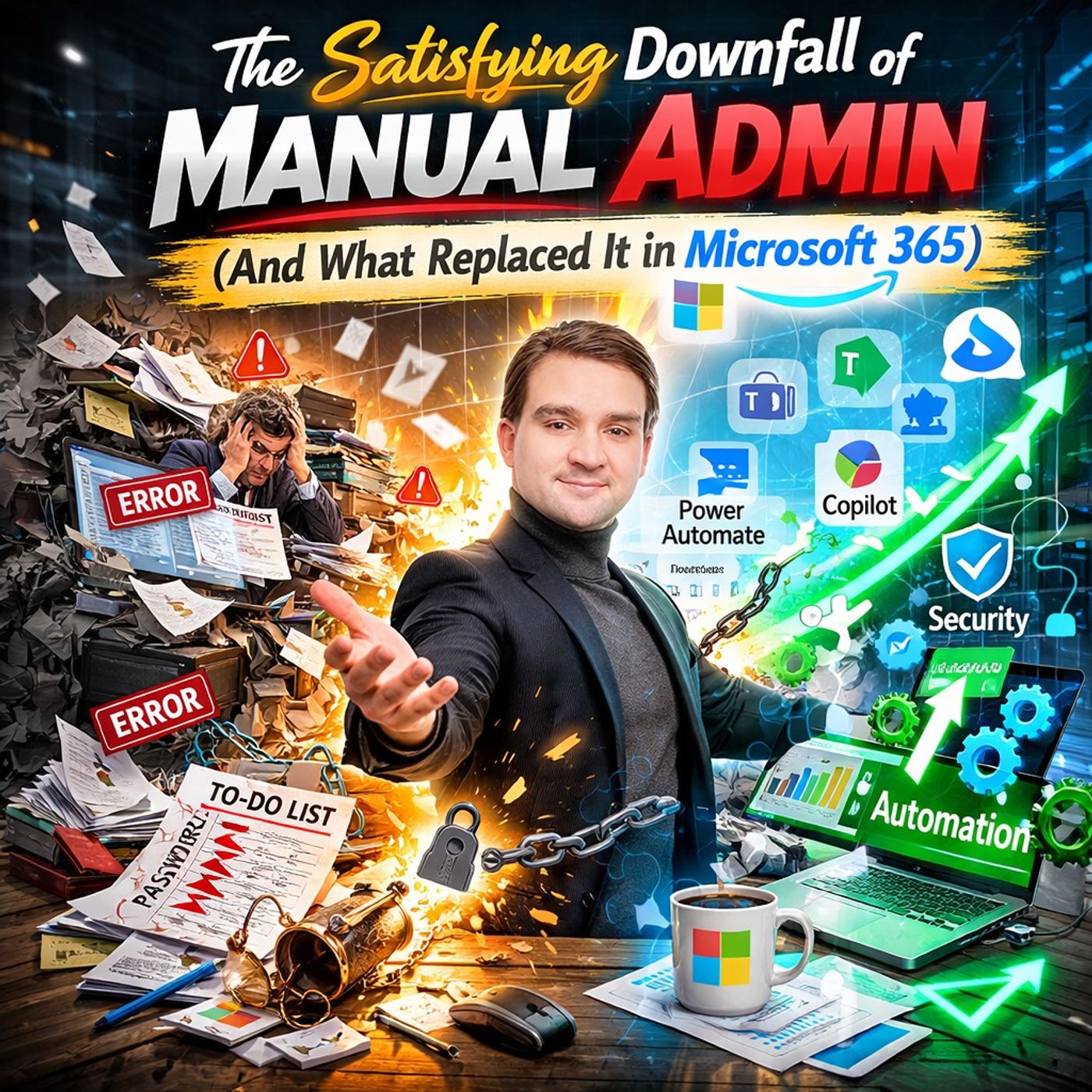
Microsoft 365 Governance: Why Manual Admin Is Dead (Automation, Security and the End of Human Control)
Season 1
Published 4 months, 3 weeks ago
Description
In this episode, you’ll learn why manual administration in Microsoft 365 is no longer scalable and how automation is fundamentally changing governance, security, and productivity. You’ll understand why human-driven admin work is being replaced by system-driven decision models.
WHY MANUAL ADMIN NO LONGER WORKS
For years, Microsoft 365 environments have been managed through manual processes. Admins reviewed access, approved requests, and controlled systems through direct interaction. This approach worked when systems were smaller and slower. But modern Microsoft 365 environments operate at a completely different scale. The number of users, identities, permissions, and data interactions has grown beyond what humans can realistically manage. Manual administration cannot keep up with the speed of modern systems. THE
REAL PROBLEM IS SCALE
The issue is not that admins are doing a bad job. The system itself has outgrown human control. Microsoft 365 operates at machine speed. Every access request, policy decision, and data movement happens continuously. Human-driven processes introduce delay, inconsistency, and gaps in enforcement. Over time, this creates entropy. Systems become harder to control, and governance becomes reactive instead of proactive.
WHY MANUAL GOVERNANCE CREATES RISK
Manual governance depends on reviews, approvals, and periodic checks. But these processes are too slow for modern environments. By the time a review happens, the system has already changed. This creates security gaps, inconsistent permissions, and unclear ownership. Microsoft security cannot rely on delayed human decisions. It requires continuous and automated enforcement.
THE SHIFT TO AUTOMATED DECISION SYSTEMS
Modern Microsoft 365 environments are moving toward automated governance models. Instead of relying on manual actions, systems enforce policies continuously. Identity, permissions, and data classification become part of an automated decision engine. This removes human latency and ensures that governance happens in real time.
FROM ADMIN TO ARCHITECT
This shift changes the role of IT professionals. Instead of managing systems manually, admins need to design how systems operate. The focus moves from clicking buttons to defining rules, structures, and automation models. The future role is not operator, but architect.
WHY THIS MATTERS FOR MODERN WORK
Modern work depends on speed, flexibility, and scale. Manual administration cannot support these requirements. It slows down processes and creates friction. Automated governance enables organizations to scale productivity while maintaining security and control. KEY TAKEAWAYS
"Manual admin is not failing. It is obsolete."
"The system failed because it needed you."
"Human speed cannot match machine speed."
"Governance must be continuous, not periodic."
"Admins are becoming architects."
TOOLS AND TOPICS
- why manual admin cannot keep up with Microsoft 365 complexity
- how automation changes Microsoft security and governance
- why modern work requires system-level thinking instead of manual control
WHY MANUAL ADMIN NO LONGER WORKS
For years, Microsoft 365 environments have been managed through manual processes. Admins reviewed access, approved requests, and controlled systems through direct interaction. This approach worked when systems were smaller and slower. But modern Microsoft 365 environments operate at a completely different scale. The number of users, identities, permissions, and data interactions has grown beyond what humans can realistically manage. Manual administration cannot keep up with the speed of modern systems. THE
REAL PROBLEM IS SCALE
The issue is not that admins are doing a bad job. The system itself has outgrown human control. Microsoft 365 operates at machine speed. Every access request, policy decision, and data movement happens continuously. Human-driven processes introduce delay, inconsistency, and gaps in enforcement. Over time, this creates entropy. Systems become harder to control, and governance becomes reactive instead of proactive.
WHY MANUAL GOVERNANCE CREATES RISK
Manual governance depends on reviews, approvals, and periodic checks. But these processes are too slow for modern environments. By the time a review happens, the system has already changed. This creates security gaps, inconsistent permissions, and unclear ownership. Microsoft security cannot rely on delayed human decisions. It requires continuous and automated enforcement.
THE SHIFT TO AUTOMATED DECISION SYSTEMS
Modern Microsoft 365 environments are moving toward automated governance models. Instead of relying on manual actions, systems enforce policies continuously. Identity, permissions, and data classification become part of an automated decision engine. This removes human latency and ensures that governance happens in real time.
FROM ADMIN TO ARCHITECT
This shift changes the role of IT professionals. Instead of managing systems manually, admins need to design how systems operate. The focus moves from clicking buttons to defining rules, structures, and automation models. The future role is not operator, but architect.
WHY THIS MATTERS FOR MODERN WORK
Modern work depends on speed, flexibility, and scale. Manual administration cannot support these requirements. It slows down processes and creates friction. Automated governance enables organizations to scale productivity while maintaining security and control. KEY TAKEAWAYS
- manual admin is not inefficient, it is no longer scalable
- Microsoft 365 requires automated governance models
- Microsoft security depends on continuous enforcement
- human-driven processes create delays and risk
- the role of admins is shifting toward architecture
"Manual admin is not failing. It is obsolete."
"The system failed because it needed you."
"Human speed cannot match machine speed."
"Governance must be continuous, not periodic."
"Admins are becoming architects."
TOOLS AND TOPICS
- Automation Models - system-driven governance
- Identity Systems - continuous access decisions
- Policy Enforcement - real-time control mechanisms
- Governance Automation - replacing manual processes
- Decision Syst