Episode Details
Back to Episodes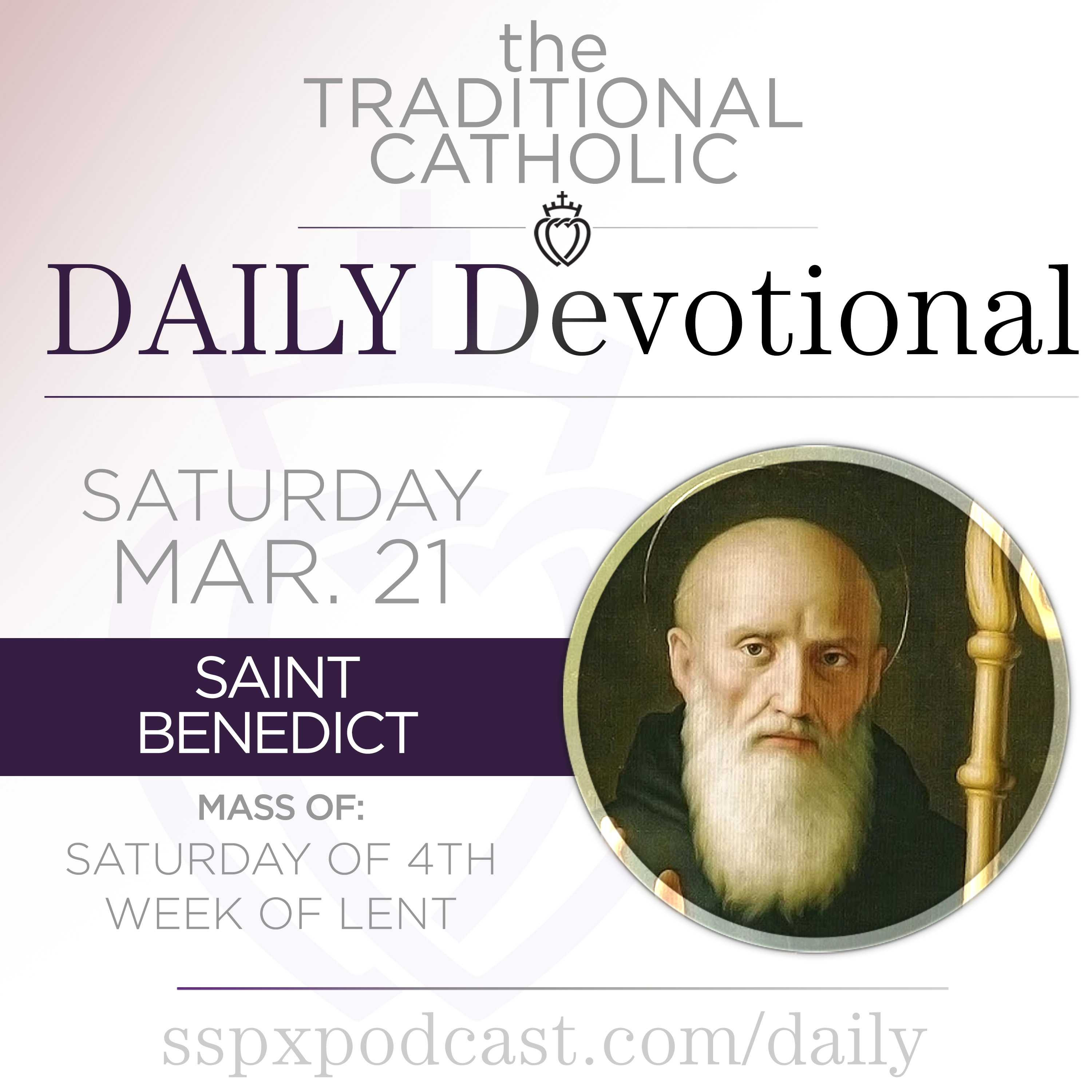
Mar 21 – Sat of 4th Wk of Lent / S Benedict
Description
Sources Used Today:
- "Love and Obedience" — Toward Easter
- "A Bishop Equates Sunday Mass at a Society Chapel with Invalidity" (FSSPX.news)
- https://fsspx.news/en/news/united-kingdom-bishop-equates-sunday-mass-society-chapel-invalidity-57890
- The Spiritual Life — Archbishop Marcel Lefebvre (Angelus Press)
Saint Benedict, often called the father of Western monasticism, stands at the beginning of a spiritual tradition that helped shape Christian civilization. He was born around the year 480 in Nursia, in central Italy, during a time of great upheaval following the fall of the Roman Empire. As a young man, he was sent to Rome for his studies, but he soon grew disillusioned with the moral corruption he found there. Seeking God more earnestly, he withdrew from the world and lived as a hermit in a cave at Subiaco.
In that hidden life of prayer and penance, Benedict learned to listen deeply to God. Over time, others were drawn to his example, and he began to guide them in the spiritual life. Eventually, he founded a monastery at Monte Cassino, where he wrote his famous Rule. This Rule was not harsh or extreme, but balanced and deeply practical, organizing monastic life around prayer, work, and community. Its guiding spirit can be summed up in the phrase “ora et labora,” prayer and work, lived in harmony.
The Church sees in Saint Benedict not only a founder of monasteries, but a builder of Christian culture. His Rule became the foundation for countless monasteries across Europe, places where the faith was preserved, cultivated, and handed on during centuries of instability. Monks following his way copied manuscripts, educated the young, cared for the poor, and rooted entire regions in a rhythm of Christian life. For this reason, Pope Paul VI declared him a patron of Europe, recognizing his role in shaping the continent’s spiritual identity.
Saint Benedict is also remembered for his spiritual wisdom, especially his emphasis on humility, obedience, and stability. He taught that holiness is found not in extraordinary visions, but in perseverance in daily duties, lived in charity and order. His influence continues today in monasteries throughout the world, where his Rule is still followed.
Devotion to Saint Benedict is closely tied to the well-known Benedict Medal, a sacramental rich in symbolism and prayers of protection. Many of the faithful wear or keep this medal as a reminder of the power of Christ over evil and the call to live faithfully. His feast day, celebrated on July 11 in the traditional calendar, is marked especially in Benedictine commun