Episode Details
Back to Episodes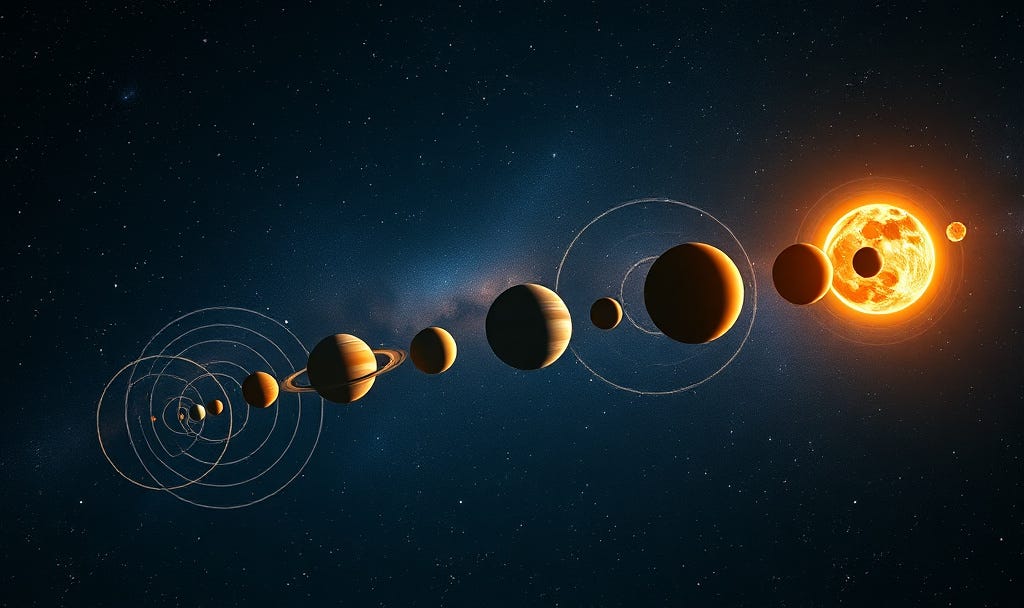
The Solar System Has Frets
Description
This podcast (20min) was generated by NotebookLM to simplify complex scientific concepts into an accessible format — based entirely on my own research.
The Solar System Has a Hidden Mathematical Code — And It Was Carved in Stone a Thousand Years Ago
Look up at the night sky. Those planets you can barely make out — Mars, Jupiter, Saturn glowing faintly in the dark — are they just randomly scattered rocks that happened to settle wherever gravity left them after billions of years of cosmic chaos?
Or is there something else going on?
That’s the question at the heart of my research paper, The Harmonic Architecture of the Solar System, and the answer I’ve found is stranger and more precise than I ever expected.
The Guitar String and the Solar System
Here’s an analogy that might help.
When you pluck a guitar string, it doesn’t produce a chaotic mush of sound. It produces a specific note because of the placement of the frets along the neck. The string can only vibrate in specific harmonic fractions. Those frets dictate everything.
What I’m proposing is that our solar system has frets.
The Sun’s gravity is the string. And the planets — Mercury, Venus, Earth, Mars, Jupiter, Saturn, Uranus, Neptune, Pluto — are sitting on specific, mathematically precise positions dictated by a single geometric constant: the Silver Ratio.
A planet cannot exist just anywhere. If it sits between the frets, the system's gravitational resonance will eventually destabilise it — either throwing it into the Sun or ejecting it into deep space. Only the frets are stable. And the geometry of the Silver Ratio dictates exactly where those frets must go.
What Is the Silver Ratio?
Most people have heard of the Golden Ratio — that famous proportion that appears in seashells, hurricanes, and the arms of galaxies. The Silver Ratio is its lesser-known sibling: mathematically, it’s simply 1 + √2 ≈ 2.414.
Equally fundamental. Far less famous.
What makes this interesting is where this number comes from in my framework. I didn’t pull it from thin air. It emerges directly from the geometry of the Celtic Cross — that ancient ringed cross carved into standing stones across the British Isles by monks over a thousand years ago.
Take a 3×3 grid of equal squares — a simple tic-tac-toe board. Draw concentric circles outward from the centre, and additional circles anchored at the four corners. The ratios of the distances where these circles intersect the grid lines are completely determined by √2 and its derivatives. The Silver Ratio falls out of this construction naturally, without any fitting or adjustment.
That’s the geometric key. A flat, two-dimensional drawing of circles and squares — and the proportions it generates map onto three-dimensional physical space across billions of miles.
The Numbers
This isn’t just a poetic idea. The framework — which I call the Silver Ratio Harmonic Framework (SRHF) — produces explicit, testable predictions.
Applied to the nine major bodies of the Solar System, from Mercury to Pluto, it achieves a mean error of just 0.72%. To put that in context:
- Kepler’s nested Platonic solids: ~10.3% error
- The classical Titius-Bode law: ~2–3% error, and it collapses completely at Neptune
- The SRHF: 0.72% error, holding all the way to the outer Solar System
The probability of matching all nine orbits to within 2% by pure chance, treating each as an independent statistical event, is approximately 10⁻¹³. That’s 0.0000000000001. The Texas sharpshooter fallacy doesn’t hold up to that number.
The Ghost
But here’s where it gets truly interesting.
Fol