Episode Details
Back to Episodes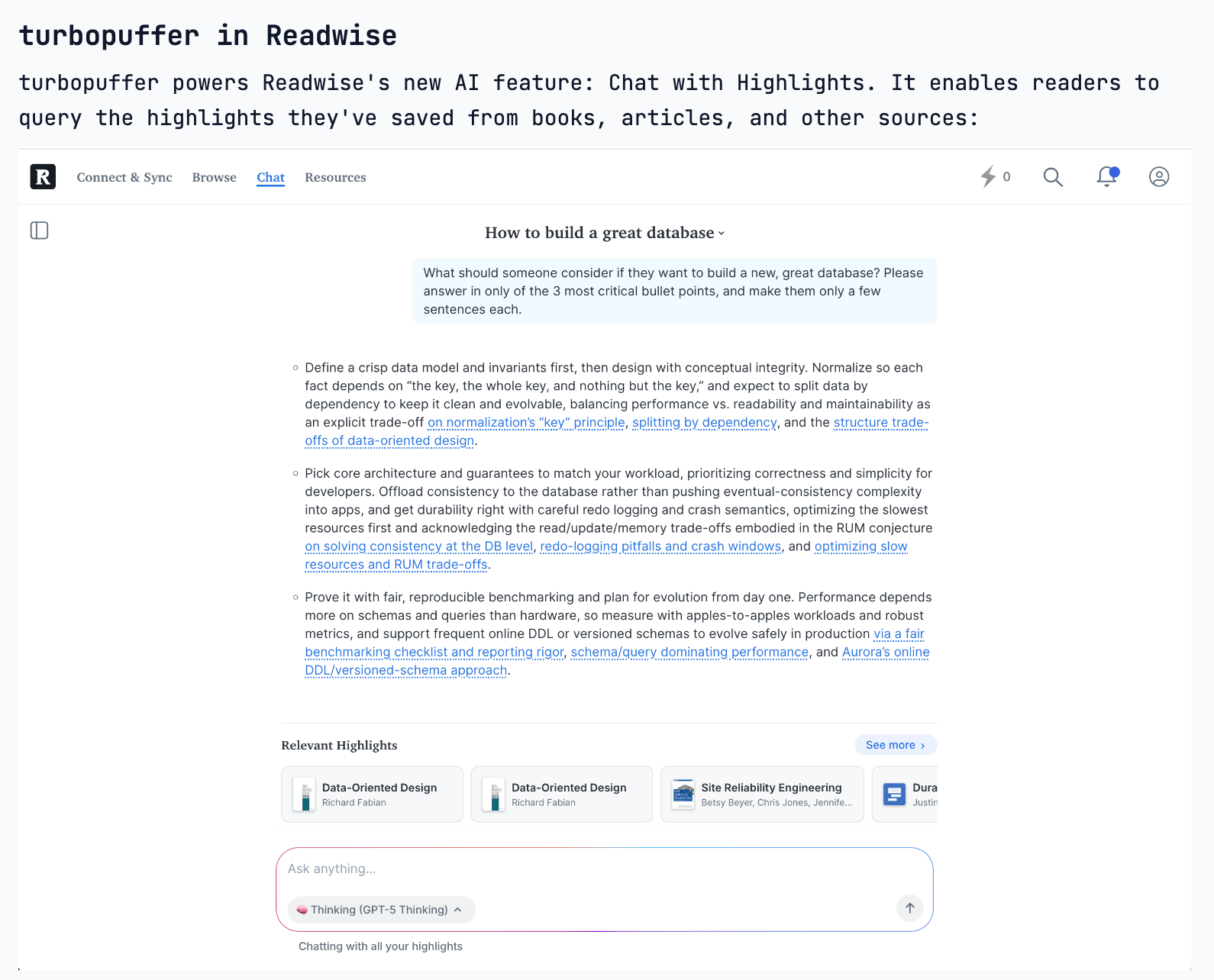
Retrieval After RAG: Hybrid Search, Agents, and Database Design — Simon Hørup Eskildsen of Turbopuffer
Description
Turbopuffer came out of a reading app.
In 2022, Simon was helping his friends at Readwise scale their infra for a highly requested feature: article recommendations and semantic search. Readwise was paying ~$5k/month for their relational database and vector search would cost ~$20k/month making the feature too expensive to ship. In 2023 after mulling over the problem from Readwise, Simon decided he wanted to “build a search engine” which became Turbopuffer.
We discuss:• Simon’s path: Denmark → Shopify infra for nearly a decade → “angel engineering” across startups like Readwise, Replicate, and Causal → turbopuffer almost accidentally becoming a company • The Readwise origin story: building an early recommendation engine right after the ChatGPT moment, seeing it work, then realizing it would cost ~$30k/month for a company spending ~$5k/month total on infra and getting obsessed with fixing that cost structure • Why turbopuffer is “a search engine for unstructured data”: Simon’s belief that models can learn to reason, but can’t compress the world’s knowledge into a few terabytes of weights, so they need to connect to systems that hold truth in full fidelity • The three ingredients for building a great database company: a new workload, a new storage architecture, and the ability to eventually support every query plan customers will want on their data • The architecture bet behind turbopuffer: going all in on object storage and NVMe, avoiding a traditional consensus layer, and building around the cloud primitives that only became possible in the last few years
• Why Simon hated operating Elasticsearch at Shopify: years of painful on-call experience shaped his obsession with simplicity, performance, and eliminating state spread across multiple systems • The Cursor story: launching turbopuffer as a scrappy side project, getting an email from Cursor the next day, flying out after a 4am call, and helping cut Cursor’s costs by 95% while fixing their per-user economics
• The Notion story: buying dark fiber, tuning TCP windows, and eating cross-cloud costs because Simon refused to compromise on architecture just to close a deal faster
• Why AI changes the build-vs-buy equation: it’s less about whether a company can build search infra internally, and more about whether they have time especially if an external team can feel like an extension of their own • Why RAG isn’t dead: coding companies still rely heavily on search, and Simon sees hybrid retrieval semantic, text, regex, SQL-style patterns becoming more important, not less • How agentic workloads are changing search: the old pattern was one retrieval call up front; the new pattern is one agent firing many parallel queries at once, turning search into a highly concurrent tool call • Why turbopuffer is reducing query pricing: agentic systems are dramatically increasing query volume, and Simon expects retrieval infra to adapt to huge bursts of concurrent search rather than a small number of carefully chosen calls • The philosophy of “playing with open cards”: Simon’s habit of being radically honest with investors, including telling Lachy Groom he’d return the money if turbopuffer didn’t hit PMF by year-end • The “P99 engineer”: Simon’s framework for building a talent-dense company, rejecting by default unless someone on the team