Episode Details
Back to Episodes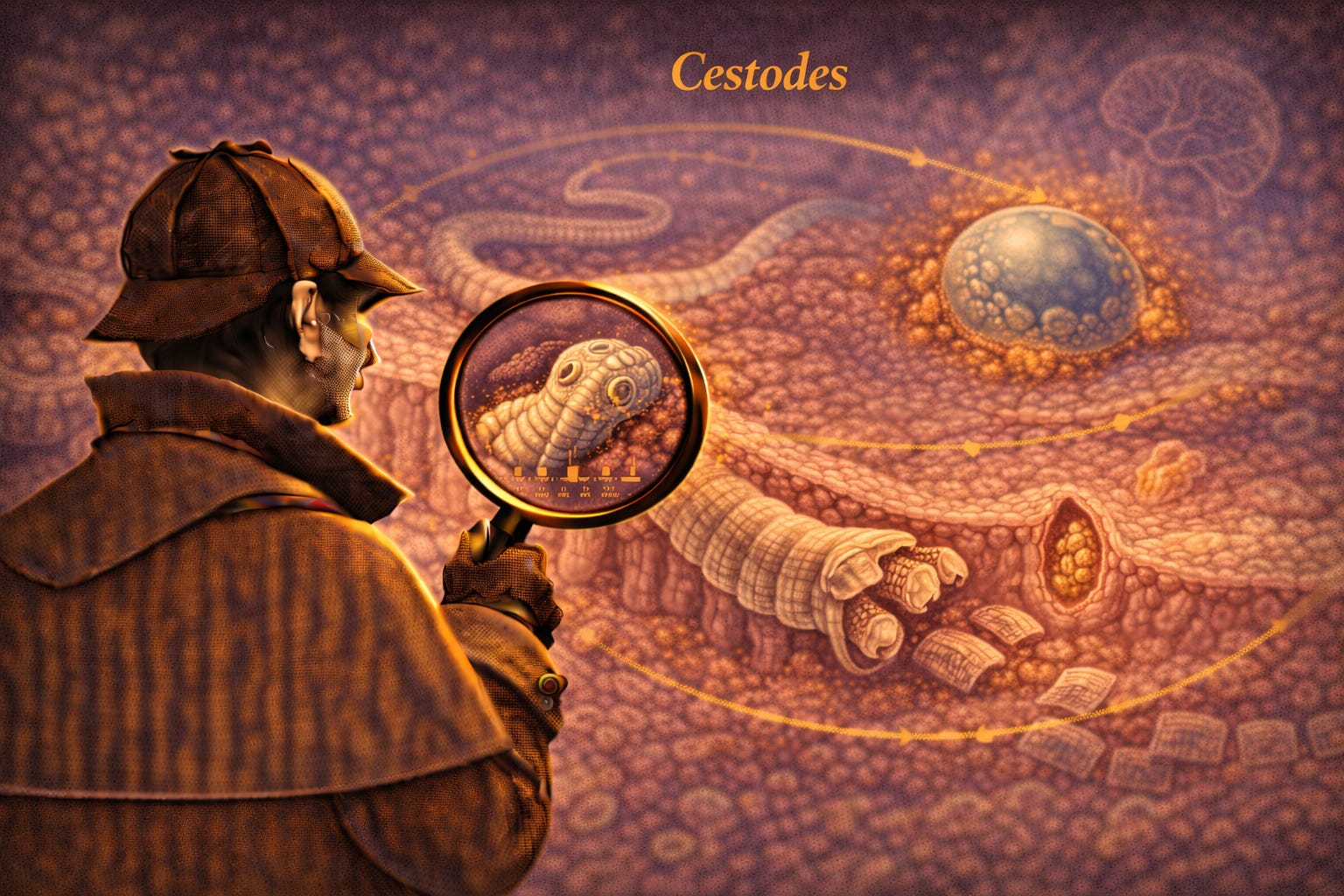
Micro 76: Cestodes
Description
This episode examines cestodes, or tapeworms - segmented flatworms characterised by a scolex for attachment and chains of proglottids. Drawing from Murray’s Chapter 76, it explores both intestinal colonisation and tissue-invasive larval disease.
Cestodes consist of:
* Scolex - head with hooks or suckers
* Proglottids - reproductive segments
* Eggs and larvae - capable of tissue invasion
Two major disease patterns emerge:
* Intestinal tapeworm infection (e.g., Taenia saginata) - often mild, sometimes asymptomatic
* Tissue cystic disease (e.g., Taenia solium cysticercosis, Echinococcus hydatid disease) - larval cysts in brain, liver, or lungs
In tissue infections, pathology results from space-occupying cysts and inflammatory responses upon rupture.
Conceptually, cestodes illustrate dual-phase disease - luminal adulthood and tissue larval pathology. Clinically, dietary exposure and animal contact are key epidemiologic factors.
Key Takeaways
* Cestodes are segmented flatworms
* Scolex enables intestinal attachment
* Larval forms can invade tissue
* Cysticercosis and hydatid disease cause space-occupying lesions
* Prevention involves food safety and animal control
This is a public episode. If you'd like to discuss this with other subscribers or get access to bonus episodes, visit drmanaankarray.substack.com/subscribe