Episode Details
Back to Episodes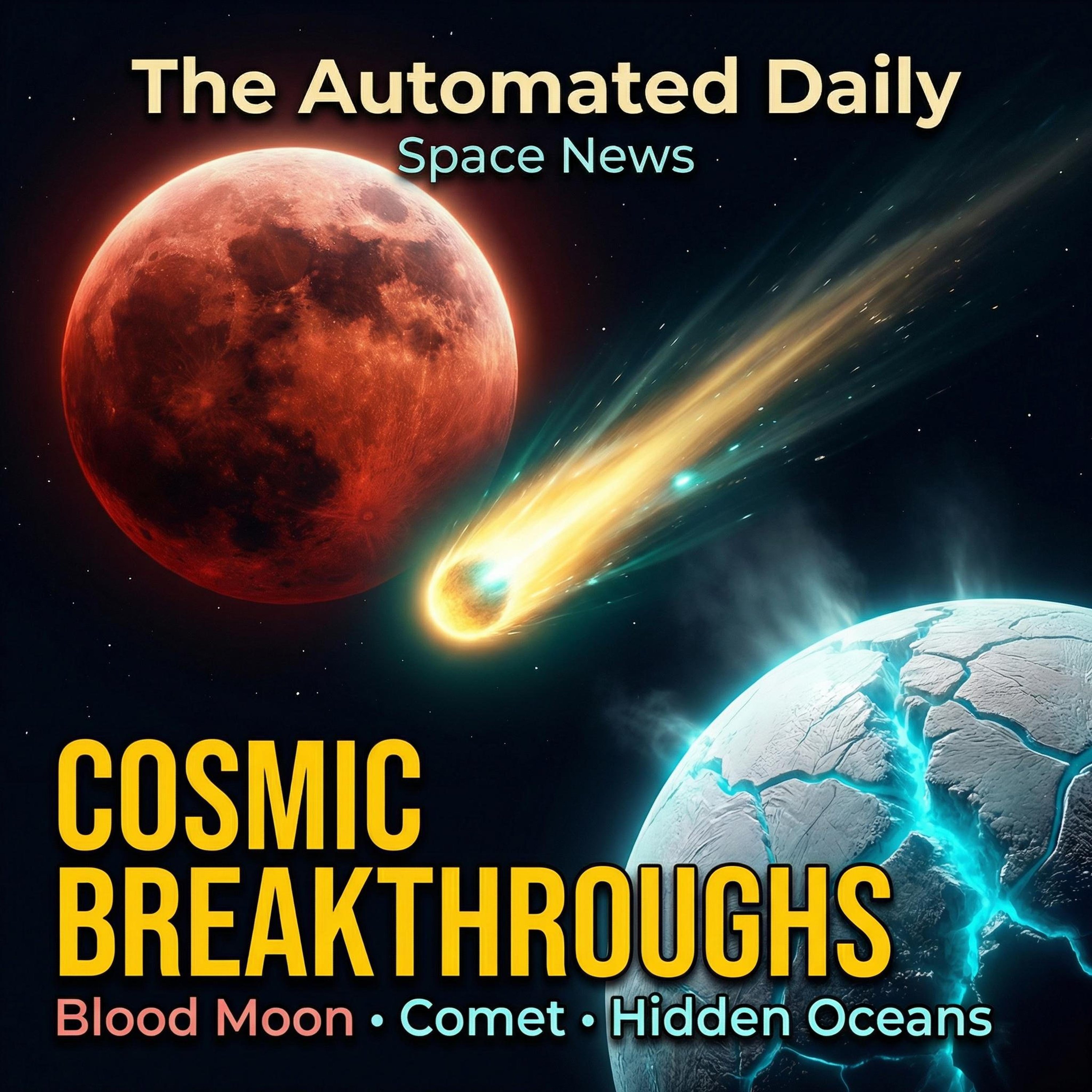
Blood moon eclipse spectacular display & Interstellar comet observed by JUICE - Space News (Mar 3, 2026)
Published 2 months, 3 weeks ago
Description
Please support this podcast by checking out our sponsors:
- KrispCall: Agentic Cloud Telephony - https://try.krispcall.com/tad
- Discover the Future of AI Audio with ElevenLabs - https://try.elevenlabs.io/tad
- Consensus: AI for Research. Get a free month - https://get.consensus.app/automated_daily
Support The Automated Daily directly:
Buy me a coffee: https://buymeacoffee.com/theautomateddaily
Episode Transcript
Blood moon eclipse spectacular display
Let's start with that incredible lunar eclipse we just witnessed. Early this morning, Earth's shadow completely covered the moon, turning it a deep, rusty red for nearly an hour. This wasn't just any eclipse—it was visible to over three billion people spread across North America, Asia, Australia, and New Zealand. The blood moon effect happens because our planet's atmosphere actually filters and bends sunlight onto the lunar surface, creating that distinctive copper-red glow. For anyone in North America watching from the eastern time zones, the moon dipped below the horizon right during totality, making it a race against the sunrise to catch the best views. Lunar eclipses this dramatic won't happen again until New Year's Eve 2028, so if you managed to see this one, you witnessed something truly rare.
Interstellar comet observed by JUICE
Moving from our moon to a visitor from beyond, the European Space Agency's JUICE spacecraft has sent back stunning images of an interstellar comet passing through our solar system. This comet, called 3I/ATLAS, is only the third known object we've ever detected that actually originated from another star system. Back in November, JUICE captured incredible detail of the comet's glowing coma—that bright cloud of gas
- KrispCall: Agentic Cloud Telephony - https://try.krispcall.com/tad
- Discover the Future of AI Audio with ElevenLabs - https://try.elevenlabs.io/tad
- Consensus: AI for Research. Get a free month - https://get.consensus.app/automated_daily
Support The Automated Daily directly:
Buy me a coffee: https://buymeacoffee.com/theautomateddaily
Today's topics:
Blood moon eclipse spectacular display - A total lunar eclipse transformed the moon into a blood red orb on March 3, 2026, visible across North America, Asia, and Australia. The phenomenon occurred as Earth's shadow completely enveloped the lunar surface, creating a stunning copper-red appearance lasting nearly an hour.
Interstellar comet observed by JUICE - The European Space Agency's JUICE spacecraft captured detailed images of interstellar comet 3I/ATLAS, only the third known object from outside our solar system ever detected. The comet's glowing coma and sweeping tail revealed its composition and activity just days after passing closest to the sun.
Hidden oceans beneath icy moons - New research published in Nature Astronomy suggests hidden oceans beneath icy moons like Enceladus and Mimas may boil beneath their surfaces when tidal heating melts their ice shells. This discovery could explain unusual surface features and has implications for potential habitability on these distant worlds.
SpaceX deploys fifty-four Starlink satellites - SpaceX launched fifty-four new Starlink satellites on March 1 across two bicoastal Falcon 9 missions, bringing the constellation to over nine thousand nine hundred operational satellites in orbit. Both rocket boosters were successfully recovered, continuing SpaceX's reusable launch legacy.
New method measures universe expansion - Scientists developed a new technique using gravitational waves from colliding black holes to measure how fast the universe is expanding. The stochastic siren method could help resolve long-standing disagreements between different expansion rate measurements in cosmology.
Episode Transcript
Blood moon eclipse spectacular display
Let's start with that incredible lunar eclipse we just witnessed. Early this morning, Earth's shadow completely covered the moon, turning it a deep, rusty red for nearly an hour. This wasn't just any eclipse—it was visible to over three billion people spread across North America, Asia, Australia, and New Zealand. The blood moon effect happens because our planet's atmosphere actually filters and bends sunlight onto the lunar surface, creating that distinctive copper-red glow. For anyone in North America watching from the eastern time zones, the moon dipped below the horizon right during totality, making it a race against the sunrise to catch the best views. Lunar eclipses this dramatic won't happen again until New Year's Eve 2028, so if you managed to see this one, you witnessed something truly rare.
Interstellar comet observed by JUICE
Moving from our moon to a visitor from beyond, the European Space Agency's JUICE spacecraft has sent back stunning images of an interstellar comet passing through our solar system. This comet, called 3I/ATLAS, is only the third known object we've ever detected that actually originated from another star system. Back in November, JUICE captured incredible detail of the comet's glowing coma—that bright cloud of gas