Episode Details
Back to Episodes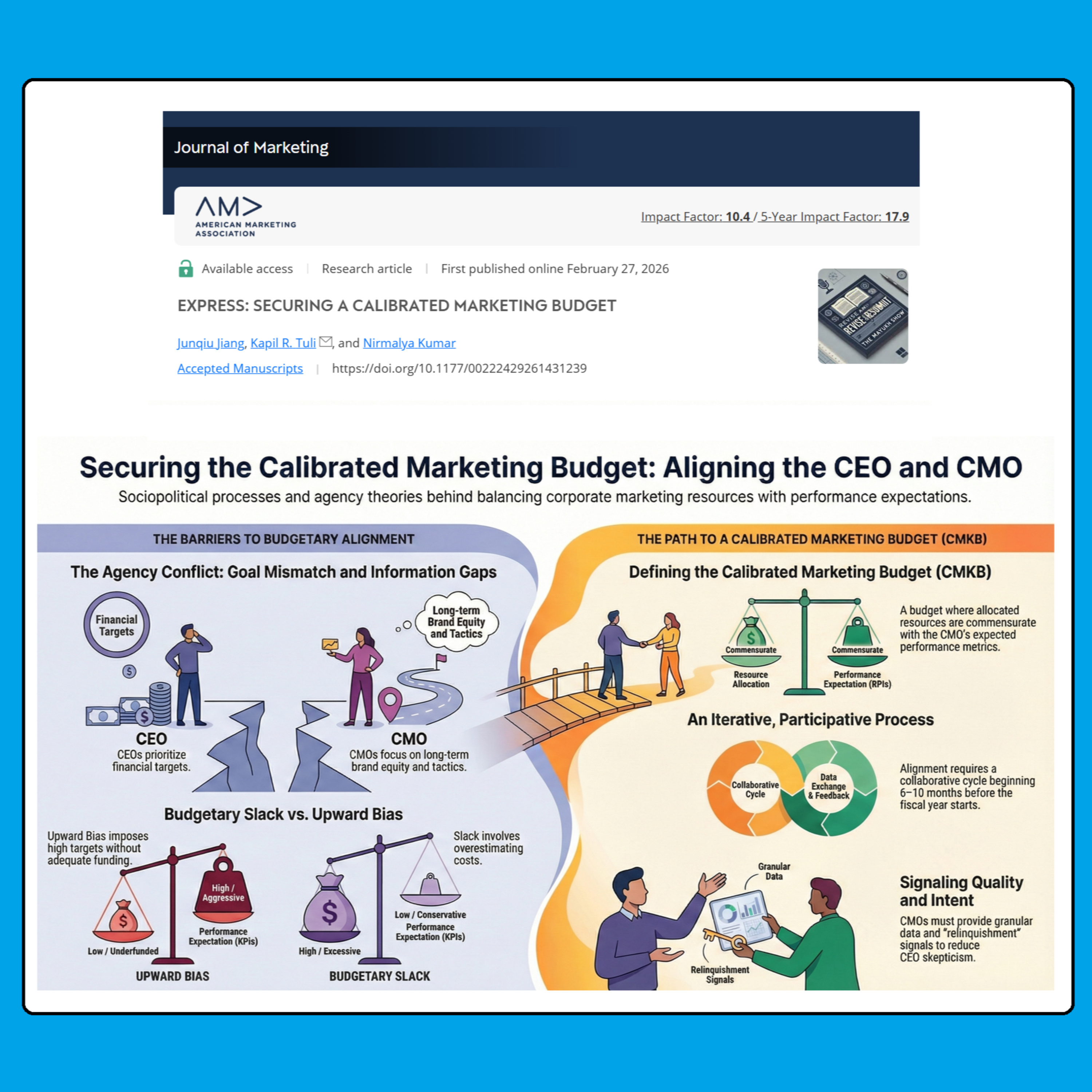
Securing a calibrated marketing budget (Jiang et al 2026) | FT50 JM
Description
English Podcast Starts at 00:00:00
Bengali Podcast Starts at 00:19:24
Hindi Podcast Starts at 00:32:41
Danish Podcast Starts at 00:44:17
Reference
Jiang, J., Tuli, K. R., & Kumar, N. (2026). SECURING A CALIBRATED MARKETING BUDGET. Journal of Marketing. https://doi.org/10.1177/00222429261431239
Youtube Channel
https://www.youtube.com/@weekendresearcher
Connect over linkedin
https://www.linkedin.com/in/mayukhpsm/
Welcome to Revise and Resubmit 🎙️✨ the place where serious scholarship meets the messy, human backstage of how big decisions actually get made.
Because here is the thing about a “budget” in a multinational corporation. On paper, it looks like math. In real life, it looks like a relationship. It is a story told in numbers, yes, but also in trust, worry, persuasion, and the quiet politics of who believes whom when the stakes are high 📊🧠.
Today’s episode dives into a brand-new article, published online on 27 February 2026 in the Journal of Marketing, a truly prestigious outlet and proudly part of the FT50 journal list 🏛️🏆. The paper is titled “Securing a calibrated marketing budget” by Junqiu Jiang, Kapil R. Tuli, and Nirmalya Kumar.
What they do, with the patience of careful listening and the clarity of sharp theory, is shift our gaze away from the usual question, “What is the optimal marketing budget?” and toward the more uncomfortable one: “How does a marketing budget survive the journey through the organization?” 🧩
Their idea of a calibrated marketing budget, or CMKB, is disarmingly practical. It is not just a number you defend once and forget. It is iterative, participative, and built to align promised performance with allocated resources, again and again, until it is sturdy enough to carry the weight of expectation. And in that process, the CMO is not merely presenting forecasts. The CMO is sending signals to the CEO, signals about quality and signals about intent 🔎🤝.
Quality signals sound like the language of competence: granularity that shows you have done the work, opportunity elaboration that shows you see the upside clearly, threat mitigation that proves you are not naïve about competitors or shocks. Intent signals sound like the language of reassurance: cultivated endorsements that say, “Others believe this too,” and relinquishment that says, “I am not gaming you, I am sharing control.” The study even distinguishes between Growth Focused and Constrained CMKBs, showing that what persuades in one context can fall flat in another ⚖️📈📉.
If that makes you slightly uneasy, good. Because it suggests that budgeting is not a sterile exercise in allocation. It is a live negotiation about uncertainty, accountability, and what kind of future the firm is willing to fund.
If you’re enjoying these conversations, subscribe to Revise and Resubmit on Spotify and follow us on YouTube at “Weekend Researcher” 🎧📺. You can also find the show on Amazon Prime and Apple Podcast 🍏🎙️.
And a sincere thank you to the authors, Junqiu Jiang, Kapil R. Tuli, and Nirmalya Kumar, and to SAGE Publications for publishing this important work in the Journal of Marketing 🙏📚.
So here is the question I can’t stop thinking about 🌀: when a CMO “secures” a calibrated marketing budget, are they really securing resources, or are they securing belief?