Episode Details
Back to Episodes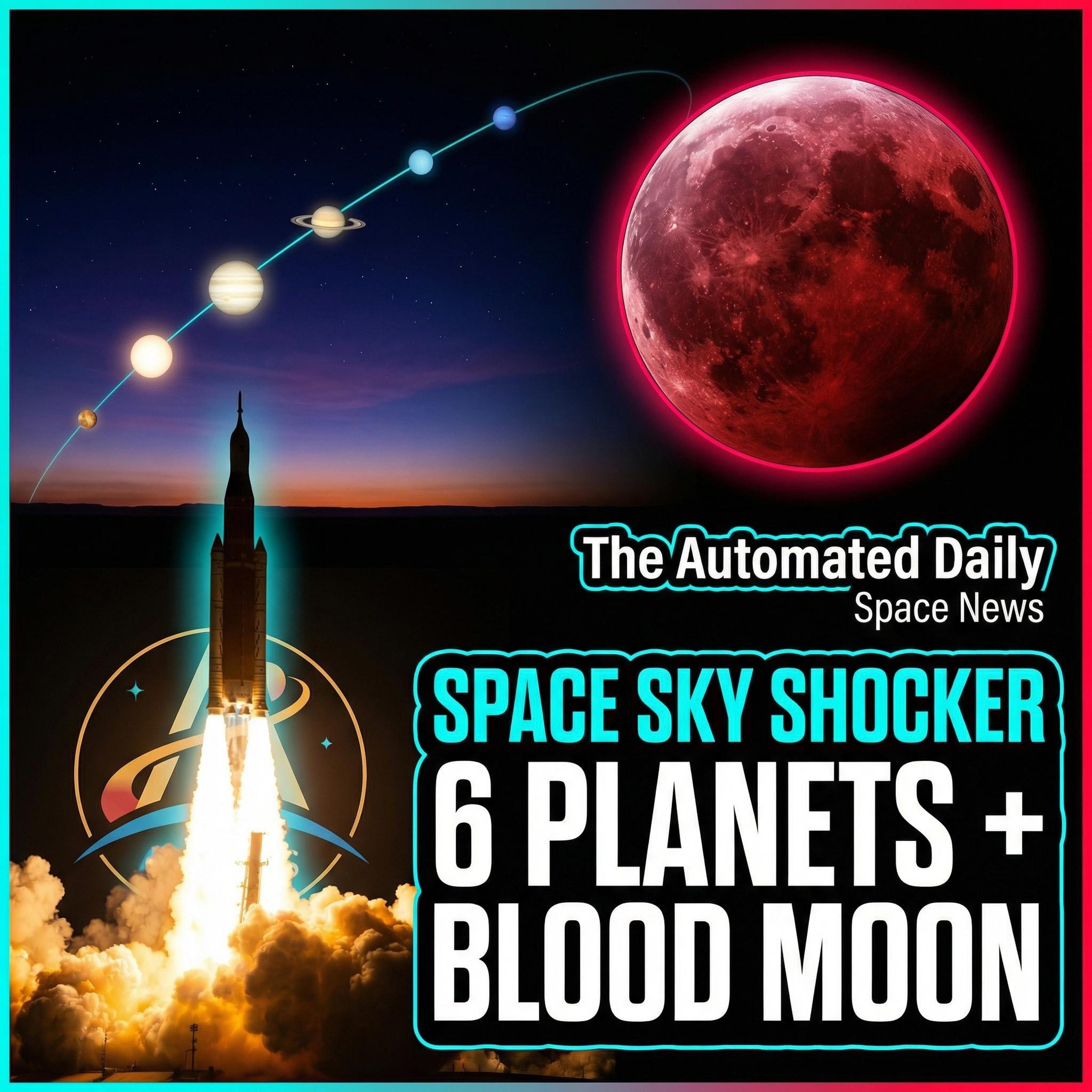
Tonight's Six-Planet Parade & NASA Artemis Program Restructured - Space News (Feb 28, 2026)
Published 2 months, 4 weeks ago
Description
Please support this podcast by checking out our sponsors:
- Discover the Future of AI Audio with ElevenLabs - https://try.elevenlabs.io/tad
- Build Any Form, Without Code with Fillout. 50% extra signup credits - https://try.fillout.com/the_automated_daily
- Prezi: Create AI presentations fast - https://try.prezi.com/automated_daily
Support The Automated Daily directly:
Buy me a coffee: https://buymeacoffee.com/theautomateddaily
Episode Transcript
Tonight's Six-Planet Parade
Let's start with tonight's main event. If you have a clear view of the western horizon after sunset, you're looking at a pretty special opportunity. Six planets are positioned in our evening sky right now: Jupiter, Saturn, Venus, Mercury, Uranus, and Neptune. However, here's the thing you need to know—seeing all six is genuinely challenging. Jupiter is high up in the southeastern sky and relatively easy to spot. It's the brightest object you'll see and appears near the moon, which is almost full. But the real difficulty comes with the others. Venus and Mercury are sitting very low on the western horizon, competing with the twilight glow of the setting sun. You'll need a really flat, unobstructed view of the horizon to catch those two. Saturn is a bit higher than Venus and Mercury, so it might be easier to locate. As for Uranus and Neptune, well, those are basically telescope objects. Uranus requires binoculars at minimum, and Neptune really needs optical aid. The window to see the lower planets is super tight—maybe an hour or so after sunset before they disappear below the horizon. The internet's been buzzing about a 'planet parade' happening tonight, and while that's technically accurate, the reality is more nuanced. You'll probably only see two or three planets clearly with your naked eye. But that's still pretty cool for a Friday evening.
NASA Artemis Program Restructured
Now, shifting to some major news from the space agencies. NASA announced Friday a significant restructuring of its Artemis lunar program. This is important stuff. The original plan was ambitious: send Artemis II
- Discover the Future of AI Audio with ElevenLabs - https://try.elevenlabs.io/tad
- Build Any Form, Without Code with Fillout. 50% extra signup credits - https://try.fillout.com/the_automated_daily
- Prezi: Create AI presentations fast - https://try.prezi.com/automated_daily
Support The Automated Daily directly:
Buy me a coffee: https://buymeacoffee.com/theautomateddaily
Today's topics:
Tonight's Six-Planet Parade - Six planets visible after sunset on February 28, 2026, including Jupiter, Saturn, Venus, Mercury, Uranus, and Neptune in rare alignment requiring clear western horizon viewing.
NASA Artemis Program Restructured - NASA announces major Artemis overhaul adding 2027 test mission before 2028 lunar landing, emphasizing step-by-step approach, increased launch cadence, and commercial lander competition.
SpaceX Starlink Launch Finale - SpaceX concludes February with three successful Falcon 9 launches deploying 83 Starlink satellites, bringing constellation to over 9,850 units for global broadband coverage.
March 3 Total Lunar Eclipse - Last total lunar eclipse until 2028 occurs March 3, visible from North America, Asia, and Australia with 58-minute totality phase and deep red blood moon appearance.
Solar Activity Concerns Artemis - New research suggests solar superflare activity through mid-2026 may warrant delaying Artemis II beyond April, prioritizing astronaut safety during deep space mission.
SpaceX Dragon Returns Successfully - SpaceX Dragon spacecraft successfully returned from International Space Station with thousands of pounds of science experiments after six-month stay in orbit.
Episode Transcript
Tonight's Six-Planet Parade
Let's start with tonight's main event. If you have a clear view of the western horizon after sunset, you're looking at a pretty special opportunity. Six planets are positioned in our evening sky right now: Jupiter, Saturn, Venus, Mercury, Uranus, and Neptune. However, here's the thing you need to know—seeing all six is genuinely challenging. Jupiter is high up in the southeastern sky and relatively easy to spot. It's the brightest object you'll see and appears near the moon, which is almost full. But the real difficulty comes with the others. Venus and Mercury are sitting very low on the western horizon, competing with the twilight glow of the setting sun. You'll need a really flat, unobstructed view of the horizon to catch those two. Saturn is a bit higher than Venus and Mercury, so it might be easier to locate. As for Uranus and Neptune, well, those are basically telescope objects. Uranus requires binoculars at minimum, and Neptune really needs optical aid. The window to see the lower planets is super tight—maybe an hour or so after sunset before they disappear below the horizon. The internet's been buzzing about a 'planet parade' happening tonight, and while that's technically accurate, the reality is more nuanced. You'll probably only see two or three planets clearly with your naked eye. But that's still pretty cool for a Friday evening.
NASA Artemis Program Restructured
Now, shifting to some major news from the space agencies. NASA announced Friday a significant restructuring of its Artemis lunar program. This is important stuff. The original plan was ambitious: send Artemis II