Episode Details
Back to Episodes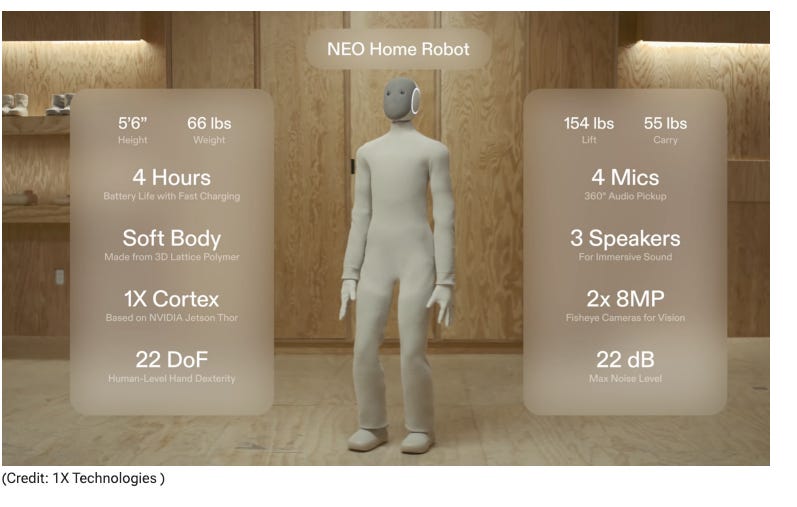
For $200, you can put down a deposit on a home robot.
Description
Editor’s Note: I could not get NotebookLM to properly pronounce NEO. (NEE-OH.) It’s not that difficult. But, it did manage every other possible pronunciation in the podcast. Other than the name butchering, the rest of the information in the pod is solid.
NEO: The First Humanoid Butler? Not So Fast.1X’s $20K home robot blends promise, privacy tradeoffs, and a human behind the scenes
Welcome Your New Roommate
NEO, a humanoid robot from 1X Technologies, is now available for preorder. It promises to do your chores, learn your habits, and blend into your daily life. What it doesn’t promise—at least loudly—is full autonomy. Because when NEO struggles, a human steps in.
Hardware Built for the Home
Physically, NEO is impressive. It stands at 66 inches tall and weighs just 66 pounds. Its design is soft-shelled with tendon-driven joints, meant to move safely around people. It can lift up to 154 pounds, carry about 55, and run four hours on a single charge.
Its 22-DoF hands give it dexterity for tasks like vacuuming, wiping counters, or picking up clutter. The idea is that NEO will become your in-home assistant: tidying up, helping with laundry, maybe providing companionship for elderly or disabled users.
It arrives with basic autonomous functions and is expected to improve over time via software updates. So far, so good.
But There’s a Human in the Loop
What the marketing doesn’t highlight is how much of NEO’s brain still belongs to a person. Many of the tasks it “performs” are actually piloted remotely by 1X employees through a feature called “Expert Mode.”
When NEO doesn’t know how to do something—or if it’s navigating unfamiliar territory—a human operator steps in. Your home becomes a training ground, and your robot becomes an interface for distant human labor.
That’s not necessarily a bad thing. It’s a common model in robotics development. But it means you’re not just buying a robot—you’re opting into an evolving human-machine hybrid system. And you’re doing it inside your home.
Your Data for Their AI
To help NEO learn, 1X requires early users to participate in a “social contract.” The robot continuously collects video and sensor data from your home. That data is used to improve the AI and autonomy—but it also means your private life is, in part, a dataset.
1X says it enforces strict privacy protections: human operators must request approval to connect, faces are blurred, and you can set no-go zones via the app. But the privacy model ultimately depends on software enforcement, corporate policy, and your own vigilance.
And not everyone is comfortable with that. As a reviewer from the Wall Street Journal relayed her experience: “I didn’t see NEO do anything autonomously... it was a human, remote-controlling a robot in my living room.”
#neorobot #1xtechnologies #droidsnewsletter
droidsnewsletter.com