Episode Details
Back to Episodes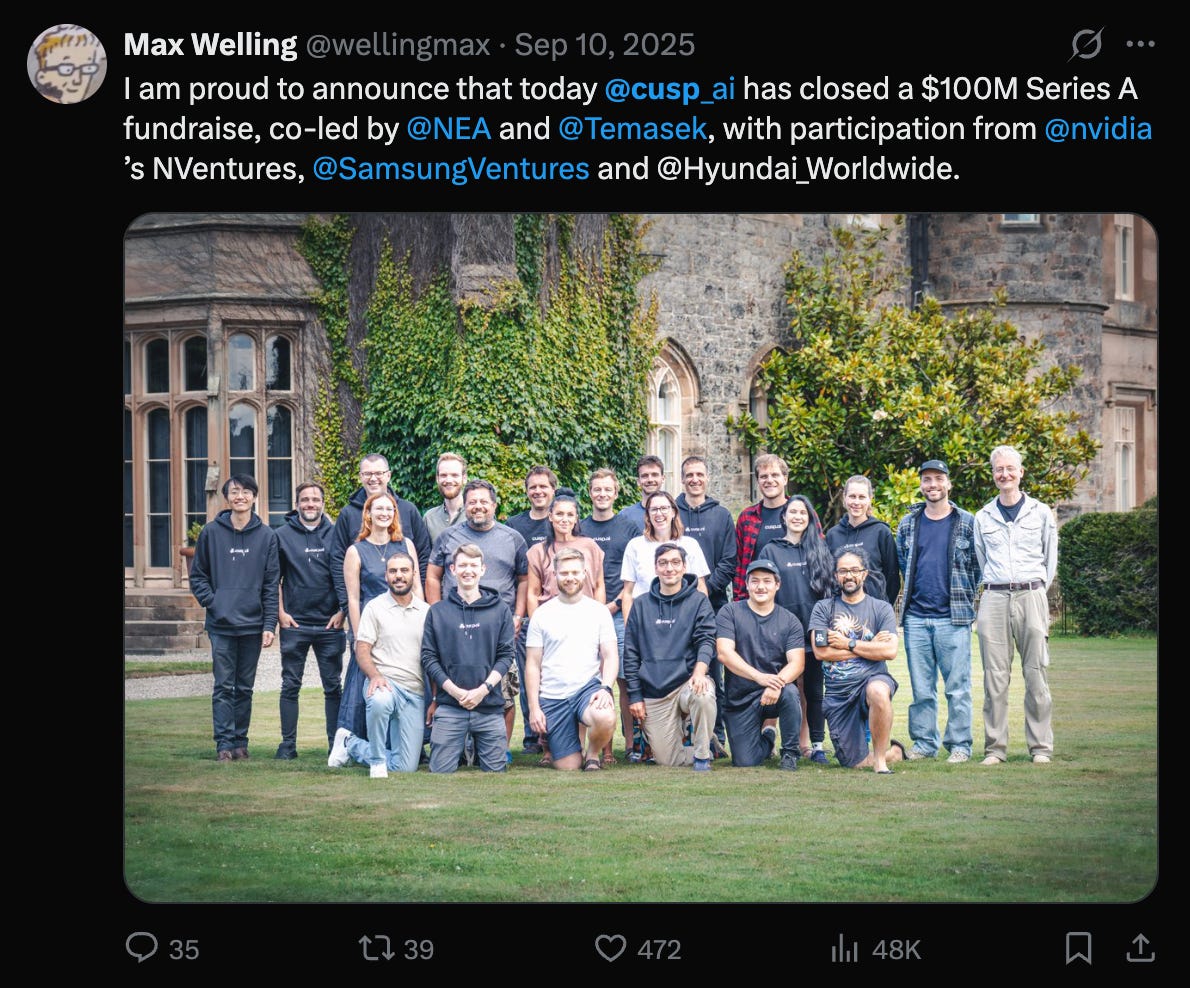
🔬Searching the Space of All Possible Materials — Prof. Max Welling, CuspAI
Description
Editor’s note: CuspAI raised a $100m Series A in September and is rumored to have reached a unicorn valuation. They have all-star advisors from Geoff Hinton to Yann Lecun and team of deep domain experts to tackle this next frontier in AI applications.
In this episode, Max Welling traces the thread connecting quantum gravity, equivariant neural networks, diffusion models, and climate-focused materials discovery (yes, there is one!!!).
We begin with a provocative framing: experiments as computation. Welling describes the idea of a “physics processing unit”—a world in which digital models and physical experiments work together, with nature itself acting as a kind of processor. It’s a grounded but ambitious vision of AI for science: not replacing chemists, but accelerating them.Along the way, we discuss:
* Why symmetry and equivariance matter in deep learning
* The tradeoff between scale and inductive bias
* The deep mathematical links between diffusion models and stochastic thermodynamics
* Why materials—not software—may be the real bottleneck for AI and the energy transition
* What it actually takes to build an AI-driven materials platform
Max reflects on moving from curiosity-driven theoretical physics (including work with Gerard ‘t Hooft) toward impact-driven research in climate and energy. The result is a conversation about convergence: physics and machine learning, digital models and laboratory experiments, long-term ambition and incremental progress.
Full Video Episode
Timestamps
* 00:00:00 – The Physics Processing Unit (PPU): Nature as the Ultimate Computer
* Max introduces the idea of a Physics Processing Unit — using real-world experiments as computation.
* 00:00:44 – From Quantum Gravity to AI for Materials
* Brandon frames Max’s career arc: VAE pioneer → equivariant GNNs → materials startup founder.
* 00:01:34 – Curiosity vs Impact: How His Motivation Evolved
* Max explains the shift from pure theoretical curiosity to climate-driven impact.
* 00:02:43 – Why CaspAI Exists: Technology as Climate Strategy
* Politics struggles; technology scales. Why materials innovation became the focus.
* 00:03:39 – The Thread: Physics → Symmetry → Machine Learning
* How gauge symmetry, group theory, and relativity informed equivariant neural networks.
* 00:06:52 – AI for Science Is Exploding (Not Emerging)
* The funding surge and why AI-for-Science feels like a new industrial era.
* 00:07:53 – Why Now? The Two Catalysts Behind AI for Science
* Protein folding, ML force fields, and the tipping point moment.
* 00:10:12 – How Engineers Can Enter AI for Science
* Practical pathways: curriculum, workshops, cross-disciplinary training.
* 00:11:28 – Why Materials Matter More Than Software
* The argument that everything—LLMs included—rests on materials innovation.
*
Listen Now
Love PodBriefly?
If you like Podbriefly.com, please consider donating to support the ongoing development.
Support Us