Episode Details
Back to Episodes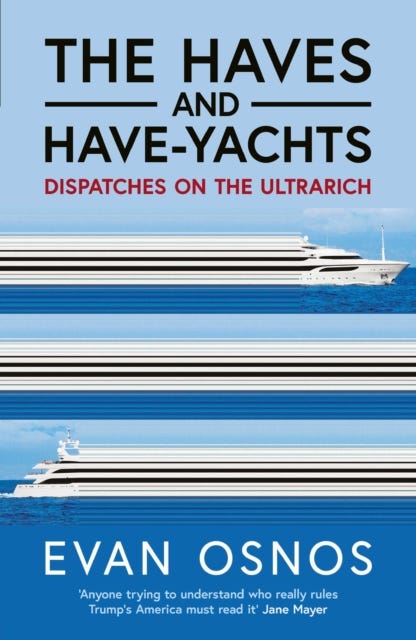
Okay, but Can We Shame Billionaires?
Description
Lately, the misdeeds of the wealthy feel inescapable. Whether it’s Trump’s blatant corruption and grifting (which has netted him $3 billion so far this term) or the Epstein Files, I can’t recall a period in my life where it has been clearer that the wealthy are not bound by the same laws and sense of morality as us mere mortals.
One of the clearest distillations of this distinction can be found in The Haves and Have Yachts: Dispatches on the Ultrarich. In it, journalist Evan Osnos writes:
“America’s record in recent years suggests that shamelessness might be a larger problem [than shame].”
To support this claim, he examines in lavish detail the spending sprees and controversies of the ultrarich: everything from the cost of flying in an aging rapper to emcee your birthday to throwing an adult temper tantrum on a Monaco pier because your superyacht got a less-desirable berth.
Heretic Hereafter is a reader-supported publication. To receive new posts and support my work, consider becoming a free or paid subscriber.
Reading this book is an exercise in toggling between astonishment and rage; on the one hand, fantasizing about what that lifestyle must be like before snapping back to disgust that people could spend this selfishly while around the world children are starving and dying of preventable diseases. (Peter Singer WOULD NEVER.)
As I have argued at countless Seattle cocktail parties, no human needs a billion dollars. A billion is a thousand million. It’s a number so large that it’s hard for us to comprehend.
In the United States, we have 902 billionaires. Worldwide, there are 2,640. Depending on how stock valuations go, Elon Musk may become the world’s first trillionaire. That’s a thousand billions!
Have these billionaires achieved such levels of wealth by generously compensating their employees? Absolutely not! While Bezos spent roughly $50 million on his second wedding, Amazon fulfillment workers lack air conditioning and bathroom breaks. Rob Walton spent $4.65 billion to buy the Denver Broncos while paying Wal-Mart employees poverty wages that push a large proportion of full-time workers onto government assistance.
This is greed, pure and simple. It’s superyachts for me and food banks for thee! I can only guess that billionaires rely on a thick blanket of denial to get to sleep at night.
So, is Osnos right? In our era of superrich exploitation, is shamelessness more of a problem than shame? Should we start MASS SHAMING BILLIONAIRES?
Not so fast. As we looked at earlier this month, the urge to shame can come from different needs, like a lack of accountability. In the case of the Have-Yachts, the problem of “shamelessness” doesn’t mean that we necessarily want rich people to be publicly pilloried, but that we want them to develop a sense of morality and responsibility.
I mean, even Spiderman knew that “with great power comes great responsibility,” but billionaires often act as if they don’t owe anyone anything. And they’re propped up by a trio of American cultural beliefs around wealth. We believe that the wealthy deserve their riches because:
* They’re self-made. Read enough rich people biographies and you’ll notice a pattern. All of these wealthy folks actually came from humble beginnings! They’ve worked so hard to get here, and they’re not even really that rich, more like “middle class.” Again and again, they downplay the loans, gifts,