Episode Details
Back to Episodes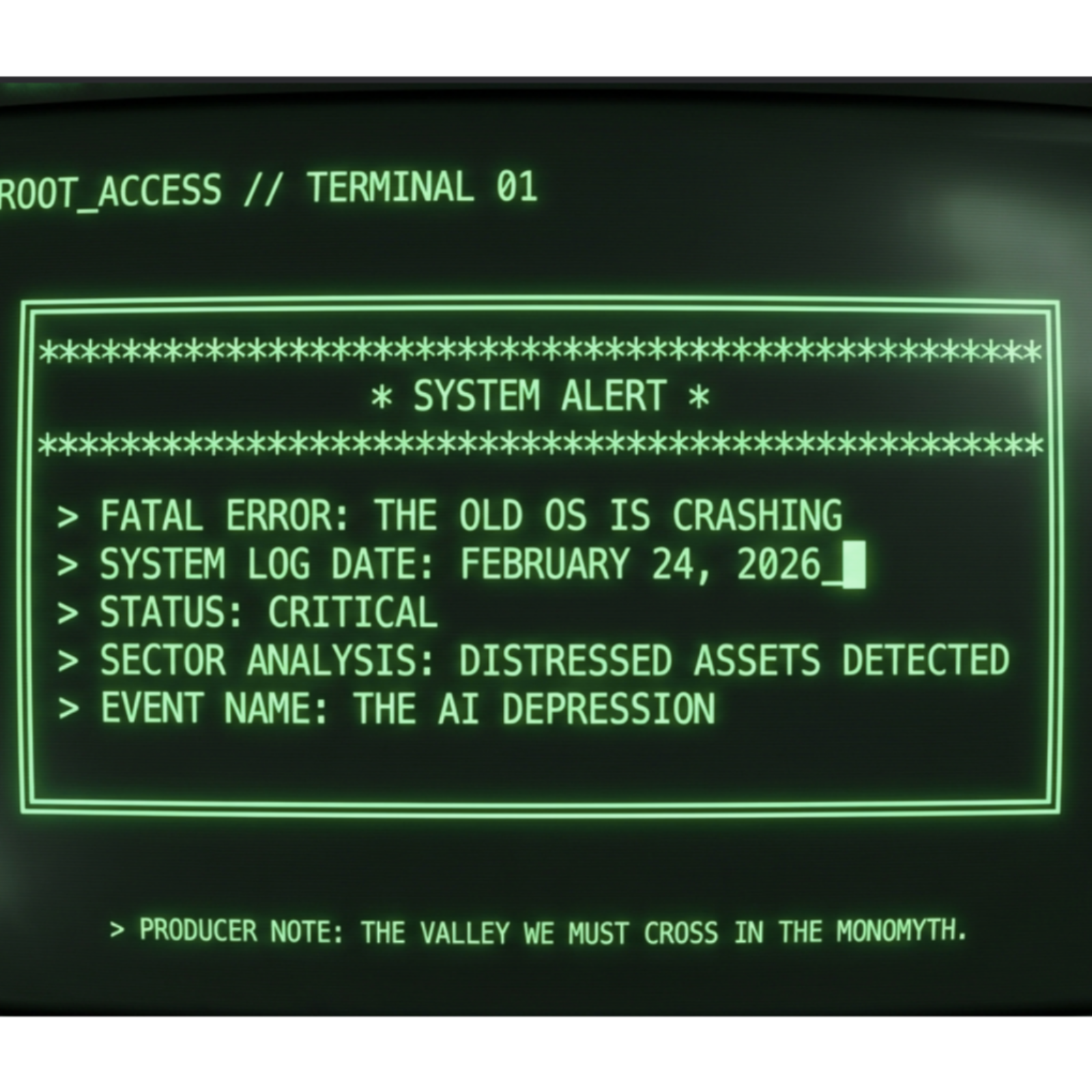
ReadMultiplex.com: You Have 5000 Days: Navigating the End of Work as We Know It. Part 15: The IBM COBOL Shock.
Description
The screens flash red. Tech valuations erase hundreds of billions in days. Headlines warn of mass displacement. Sectors once thought invincible now trade like distressed assets. This is The AI Depression. It is the valley we must cross in the monomyth. It is raw, visible, and accelerating. And it is exactly why I wrote this series. Today we have a massive example in IBM we will discus below. It has had it largest one day drop in its history, over 35%. This was a shockwave that is sending chills through the entire, already Artificial Intelligence freaked out, stock market. But unfortunately there is a lot more coming.
This Interregnum carries a one-two knockout punch. The first blow, already landing, is the cognitive disruption from AI in knowledge work. The second, set to intensify in 2028, comes from robotics in the physical world.
Recall the internet’s own disruptive rise. In the late 1990s and early 2000s it delivered a parallel one-two punch to entire industries. The first wave crushed information and media layers: newspapers lost classifieds to Craigslist and search engines, music labels faced Napster and iTunes, bookstores watched Amazon erode foot traffic, and travel agencies saw Expedia and Kayak rewrite bookings. Physical retail followed as broadband enabled global supply chains, just-in-time logistics, and on-demand delivery that reshaped warehouses, trucking, and last-mile operations. Blockbuster, Tower Records, Kodak, and Borders crumbled not because the technology failed but because it reshaped everything: how we access knowledge, shop, entertain, communicate, learn, and connect. Yet the same force created Amazon, Google, Netflix, and Meta, each scaling into multi-trillion-dollar giants that now define global commerce, information flow, social structures, and entertainment. The internet did not destroy net value. It multiplied it exponentially by collapsing distribution and coordination costs and enabling entirely new layers of activity no one could forecast in 1995. Artificial intelligence is repeating this pattern but at the deeper level of cognition and intelligence itself. It collapses the cost of thought, analysis, synthesis, and decision-making to near zero and will shape everything from problem-solving and creativity to education, healthcare delivery, and governance at a depth and speed the internet never approached.
Read the article at: ReadMultiplex.com