Episode Details
Back to Episodes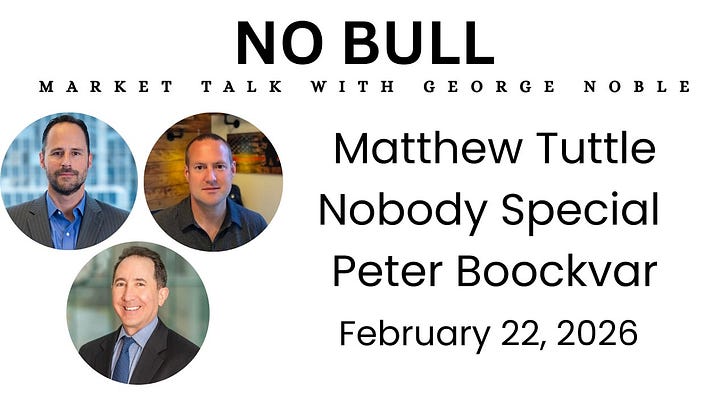
Matthew Tuttle, Nobody Special, Peter Boockvar
Description
1.Strategic Actions and Decisions
* Aggressively rotate portfolio exposure away from US large-cap tech: The “Magnificent Seven,” and passive index funds, redirecting capital into international markets, small/mid-cap value, energy, and gold. The group cites a “tectonic shift in leadership” where foreign markets (like China) have already begun to outperform and commodity-driven economies are benefiting from a structural boom. [00:03:26] [00:08:04] [00:12:21] [00:14:55]
* Initiate or increase positions in the energy sector: Based on a fundamental call that oil has limited downside near $60. The thesis is supported by near-15-year lows in speculative net long positions, plateauing US shale production (which loses money below $55), declining Cushing inventories, and limited true OPEC spare capacity despite rising quotas. [00:26:09] [00:26:57]
* Consider adding consumer staples names (e.g., Kraft Heinz, Kimberly-Clark) as a defensive, high-yield play: These stocks offer valuations of 9-12x earnings with 5-6% dividend yields. The investment thesis is not based on growth acceleration, but on the story moving from “bad to less bad,” where an end to profit deceleration and renewed investor attention can drive multiple expansion from 10x to 15x. [00:17:43] [00:19:31] [00:22:58]
* Short or strictly avoid “neo-cloud” AI infrastructure builders and crypto-adjacent equities: The group highlights the first major instance of capital drying up (Blue Owl refusing to finance CoreWeave) and argues these entities are “WeWorks with GPUs.” They are characterized as high-beta, non-cash-flowing businesses that will be “obliterated” when the AI trade unwinds. [00:47:15] [00:48:32] [01:03:55]
* Prepare for a regime change by shifting from passive indexing to active management: The group argues that the ten-year period of passive outperformance is ending. Investors are advised to use market reaction (not headlines) as their primary signal, and to engage with high-conviction independent research to gain an informational edge. [00:09:40] [00:14:35] [01:58:15]
2.Executive Summary
This discussion centers on a decisive and likely multi-year rotation in market leadership, moving away from US large-cap tech and toward international markets, commodities, and small/mid-cap value stocks. The group argues that the AI infrastructure trade is peaking, evidenced by falling free cash flow at hyperscalers, cooling reactions to CapEx announcements, and the first signs of financing drying up for “neo-cloud” players. In contrast, sectors like energy and consumer staples offer compelling valuations and are poised to benefit from this capital rotation. The conversation also highlights significant risks in private credit and certain crypto-adjacent equities, framing them as liquidity traps. The key takeaway for leaders is the need to actively reposition portfolios to capture this structural shift and avoid the complacency of passive indexing.
3.Key Takeaways and Practical Lessons
1. Market Leadership is Rotating: The 10+ year dominance of US large-cap tech is ending. Money is moving to international markets, commodities, and small/mid-cap value, driven by peaking AI capital expenditure and broadening global growth.
* Practical Lesson: Review your portfolio’s concentration in the “Magnificent Seven” and begin trimming positions to fund allocations in international ETFs (e.g., European defense/sovereignty) or commodity-focused funds.
2. The “Golden Age of Active Management” is Here: The era where simply buying the index guaranteed outperformance is over. The current market requires stock-picking to differentiate winners from losers within sectors, particularly as the AI trade matures.<