Episode Details
Back to Episodes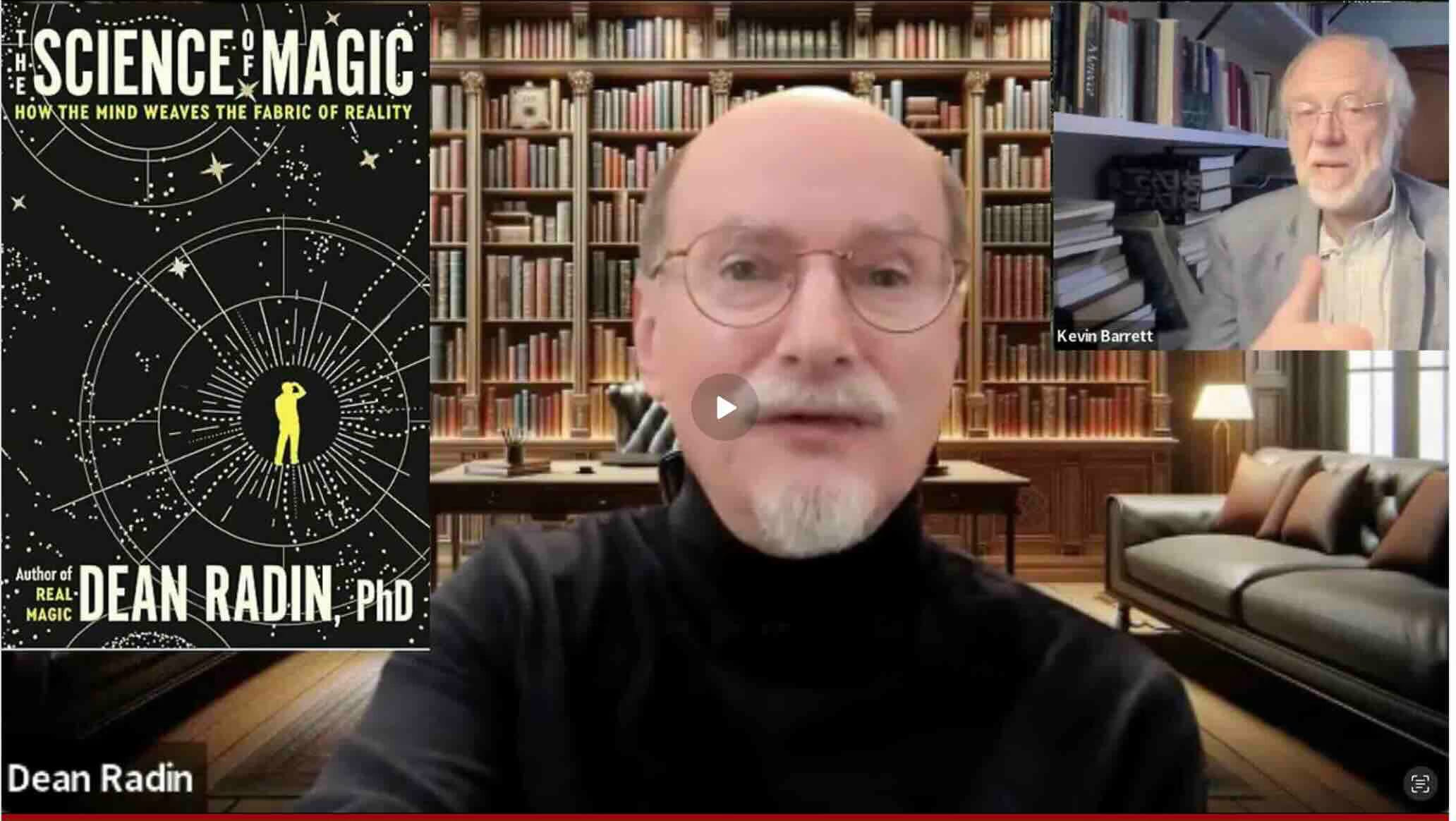
Dean Radin on "the Science of Magic"
Description
Dean Radin is the English-speaking world’s leading popularizer of the science of psi and its implications, and the author of many books and scientific papers. He is Chief Scientist at the Institute of Noetic Sciences (IONS), Associated Distinguished Professor at the California Institute of Integral Studies, and cofounder and chairman of the neuroengineering company, Cognigenics. He earned a BS and MS in electrical engineering and a PhD in psychology from the University of Illinois, Urbana-Champaign. In 2022 he was awarded an Honorary DSc from the Swami Vivekananda University in Bangalore, India. He has worked at AT&T Bell Labs, Princeton University, University of Edinburgh, and SRI International.
Welcome to Truth Jihad Audiovisual. I’m Kevin Barrett getting visual here for the first time with Dean Radin. I’ve had him on a few times on audio. And here we are doing actual video and talking about his great new book, The Science of Magic. And the subtitle is How the Mind Weaves the Fabric of Reality. It basically starts with the science of psi, leads us up to magic, and the notion that we’re actually all sort of co-creating the universe through paranormal means. It used to be known as magic. Anyway, it’s a good book, and it’s good to have you back, Dean Radin, welcome.
Thank you. It’s good to be here.
It’s another fascinating book. I’ve been interested in these topics since high school when I discovered the Encyclopedia of Philosophy’s entry on Psi, which shockingly basically said that, yeah, this has been proven. Unless there’s something very strange going on, clearly Psi has been proven scientifically. This was back in the mid-1970s. And so I looked into it. Wow, that’s interesting. That’s not what I’ve heard from everybody else. And I looked into it and it was true. So I’ve been sort of following that ever since and also have been aware of the fact that we’re sort of influencing reality psychically all the time. And that’s that’s where your book gets to in this kind of second half or third third. So, yeah, let’s talk about that and the wild and crazy implications. Where should we start? You tell the story of how you got into this field in the book. So maybe you can give us the short version.
Well, the short version is that like a lot of kids, usually, who start reading science fiction and fairy tales, you can’t help but start wondering if any of that stuff is true. And then you get a little bit older and you start learning about science and you hear pretty uniformly that none of it is true. And so it depends on whether or not you remain with childlike enthusiasm and imagination, or if it gets squashed when you’re a little bit older. So for a lot of people, it gets squashed pretty quick. For some, they never break out of the squashiness and their imagination begins to fail. But for others, many scientists, actually, you’re driven by curiosity, as I am. In which case you simply want to know what’s real, what’s true. And so when you start looking at the scientific evidence, which has been around since the late 1950s, it’s very difficult to reach a conclusion that the phenomena that we’re t