Episode Details
Back to Episodes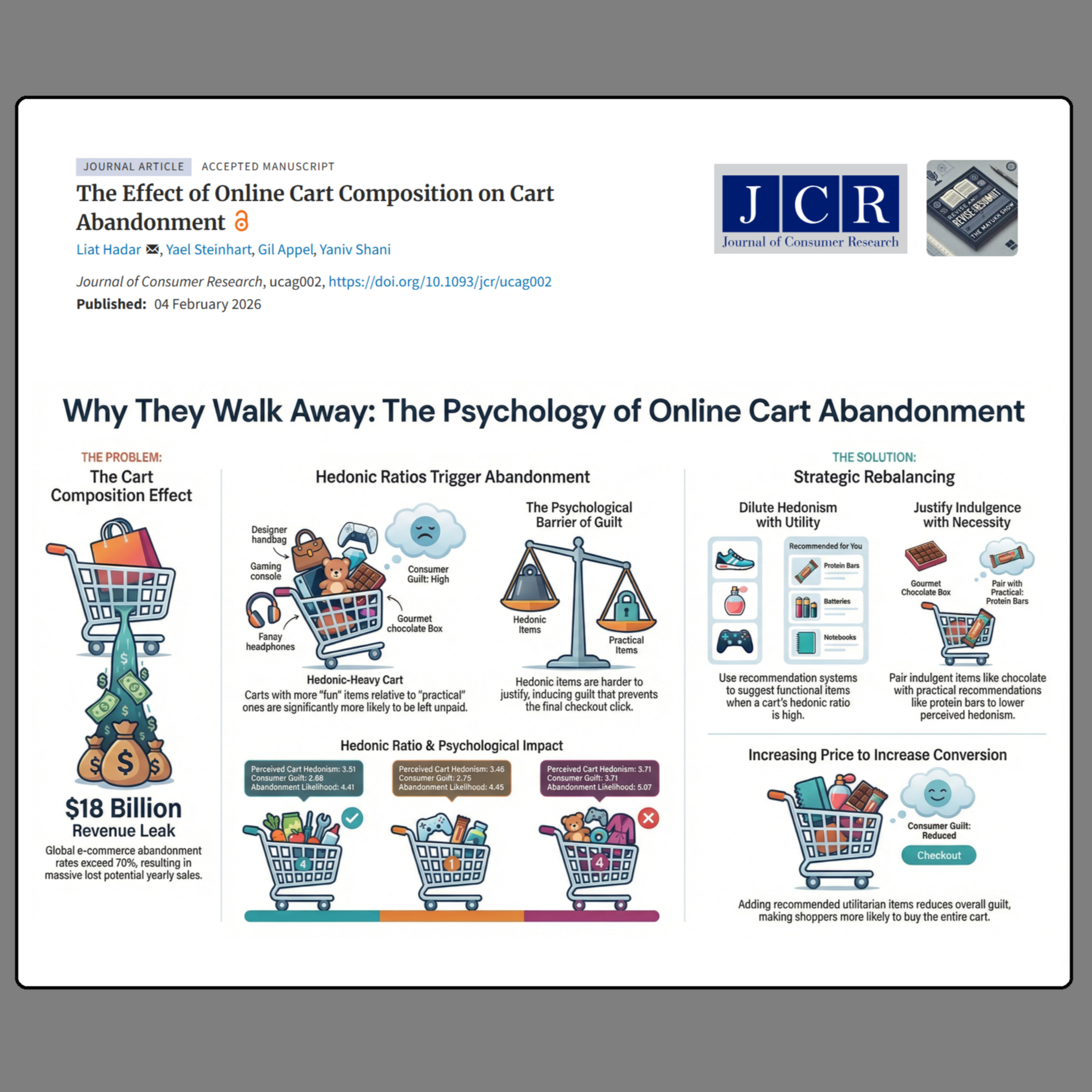
The Effect of Online Cart Composition on Cart Abandonment (Hadar et al 2026) | FT50 JCR
Description
English Podcast Starts at 00:00:00
Bengali Podcast Starts at 00:21:46
Hindi Podcast Starts at 00:39:32
Danish Podcast Starts at 00:53:35
Reference
Liat Hadar, Yael Steinhart, Gil Appel, Yaniv Shani, The Effect of Online Cart Composition on Cart Abandonment, Journal of Consumer Research, 2026; https://doi.org/10.1093/jcr/ucag002
Youtube Channel
https://www.youtube.com/@weekendresearcher
Connect over linkedin
https://www.linkedin.com/in/mayukhpsm/
Welcome to Revise and Resubmit, the show where serious research meets real life, and where a footnote can quietly explain a feeling you have never fully named. 🎙️📚
Picture the modern confession booth: it is not a church, it is a checkout page. Your cursor hovers. The total stares back. Your cart is full, but your certainty is not. A skincare “treat,” a novel you do not have time to read, noise-cancelling headphones you have already emotionally unpacked, and somewhere in there, almost as an alibi, toothpaste. You tell yourself you are just browsing. You tell yourself you will come back. Then you do what millions of people do every day. You vanish. 🛒👀💨
Today’s episode takes that small disappearance seriously, with a brand-new paper that treats cart abandonment not as a shrug, but as a story with a motive. The article is titled “The Effect of Online Cart Composition on Cart Abandonment,” by Liat Hadar, Yael Steinhart, Gil Appel, and Yaniv Shani, published online on 04 February 2026 in the Journal of Consumer Research, an FT50 journal, meaning it sits in that rarefied top tier of business scholarship that helps define what the field even is. 🏛️✨
Their idea is deceptively simple, and it lands with a thud of recognition: it is not only what you put in the cart, it is the mix. When the cart tilts toward hedonic items, the pleasure stuff, the fun stuff, the “this is so me” stuff, the cart starts to feel more indulgent overall. And that perception carries a quiet companion: guilt. Not always dramatic guilt, sometimes just a thin film of self-reproach. The kind that whispers, “Do you really need this?” and somehow turns “Add to cart” into “Exit tab.” 😅🍫🧾
What makes this research sing is the evidence. The authors bring in two large-scale field datasets and four controlled experiments, and they keep finding the same pattern. More hedonics relative to utilitarian items increases perceived hedonism, which increases guilt, which increases abandonment. And then comes the practical twist, the kind managers love and scholars respect: recommendation systems can intervene. If platforms nudge the cart with utilitarian suggestions, the cart’s overall meaning shifts. Less guilty. More justifiable. More likely to convert. 🤖🧠✅
If you love episodes that connect human emotion to the architecture of digital life, you’re in the right place. Subscribe to Revise and Resubmit on Spotify, and also catch us on the YouTube channel “Weekend Researcher.” We’re available on Amazon Prime and Apple Podcast too, so you can listen wherever your life actually happens. 🔔🎧📺🍎
And as we step into this episode, ask yourself: the next time you abandon a cart, are you really changing your mind, or are you trying to escape the person your cart says you are? 🤔🛍️
Thanks to the authors, Liat Hadar, Yael Steinhart, Gil Appel, and Yaniv Shani, and thank you to Oxford University Press for publishing this work in the Journal of Consumer Research.