Episode Details
Back to Episodes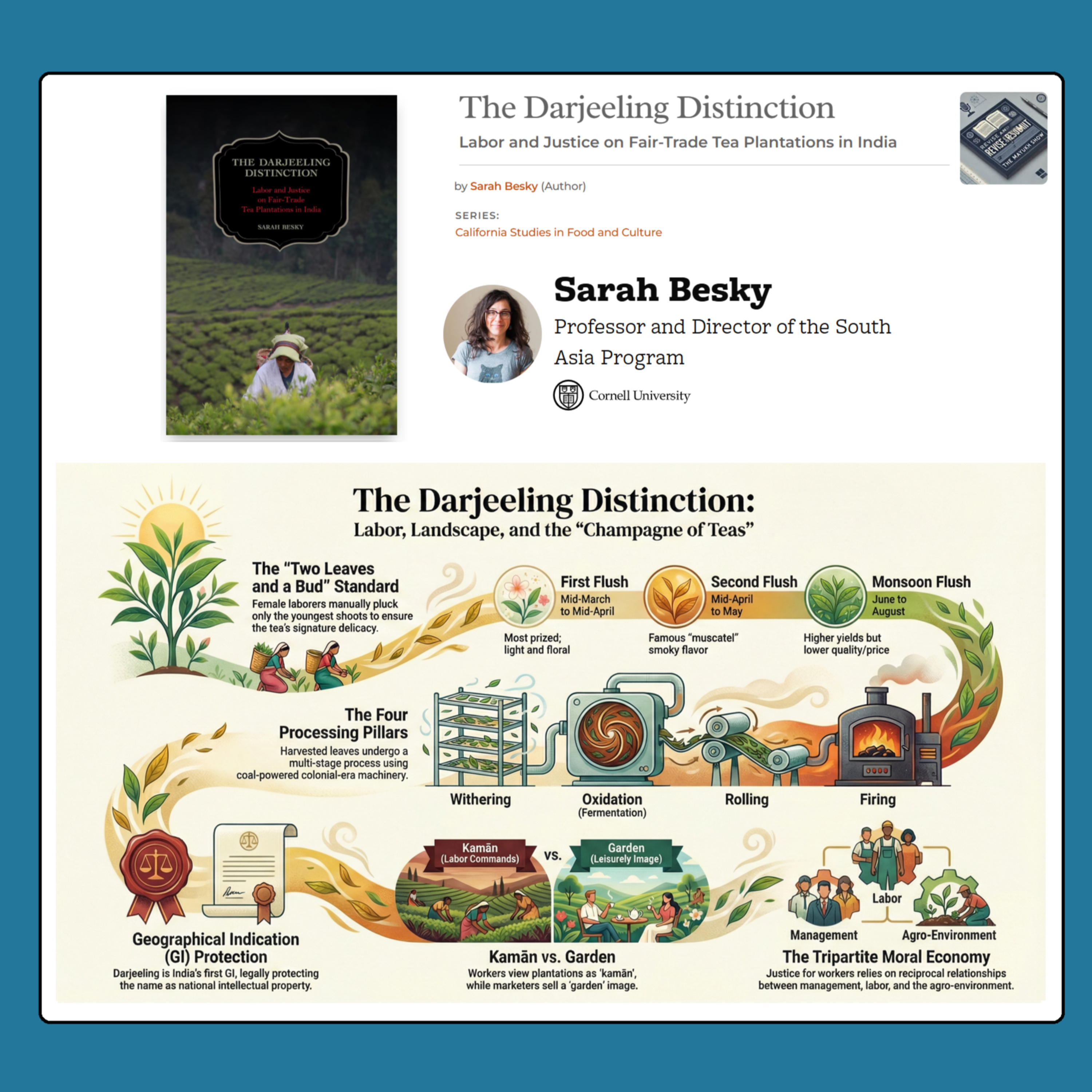
The Darjeeling Distinction (Besky 2013) - Weekend Classics
Description
English Podcast starts at 00:00:00
Bengali Podcast Starts at 00:18:36
Hindi Podcast Starts at 00:32:18
Danish Podcast Starts at 00:45:58
Reference
The Darjeeling Distinction: Labor and Justice on Fair-Trade Tea Plantations in India: by Sarah Besky, Oakland, CA, University of California Press, 2013, 264 pp., ISBN: 9780520277397. https://www.ucpress.edu/books/the-darjeeling-distinction/paper
Youtube channel link
https://www.youtube.com/@weekendresearcher
Connect on linkedin
https://www.linkedin.com/in/mayukhpsm/
🎙️ Welcome to Revise and Resubmit, and this is our episode series, Weekend Classics.
I have a book in my hands tonight that carries a familiar kind of magic, the sort that sells easily. Say “Darjeeling” and people hear mist, altitude, a slow pour, a bright cup, and a price tag that whispers luxury. But when you sit with The Darjeeling Distinction: Labor and Justice on Fair-Trade Tea Plantations in India, you start to notice the other sound beneath the romance. You hear work. You hear history. You hear the stubborn question of who gets called “fair” when the world is thirsty. 🍃☕
Sarah Besky does not write from a distance. She is an anthropologist of work, now at Cornell’s ILR School, and her scholarship has that rare discipline of actually looking, closely, at how value gets made. Not just in markets, but in bodies. In weather. In everyday decisions that never get a label. Through ethnographic and historical attention, she walks us into plantation life in Darjeeling and stays long enough to show what “fair-trade” means when it lands on a large-scale plantation with colonial roots that never really stopped shaping the present. 📚🔍
In these pages, the famous “taste of place” is not just a marketing story wrapped in a Geographical Indication seal or a Fair Trade logo. It becomes a contested portrait. We meet tea workers, especially women pluckers whose manual labor is often romanticized into something gentle and picturesque, even as wages, land, and dignity remain under pressure. And all of it unfolds alongside the long political argument for Gorkhaland, a demand for autonomy that keeps reminding us that justice is not only economic. It is also historical, environmental, and unapologetically political. ⛰️✊
What I love about Besky’s thinking is that she refuses the neat ending. She shows how fairness can become a performance, how “ethical” systems can protect brands more reliably than they protect people, and how the plantation continues to be reinvented for twenty-first-century consumers without necessarily reinventing the everyday life of those who keep the tea moving from leaf to legend. 🌿🧾
Before we get into this review, a quick ask. If you like bookish field-notes like this, please subscribe to the podcast on Spotify, and also on YouTube at Weekend Researcher. You can also find this channel on Amazon Prime Music and Apple Podcast. 🎧📺
And with gratitude, thanks to Sarah Besky, and to the University of California Press, for a book that turns a familiar cup into an unfamiliar mirror. 🙏📖
Here’s what I cannot stop wondering as we begin. If the world can learn to pay extra for a story of fairness, why does it still struggle to pay, in the most ordinary way, for the people who make that story possible? 🤔🍵