Episode Details
Back to Episodes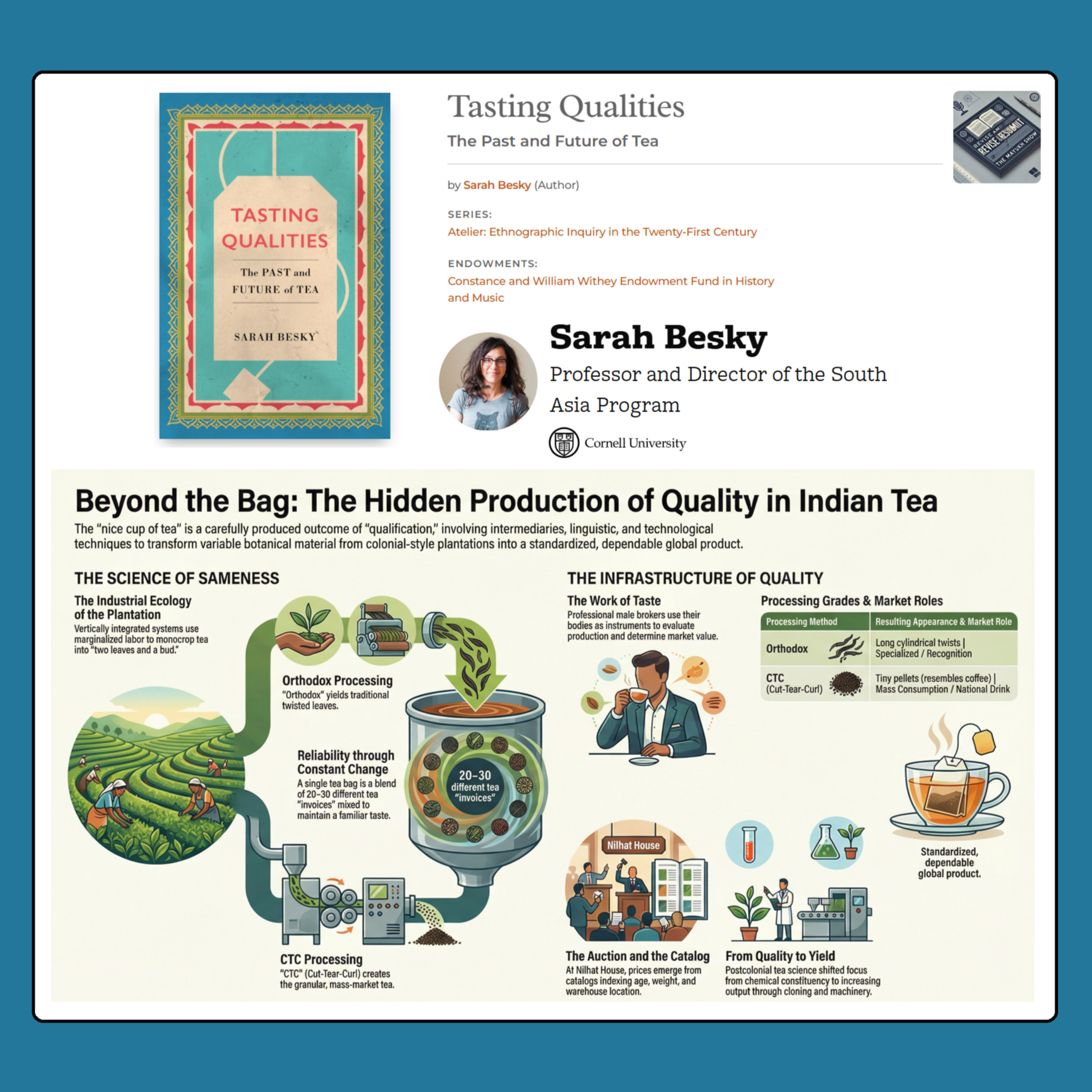
Tasting Qualities (Besky 2020) - Weekend Book Review
Description
English Podcast starts at 00:00:00
Bengali Podcast Starts at 00:18:57
Hindi Podcast Starts at 00:31:35
Danish Podcast Starts at 00:40:14
Reference
Tasting qualities: the past and future of tea: by Sarah Besky, Oakland, CA, University of California Press, 2020, 256 pp., ISBN: 9780520972704. https://www.ucpress.edu/books/tasting-qualities/paper
Pan, J. (2021). Tasting qualities: the past and future of tea: by Sarah Besky, Oakland, CA, University of California Press, 2020, 256 pp., ISBN: 9780520972704. Food, Culture & Society, 24(3), 505–506. https://doi.org/10.1080/15528014.2020.1784670
Rauf, A. A., & Abdul Majid, C. M. (2022). Media Review: Tasting qualities: The past and future of tea. Organization Studies, 44(4), 680-682. https://doi.org/10.1177/01708406221103967
Youtube channel link
https://www.youtube.com/@weekendresearcher
Connect on linkedin
https://www.linkedin.com/in/mayukhpsm/
🎙️ Welcome to Revise and Resubmit, and to our episode series “Weekend Book Review”.
I want to start with something small, almost invisible, and yet weirdly powerful. A cup of black tea. The kind you drink without thinking. The kind that shows up at railway stations, office pantries, kitchen corners, and long conversations that do not announce themselves as important until years later. ☕🌿
Today’s book is Tasting Qualities: The Past and Future of Tea by Sarah Besky, published in May 2020 by the University of California Press. And it is not “just” a book about tea. It is a book about the way capitalism trains us to worship a single word, quality, as if it were a fact of nature rather than something made, argued over, priced, tested, narrated, and defended. 🧪📈
Besky is a Professor of the Anthropology of Work at Cornell’s ILR School, and her writing carries that rare blend of patience and edge. She follows the lives of ideas as they move through real institutions and real bodies. In this case, she takes us inside the Indian tea world, from the long shadow of British rule to the early years of independence, and into the present tense where reformers try to refit a colonially rooted commodity for a 2121st-century democratic imagination.
What I kept noticing, page after page, is how “quality” is not a destination. It is a moving target. It lives in the plant, yes, but also in the auction house, in the lab, in the tongue of the professional taster, in the jargon that sounds almost poetic until you realize it can decide livelihoods. It lives in soil science and chemistry, in technoscientific instruments, and in the everyday labor that keeps the whole system breathing. 👃🫖⚗️
If you know Besky’s earlier work, The Darjeeling Distinction, you already know she does not treat tea as lifestyle décor. She treats it as history you can drink, and as a moral economy you can taste. This second book goes even further, asking a question that sounds simple until it starts to bother you in the best way. What is the place of quality in capitalism, and who gets to define it when the stakes are national, global, and deeply personal? 🌍🧑🌾
Before we begin, thank you to Sarah Besky and to the University of California Press for this work. 🙏📚
If you enjoy “Weekend Book Review,” please subscribe to Revise and Resubmit on Spotify, and also subscribe to my YouTube channel, Weekend Researcher. ▶️🎧 You can also find this podcast on Amazon Prime Music and Apple Podcast. 🍎🎵
Now let me ask you the question that this book kept pressing into my palm like a warm cup on a cold day. If quality is something we manufacture with stories, science, and power, then when you sip your next cup of tea, what exactly are you tasting? 🤔☕🌿