Episode Details
Back to Episodes“Interactive replication of GiveWell’s cost-effectiveness model” by Max Ghenis
Description
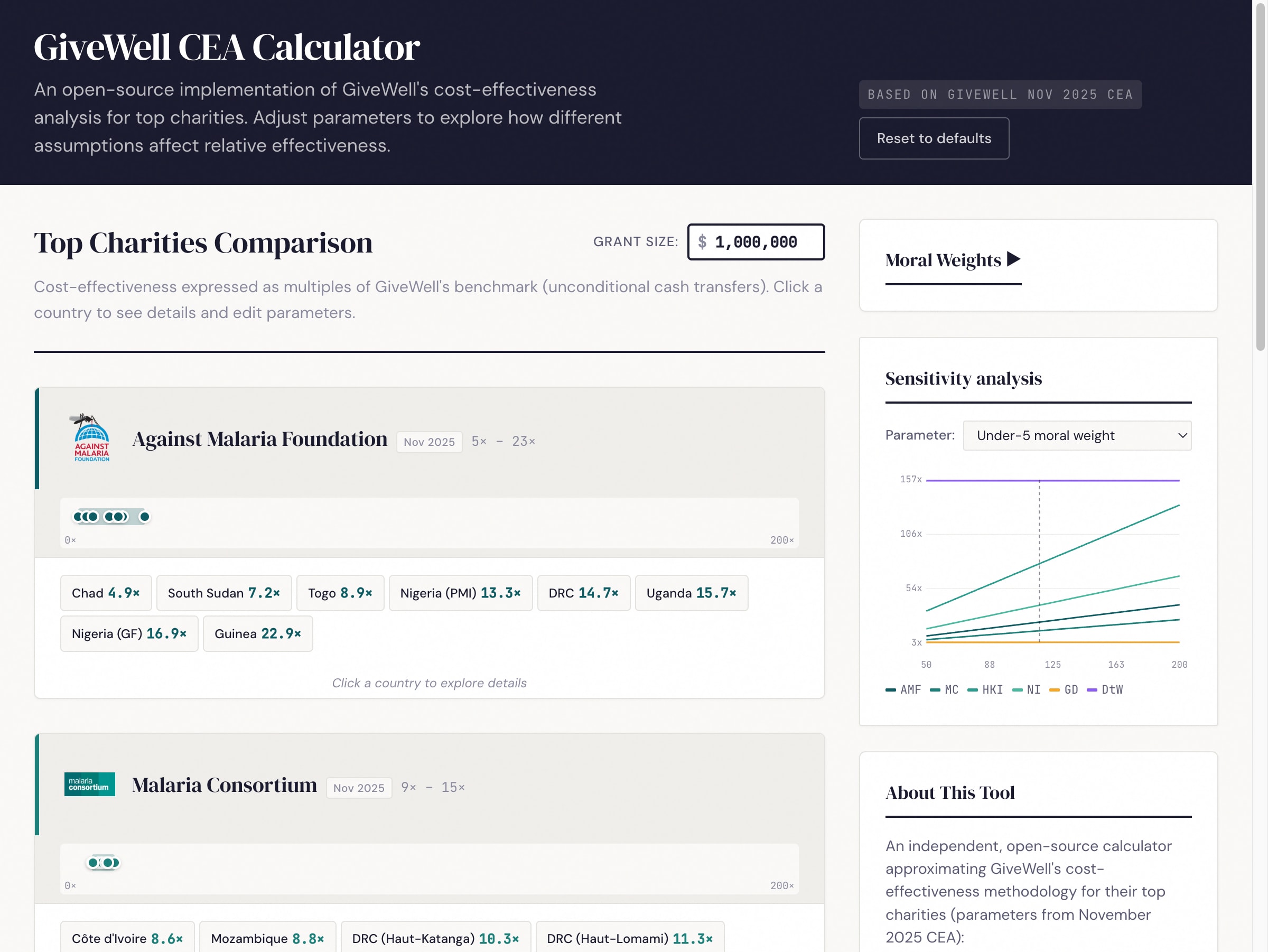
I re-implemented GiveWell's cost-effectiveness models for all six top charities as an open-source web tool: maxghenis.com/givewell-cea
The tool lets you edit any parameter and immediately see the effect on charity rankings.
Motivation
Others have done excellent work examining specific parts of GiveWell's CEA — Froolow's critical review of model architecture, Nolan, Rokebrand, and Rao's uncertainty quantification, and several pieces on deworming and AMF uncertainty. But I couldn't find a tool that implements all six charities together and makes it easy to compare them while adjusting assumptions.
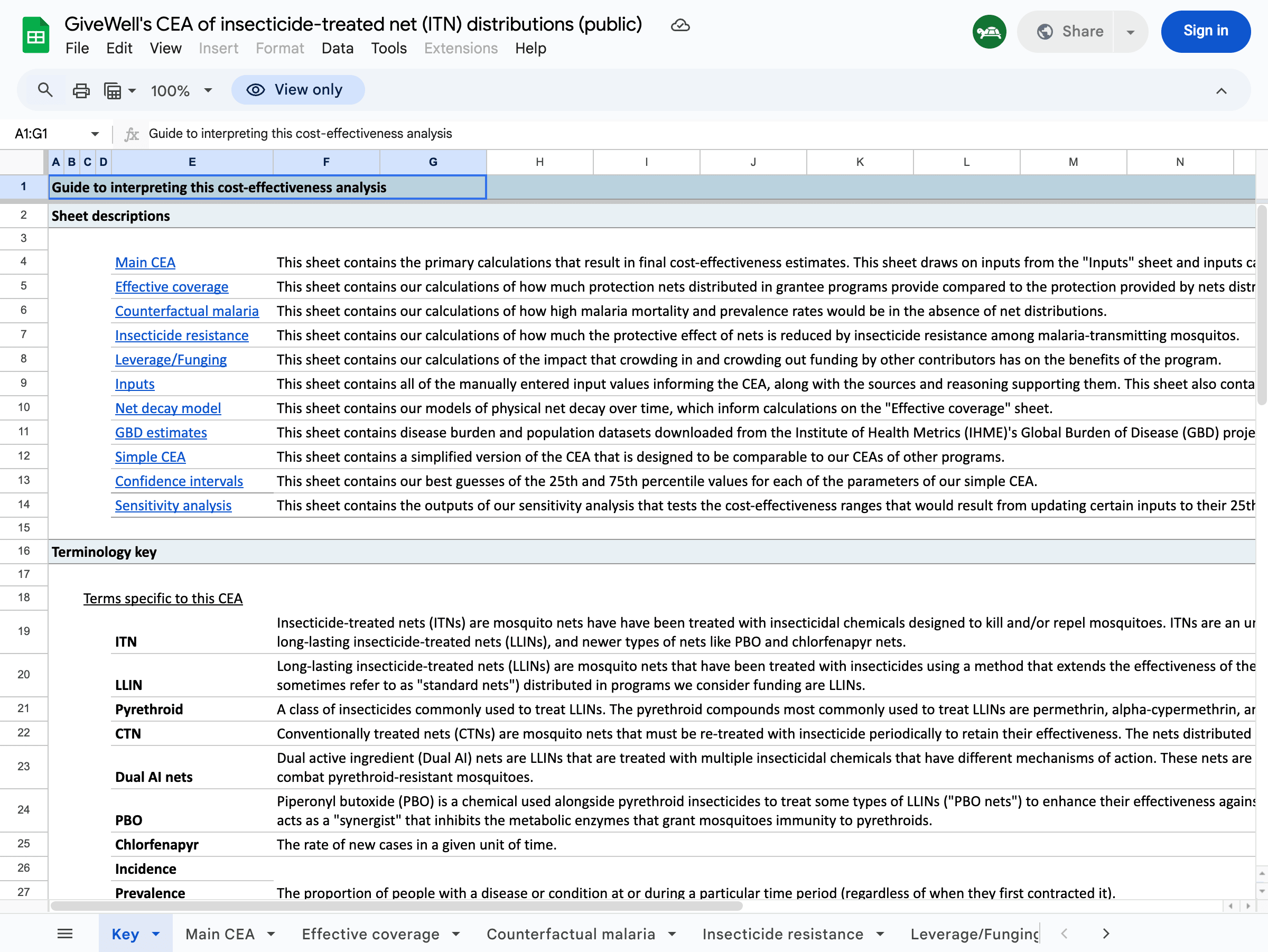
GiveWell's spreadsheets are powerful but hard to explore casually. Each charity has its own multi-tab workbook with dozens of sheets, specialized terminology, and cross-references between cells:
Changing a moral weight means editing cells across multiple sheets and comparing results manually. I wanted something where you could adjust one slider and immediately see how all six charities re-rank.
What the model covers
For each charity I implemented the core pipeline from GiveWell's spreadsheets:
- People reached: Grant size / cost per person reached
- Deaths averted (or equivalent): People reached × mortality/disease rate × intervention effect size
- Units of value: Deaths averted × moral weight (age-adjusted)
- Cost-effectiveness: Units of value per dollar / benchmark value [...]
---
Outline:
(00:37) Motivation
(01:38) What the model covers
(03:16) Observations from the replication
(06:15) Verification
(07:04) Interactive features
(08:12) How assumptions affect rankings
(10:25) Programmatic access
(11:04) Limitations
(12:33) Try it
---
First published:
February 12th, 2026
---
Narrated by TYPE III AUDIO.
---

Love PodBriefly?
If you like Podbriefly.com, please consider donating to support the ongoing development.
Support Us