Episode Details
Back to Episodes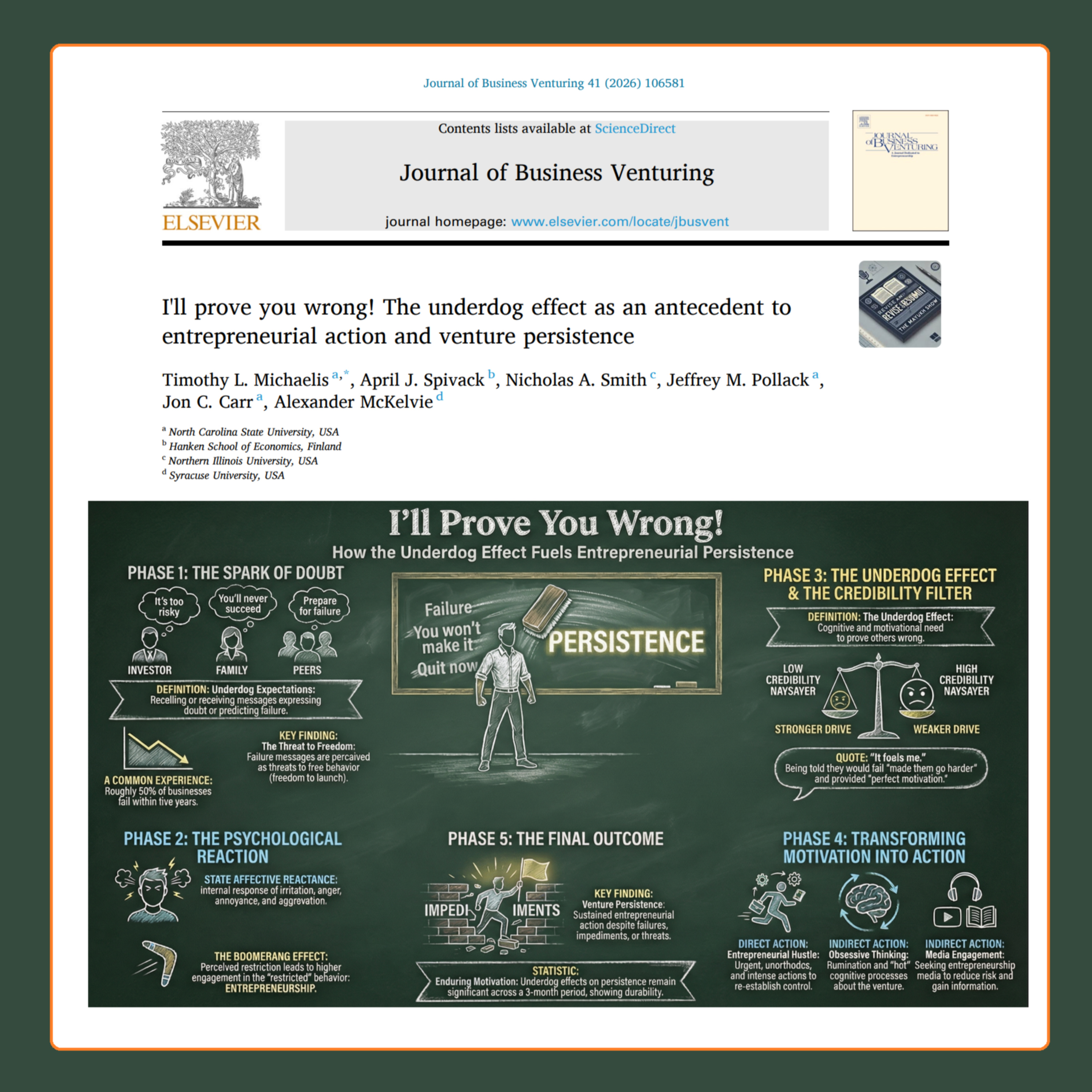
I’ll prove you wrong! (Michaelis et al 2026) | FT50 JBV
Description
English Podcast starts at 00:00:00
Bengali Podcast starts at 00:16:29
Hindi Podcast starts at 00:33:04
Danish Podcast starts at 00:47:11
Reference
Michaelis, T. L., Spivack, A. J., Smith, N. A., Pollack, J. M., Carr, J. C., & McKelvie, A. (2026). I’ll prove you wrong! The underdog effect as an antecedent to entrepreneurial action and venture persistence. Journal of Business Venturing, 41(3), 106581–106581. https://doi.org/10.1016/j.jbusvent.2026.106581
Youtube Channel
https://www.youtube.com/@weekendresearcher
Connect over linkedin
https://www.linkedin.com/in/mayukhpsm/
Welcome to Revise and Resubmit 🎙️📝
There is a particular kind of sentence that can rearrange a person. It does not shout. It arrives politely, sometimes even with good intentions. This won’t work. You’re not ready. Someone else will do it better. The room moves on, but the person who heard it does not. They carry it home. They replay it while washing dishes, while commuting, while staring at a ceiling at 22 a.m. And then, quietly, a decision forms: I’ll prove you wrong 🔥👀
Today, we examine that decision with the kind of disciplined attention it deserves, through a new research article published online on 05 February 2026 in the Journal of Business Venturing, a prestigious outlet on the FT50 journal list 🏛️📌. The paper, “I’ll prove you wrong! The underdog effect as an antecedent to entrepreneurial action and venture persistence,” is authored by Michaelis, Spivack, Smith, Pollack, Carr, and McKelvie, and it is scheduled for Volume 41, Issue 3 (May 2026) 📄⏳
The authors start with an observation that feels familiar to anyone who has tried to build something in public: doubt from others can do more than sting. It can provoke a kind of pushback, a refusal to be boxed in, that turns into motion. They build a theory-driven model and then do the unglamorous work of testing it across three studies 📊🔍: two quasi-experiments with N=424N=424 and N=579N=579, including 15 follow-up interviews with entrepreneurs in the second study, and a time-lagged model with N=417N=417. Across designs and samples, they find consistent evidence that the “underdog” impulse links tightly to persistence.
What is especially striking is how they trace the pathways. Defiance does not float in the air as motivation. It travels through mechanisms. One is direct: hustle, the concrete choice to act, to make calls, to ship, to sell, to show up again ⚙️⚡. Others are indirect: increased engagement with entrepreneurship-related media, and obsessive thinking, the looping mental rehearsal that can keep a venture present even when progress is slow 🔁📣. And there is a twist with real-world bite: the effect grows stronger when the doubter is seen as having low credibility, when the criticism feels less like guidance and more like interference 🧩🚫
If you want more episodes that treat research like evidence and stories like data, subscribe to Revise and Resubmit on Spotify 🎧✅, and subscribe to the YouTube channel Weekend Researcher ▶️📚. You can also listen on Amazon Prime and Apple Podcast 🍎📺
Now here’s the question worth sitting with: when someone tells an entrepreneur “you can’t,” are they offering protection from a bad bet, or accidentally supplying the very spark that makes persistence possible? 🤔🔥
Thanks to the authors Michaelis, Spivack, Smith, Pollack, Carr, and McKelvie, and thanks to Elsevier, the publisher of this research article.