Episode Details
Back to Episodes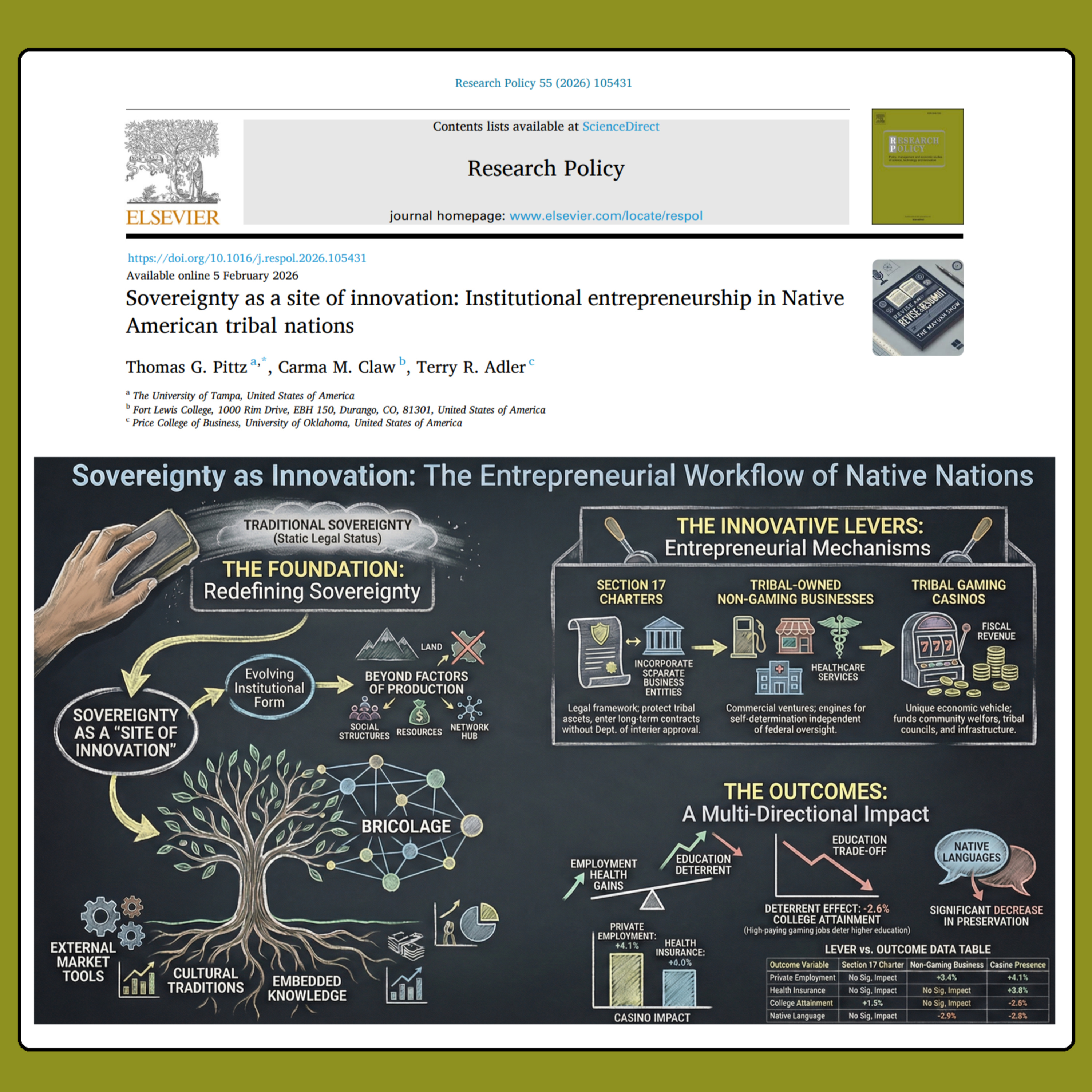
Sovereignty as a site of innovation (Pittz et al 2026) | FT50 RP
Description
English Podcast starts at 00:00:00
Bengali Podcast starts at 00:16:15
Hindi Podcast starts at 00:31:59
Danish Podcast starts at 00:48:27
Reference
Pittz, T. G., Claw, C. M., & Adler, T. R. (2026). Sovereignty as a site of innovation: Institutional entrepreneurship in Native American tribal nations. Research Policy, 55(4), 105431. https://doi.org/10.1016/j.respol.2026.105431
Youtube Channel
https://www.youtube.com/@weekendresearcher
Connect over linkedin
https://www.linkedin.com/in/mayukhpsm/
Welcome to Revise and Resubmit 🎙️📚 where big ideas meet the messy, human work of making them real.
A few years ago, I was sitting with a friend who’d grown tired of how institutions talk about people as if they were policy problems instead of living communities. “Everyone says we have the right,” they told me, “but the harder part is making that right actually work on Tuesday morning.” That line stuck with me. Because it hints at a quieter truth: power is not only declared. It’s practiced. And sometimes, it’s rebuilt in the most practical places, like paperwork, governance choices, and the everyday decisions that keep a nation standing.
Today’s episode takes us into that Tuesday morning reality through a striking new article: “Sovereignty as a site of innovation: Institutional entrepreneurship in Native American tribal nations,” by Thomas G. Pittz, Carma M. Claw, and Terry R. Adler, published online on 05 February 2026 in Research Policy 🏛️✨. This is not just any outlet. Research Policy is a prestigious FT50 journal, which means the bar is high, and the conversation echoes far beyond one discipline.
The authors ask a deceptively simple question: what if sovereignty is not a fixed status, but a living system that leaders can defend and also redesign? They stitch together two kinds of evidence with careful craft 🧵🔍: conversations with 1818 tribal leaders, then a broader analysis spanning 161161 tribal nations using public records, regulatory sources, and formal information requests. The result is a portrait of leadership that looks less like symbolism and more like engineering: leaders navigating overlapping rulebooks, building organizations, choosing structures, and using modern economic tools to expand room to govern on their own terms.
And the findings refuse to be neat. The same strategies that can strengthen economic footing and expand access to essential services can also coincide with cultural strain, including weaker preservation of Native languages. Even prosperity can carry paradoxes: when good jobs arrive quickly, the long path of additional schooling can look less urgent, and the data suggests that tension matters. The paper’s brilliance is its insistence that these are not footnotes. They are the main story 🧠⚖️.
If you want more episodes like this, subscribe to Revise and Resubmit on Spotify 🎧, and find us on YouTube at Weekend Researcher ▶️. You can also listen on Amazon Prime and Apple Podcast 🍎📺.
And before we begin, thank you to the authors and to Elsevier for publishing this work in Research Policy.
So here’s the question I can’t shake 🤔: if sovereignty can be innovated in the everyday choices of institutions, what should we measure as “success” when progress in one direction can quietly pull on something precious in another?