Episode Details
Back to Episodes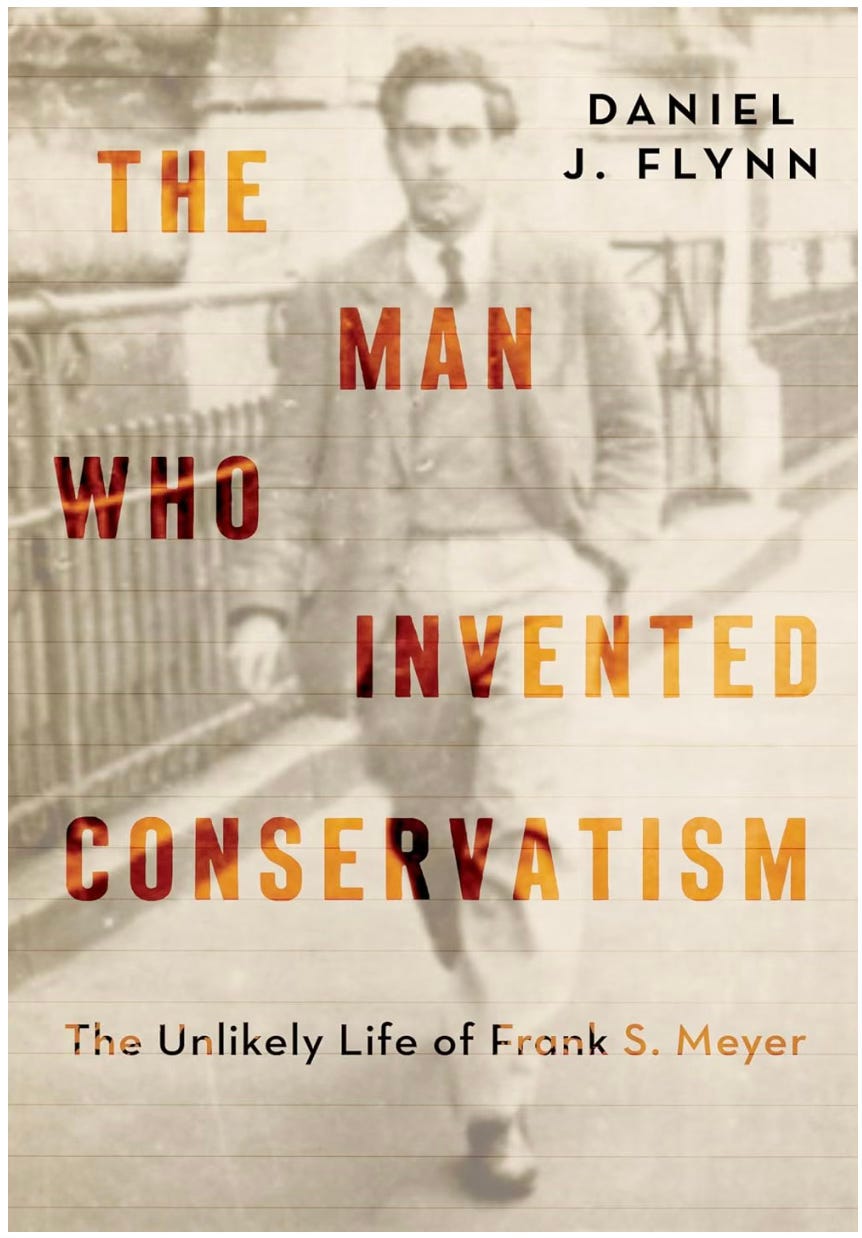
Interview | Daniel J. Flynn: Frank Meyer’s conservatism helped elect President Reagan
Description
In the aftermath of World War II, the role of the US federal government significantly expanded under the impetus of President Franklin D. Roosevelt’s New Deal. Prominent Cold War politicians who are generally classified as “liberal,” such as Truman, Kennedy, and Johnson, championed the welfare state and Keynesian economics. American conservatives, however, felt threatened by what they perceived as the liberals’ collectivism and big government. At the same time, American conservatism saw many internal divisions. Traditionalists, such as Russell Kirk, emphasized moral order, religion, and traditional communities, and opposed unbound laissez-faire individualism. Libertarians, such as Friedrich Hayek, put at the forefront individual liberty, limited government, and the market economy, while opposing all forms of coercion—including moral coercion. The two camps debated fiercely in venues such as National Review (founded in 1955), and often openly expressed disdain for each other. The unity of the conservative movement came to be endangered as a result.
At that juncture, in the year of 1962, a scholar called Frank S. Meyer published In Defense of Freedom. In this book he systematically expounded “fusionism,” arguing that tradition and liberty are complementary, insofar as it is possible to safeguard individual liberty in politics, as advocated by libertarianism, while maintaining traditional virtues in morality, as demanded by traditionalism. In sum, according to Meyer, only through free choice can true virtue be realized. Meyer above all sought to preserve the tradition of “ordered liberty” rooted in the American founding and to shore up resistance against totalitarianism. His doctrine, conceived in response to the Cold War anti-communist agenda, helped to unite the American Right and exerted great influence on Barry Goldwater’s 1964 presidential campaign as well as the conservative movement of the Reagan era.
In 1981, Ronald Reagan, speaking at the Conservative Political Action Conference (CPAC), praised Meyer for breaking free from the shackles of communism, and fashioning “a vigorous new synthesis of traditional and libertarian thought—a synthesis that is today recognized by many as modern conservatism.” As a present-day American conservative scholar Daniel J. Flynn puts it, Frank Meyer was “if not the sole architect, then at least an architect of the modern conservative movement.” This is the key thesis of Flynn’s latest biography, published in August 2025, The Man Who Invented Conservatism: The Unlikely Life of Frank S. Meyer.
Frank S. Meyer was born in 1909 into a Jewish family in Brooklyn, New York. Deeply attracted to Marxism in his youth, he became an ardent communist while studying at Oxford University in the late 1920s. In the 1930s, he took part in Communist Party’s activities in Britain and the United States, and even became an early leader of the British communist student movement. During World War II, however, he became skeptical of Stalinism and formally quit the party in 1945. And after reading Friedrich Hayek’s The Road to Serfdom, Meyer consummated his turn to anti-communism.
In the mid-1950s, Meyer joined National Review, founded by William F. Buckley Jr., as a senior editor and became a key figure in conservative circles. His most famous contribution was the formulation of “Fusionism,” which had a formative influence on Barry Goldwater’s 1964 campaign and the Reagan administration in the 1980s. Meyer’s ideas laid the foundation for mainstream modern American conservatism and continue to shape debates among conservatives on the relationship between liberty and tradition.
For a long time, Meyer was seen merely as a coordinator within the National Review circle or as a subordinate to Buckley, rather than as an origi