Episode Details
Back to Episodes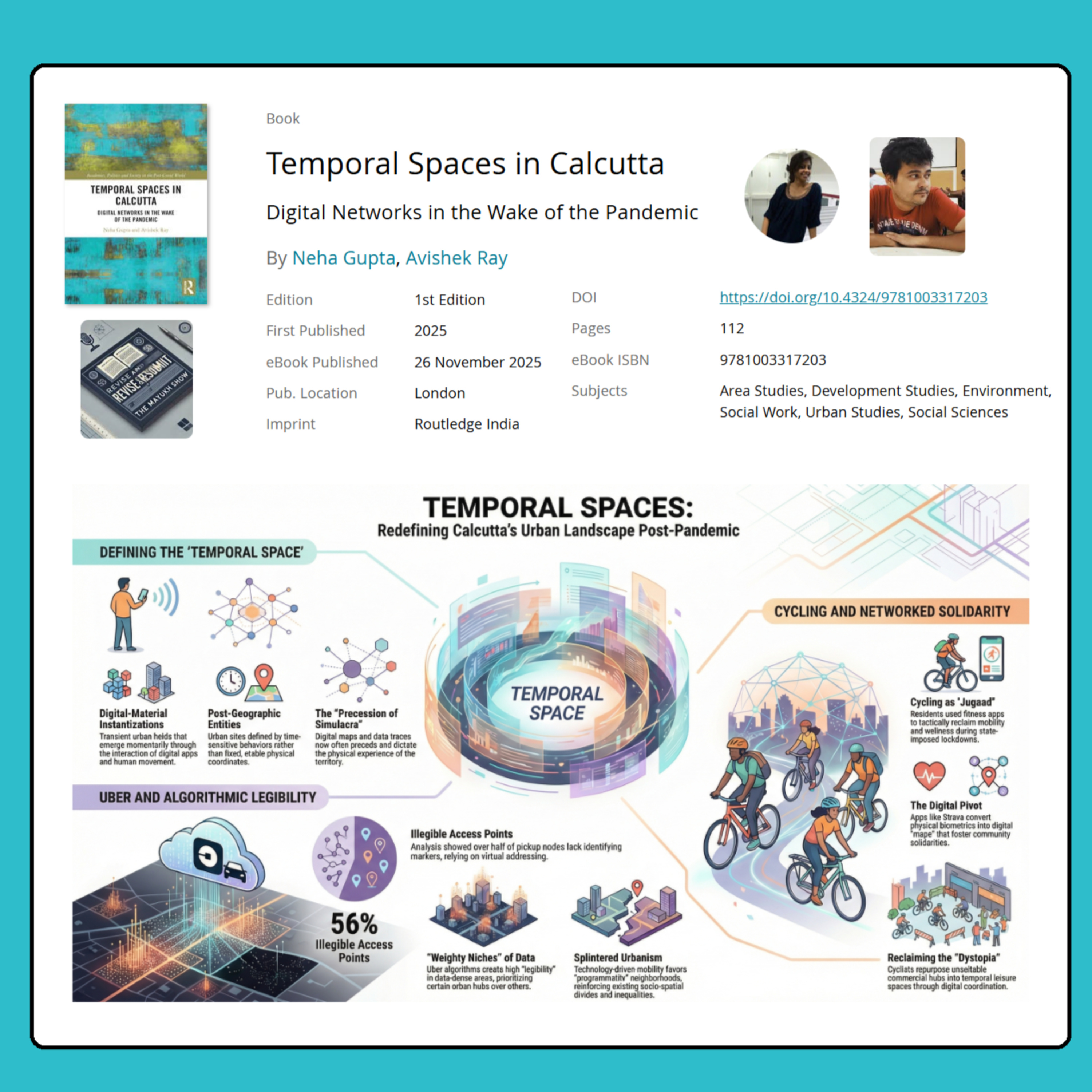
Temporal Spaces in Calcutta (Gupta & Ray, 2025) - Weekend Book Review
Description
English Podcast starts at 00:00:00
Bengali Podcast Starts at 00:16:38
Hindi Podcast Starts at 00:31:48
Danish Podcast Starts at 00:44:46
Reference
Gupta, N., & Ray, A. (2025). Temporal Spaces in Calcutta: Digital Networks in the Wake of the Pandemic (1st ed.). Routledge India. https://doi.org/10.4324/9781003317203
Youtube channel link
https://www.youtube.com/@weekendresearcher
Connect on linkedin
https://www.linkedin.com/in/mayukhpsm/
Welcome to Revise and Resubmit 🎙️, and to our episode series, Weekend Book Review 📖✨
I keep thinking about Calcutta the way it exists in memory versus the way it exists on a screen. The city you feel in your chest is never quite the same as the city your phone insists is “nearby” 📍. After the pandemic, that gap got stranger, and sometimes more intimate. We learned to navigate not just streets, but curfews, caution, longing, and the soft calculations of risk. And somewhere in that, our sense of place started behaving like time. Temporary. Adjustable. A little bit improvised 🕰️🧩.
That is the terrain Neha Gupta and Avishek Ray walk into with Temporal Spaces in Calcutta: Digital Networks in the Wake of the Pandemic (Routledge India, November 26, 2025). Gupta, a postdoctoral research fellow at TISS Mumbai, has the eye of someone who can see infrastructure as a kind of quiet power. Ray, who teaches at NIT Silchar, writes with the long view of mobility and imagination. He has already traced travel, vagabonds, and vernacular movement across South Asia, and he brings that sensibility here too, with the added authority of a Fulbright-Nehru Academic and Professional Excellence Fellowship that signals both recognition and responsibility 🎓📚.
This book gives you three anchors, and each one feels like a familiar scene that turns, slowly, into an argument. Uber pickup points where the “where are you” becomes a negotiation with algorithms and curbside reality 🚕📲. Cycling pathways where roads become leisure, and leisure becomes data, routed through fitness apps 🚴♂️💨. Cafés where the idea of hanging out is braided with Instagram and platform rhythms, so that intimacy can be staged, saved, and re-entered later ☕📸.
Gupta and Ray call these digitally mediated, hybrid geographies “temporal spaces”, spaces made in motion, sustained by digital traces and human habits, and reshaped through small acts of jugaad, that stubborn, creative improvisation that keeps city life human even when systems want it neat 🔧🌆. What I admire is the way the book refuses the easy story of “back to normal.” It asks what normal even means when the city is constantly being co-produced by software interfaces, networked publics, and the material fact of your feet on the ground.
Today, I am reviewing this book not just as scholarship, but as a mirror. Because if you live in a city now, you have probably felt it: the sense that a place can appear, vanish, and reappear, depending on an app notification, a surge of people, a sudden rain, or the memory of what was lost 🌧️🧠.
Subscribe to Revise and Resubmit on Spotify 🎧 and to our YouTube channel, Weekend Researcher ▶️. You can also find the podcast on Amazon Prime Music and Apple Podcast 🔊🍏.
And with thanks to Neha Gupta, Avishek Ray, and Routledge India 🙏📘, here is the question I want to leave hanging in the air: when your phone helps you move through the city, is it giving you freedom, or quietly teaching you what the city is allowed to be? 🤔