Episode Details
Back to Episodes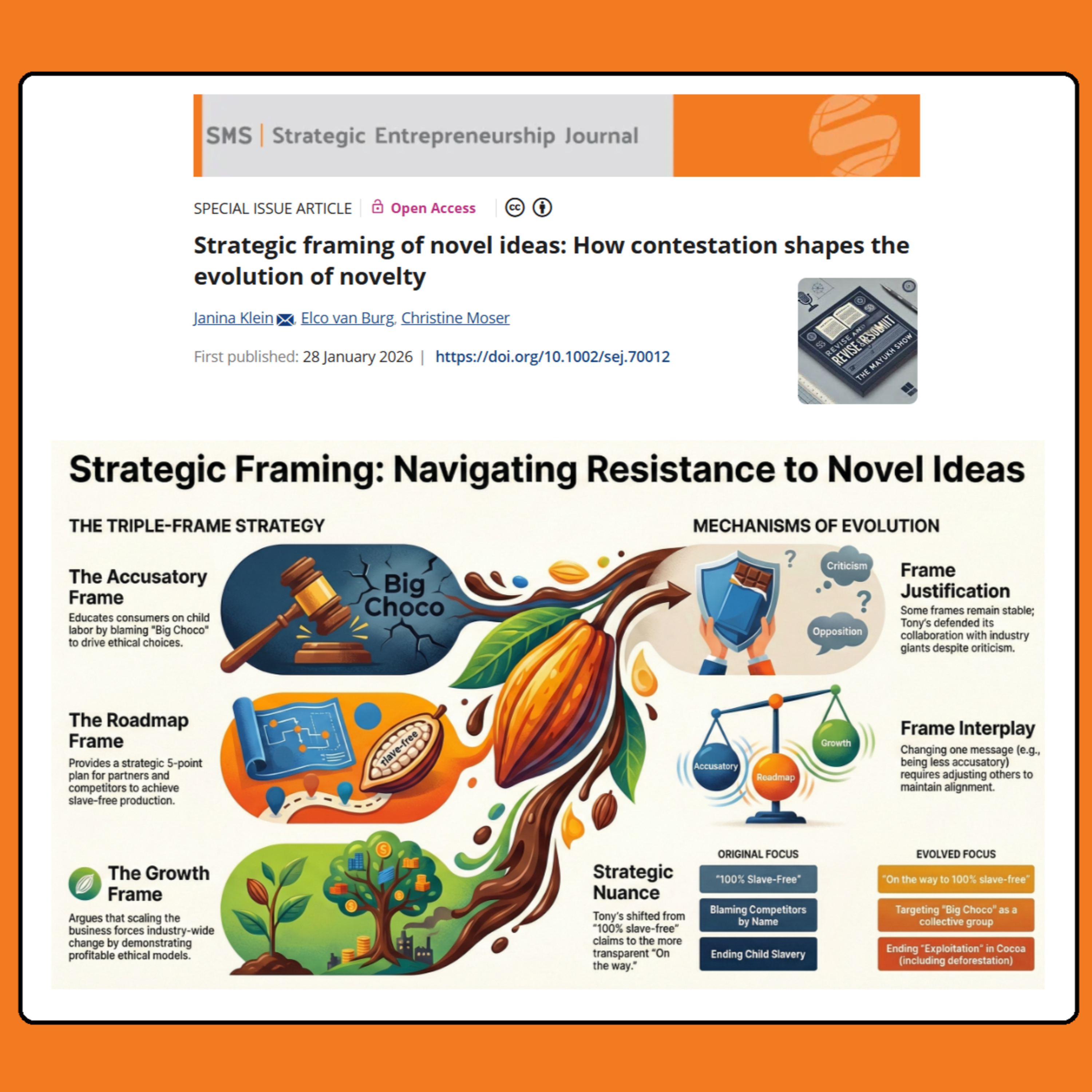
Strategic framing of novel ideas (Klein et al. 2026) | FT50 SMJ
Description
English Podcast starts at 00:00:00
Bengali Podcast starts at 00:17:44
Hindi Podcast starts at 00:34:09
Danish Podcast starts at 00:49:51
Reference
Klein, J., van Burg, E., & Moser, C. (2026). Strategic framing of novel ideas: How contestation shapes the evolution of novelty. Strategic Entrepreneurship Journal, 1–30. https://doi.org/10.1002/sej.70012
Youtube Channel
https://www.youtube.com/@weekendresearcher
Connect over linkedin
https://www.linkedin.com/in/mayukhpsm/
🎙️ Welcome to Revise and Resubmit 🧠✨
I want to begin with a small confession. The first time I held a chocolate bar and thought about the invisible hands that made it, the sweetness thinned. Curiosity does that. It makes comfort provisional. Today’s episode sits right in that uneasy, necessary space where ideas are new, resistance is loud, and meaning has to be carefully built, tested, and rebuilt again 🔬📚.
We are diving into a remarkable paper titled “Strategic framing of novel ideas: How contestation shapes the evolution of novelty” by Janina Klein, Elco van Burg, and Christine Moser, published online on 28 January 2026 in the Strategic Entrepreneurship Journal, one of the most prestigious outlets in management research and proudly part of the FT50 journal list 🏆📈.
With clinical precision and narrative patience, this research follows Tony’s Chocolonely, a social enterprise that dared to say something unsettling. Chocolate should be slave-free. That sentence sounds obvious now. It was not then. As the authors show, novelty is rarely rejected because it is wrong. More often, it is rejected because it disrupts how audiences understand their world. Using rich archival data and interviews, the study traces how contestation from consumers, competitors, and industry insiders forced the organization to adjust some frames, stabilize others, and carefully manage the interplay between them 🧩🗂️.
What emerges is an evidence-based insight with real human weight. Innovation survives not by shouting louder, but by listening harder. Framing is not spin. It is diagnosis. It is adaptation. It is knowing when to hold steady and when to change course without losing your moral center ❤️🩹📊.
Huge thanks to the authors for this thoughtful contribution, and to John Wiley & Sons Ltd, publishing on behalf of the Strategic Management Society, for stewarding research that shapes how we think, teach, and practice strategy 🙌📖.
If you enjoy conversations where scholarship meets lived experience, subscribe to Revise and Resubmit on Spotify, and join our growing community on YouTube at Weekend Researcher 🎧▶️. You can also find us on Amazon Prime and Apple Podcast 🍎📡.
So here is the question I will leave you with 🤔✨. When your idea challenges not just a market, but a mindset, which frames must evolve, and which must remain unbreakably intact?