Episode Details
Back to Episodes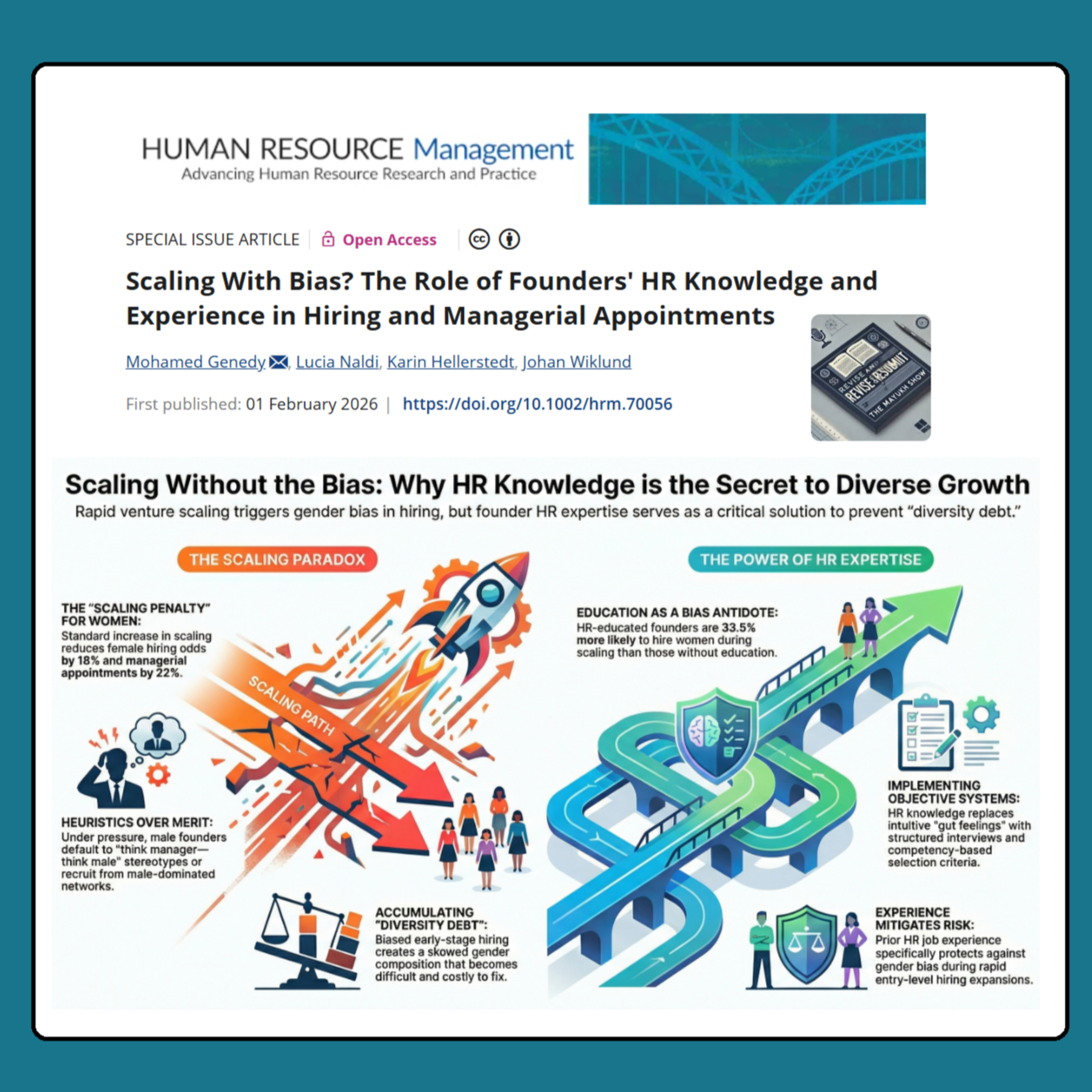
Scaling With Bias? (Genedy et al. 2026) | FT50 HRM
Description
English Podcast starts at 00:00:00
Bengali Podcast starts at 00:21:47
Hindi Podcast starts at 00:35:05
Danish Podcast starts at 00:49:37
Reference
Genedy, M., L. Naldi, K. Hellerstedt, and J. Wiklund. 2026. “ Scaling With Bias? The Role of Founders' HR Knowledge and Experience in Hiring and Managerial Appointments.” Human Resource Management 1–31. https://doi.org/10.1002/hrm.70056.
Youtube Channel
https://www.youtube.com/@weekendresearcher
Connect over linkedin
https://www.linkedin.com/in/mayukhpsm/
Welcome to Revise and Resubmit 🎙️✨ a place where ideas breathe, evidence wrestles with instinct, and scholarship tells us something quietly human about who we are and how we choose.
Today’s story begins the way so many modern stories do, with growth. Fast growth. The kind that feels like a victory lap and a fire drill at the same time 🔥📈. The paper we are opening up is titled “Scaling With Bias? The Role of Founders' HR Knowledge and Experience in Hiring and Managerial Appointments.” It is written by Mohamed Genedy, Lucia Naldi, Karin Hellerstedt, and Johan Wiklund, and it appears in Human Resource Management, one of the most prestigious journals in the world and proudly part of the FT50 journal list 🏆📚.
This research asks a deceptively simple question. What happens to fairness when a company grows too fast to think? As new ventures scale, founders are forced to make hiring and leadership decisions at speed, often guided less by careful evaluation and more by gut feeling. And as this paper shows, guts have memories, and memories carry stereotypes.
Drawing on extraordinary matched employer employee census data from Sweden, covering every solo male founded venture between 2004 and 2018, the authors reveal a sobering pattern. As firms grow, women become less likely to be hired and less likely to be appointed to managerial roles. Not because of competence, but because scaling invites shortcuts 🧠⚡. The mind reaches for familiar images of the “ideal worker,” and too often that image is male.
But this is not a story without hope. The paper shows that founders with HR education slow the slide into bias, both in hiring and in leadership appointments. Founders with HR experience also help, especially when it comes to hiring. Structure, training, and professionalized HR practices become a kind of moral ballast, keeping organizations steady when growth threatens to tip them over ⚖️🌱.
This is research that reminds us that bias is rarely loud. It arrives quietly, disguised as efficiency. And it leaves behind consequences that shape careers, companies, and lives.
If you enjoy conversations that sit at the intersection of evidence, ethics, and everyday decision making, make sure to subscribe to Revise and Resubmit on Spotify 🎧 and to our YouTube channel Weekend Researcher ▶️. You can also find us on Amazon Prime and Apple Podcast 🍎📺 so the conversation is always within reach.
We extend our sincere thanks to the authors Mohamed Genedy, Lucia Naldi, Karin Hellerstedt, and Johan Wiklund, and to Wiley Periodicals LLC, the publisher of this outstanding FT50 research 🙏📖, which leaves us wondering, when growth demands speed and certainty feels urgent, do we choose the comfort of instinct or the courage to design better decisions? 🤔✨