Episode Details
Back to Episodes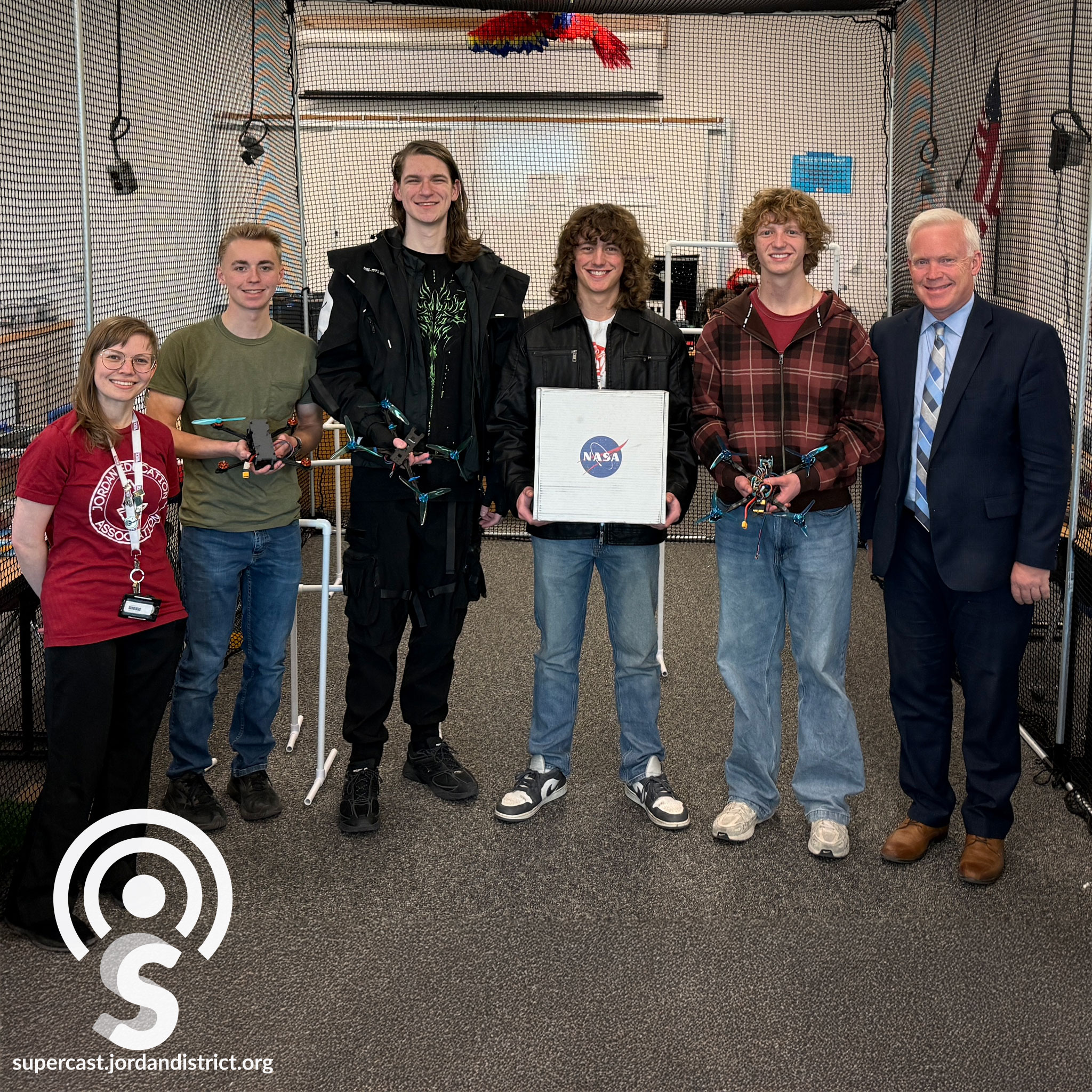
Jordan School District Students to Work with NASA Aerospace Engineers on Exciting Project They Designed
Description
You could say they are hitting new heights as winners of a NASA Aerospace Engineering contest.
On this episode of the Supercast, we head to JATC North to hear how four students will be working with NASA TechRise engineers over the next 18 months to bring an experiment they proposed to life. It is an experiment, with real world applications, that will be launched into the edge of space on one of NASA’s high altitude balloons, a dream come true for aspiring space engineers.
Audio Transcription
Student:
Now that we've won, we're going to be building some things that we can put in a box that they'll send up to the edge of space and we'll measure the amount that these different data storage units are going to... like what just happens to them.
Student:
It'll reach 60,000 feet
Student:
And we are going to test how the radiation and pressure there affects the electronics.
Anthony Godfrey:
Hello and welcome to the Supercast. I'm your host, Superintendent Anthony Godfrey. You could say they are hitting new heights as winners of a NASA Aerospace Engineering contest. On this episode of the Supercast, we head to JATC North to hear how four students will be working with NASA TechRise engineers over the next 18 months to bring an experiment they proposed to life. They'll be working on an experiment with real-world applications that will be launched using NASA's high-altitude balloons, a dream come true for these incredibly talented students.
Anthony Godfrey:
We are here at the JATC North campus to talk with Amber Saffen and some of her students about the Aerospace Engineering program. Amber, thanks for talking with us today.
Amber Saffen:
Yeah, welcome. Welcome to our program.
Anthony Godfrey:
Tell me how you and your students are now involved with NASA.
Amber Saffen:
Yes, so our CTE coordinator right at the beginning of the school year sent an email our way that NASA has a competition called NASA TechRise where students can write proposals for an experiment to be sent up into the stratosphere, and so as part of my program, I was like, "Hey, we're the aerospace program. That seems pretty dang relevant." So fresh to the program, my students got in and they did some research and they put together some proposals of some things that useful experiments they thought would be good to send up there. And then just a couple months ago, I got an email that one of those proposals had been accepted. And so I'm here with four of my students and they wrote a proposal and now NASA will be working with them once a week for the next 18 weeks to build the proposal. Gave them, is going to provide $1,500 for them to buy the supplies, is going to help them learn how to do it, and then that will be shipped back to be go up on the WorldView balloon.
Anthony Godfrey:
Let's meet your students and have them describe to me what this experiment is all about. Introduce yourselves, tell us what grade you're in, and what school you're from.
Student:
All right. My name is Blake Bigler. I'm a senior at Mountain Ridge High School.
Student:
My name is Canyon Bullock, and I'm a senior at Herriman High School.
Student:
My name is Mason Rice, and I'm also a senior at Mountain Ridge High School.
Student:
My name is Zach Hull, and I'm a senior at Riverton High School.
Anthony Godfrey:
Someone tell me about this experiment, what's involved exactly. What will you learn from being a part of this?
Student:
Yeah, we created this proposal like six months ago, but basically what it is, is we designed an experiment where we are testing how data storage is affected and how it works in space with like radiation and lower pressure. So now that we've won, we're going to be building some things that we can put in a box that