Episode Details
Back to Episodes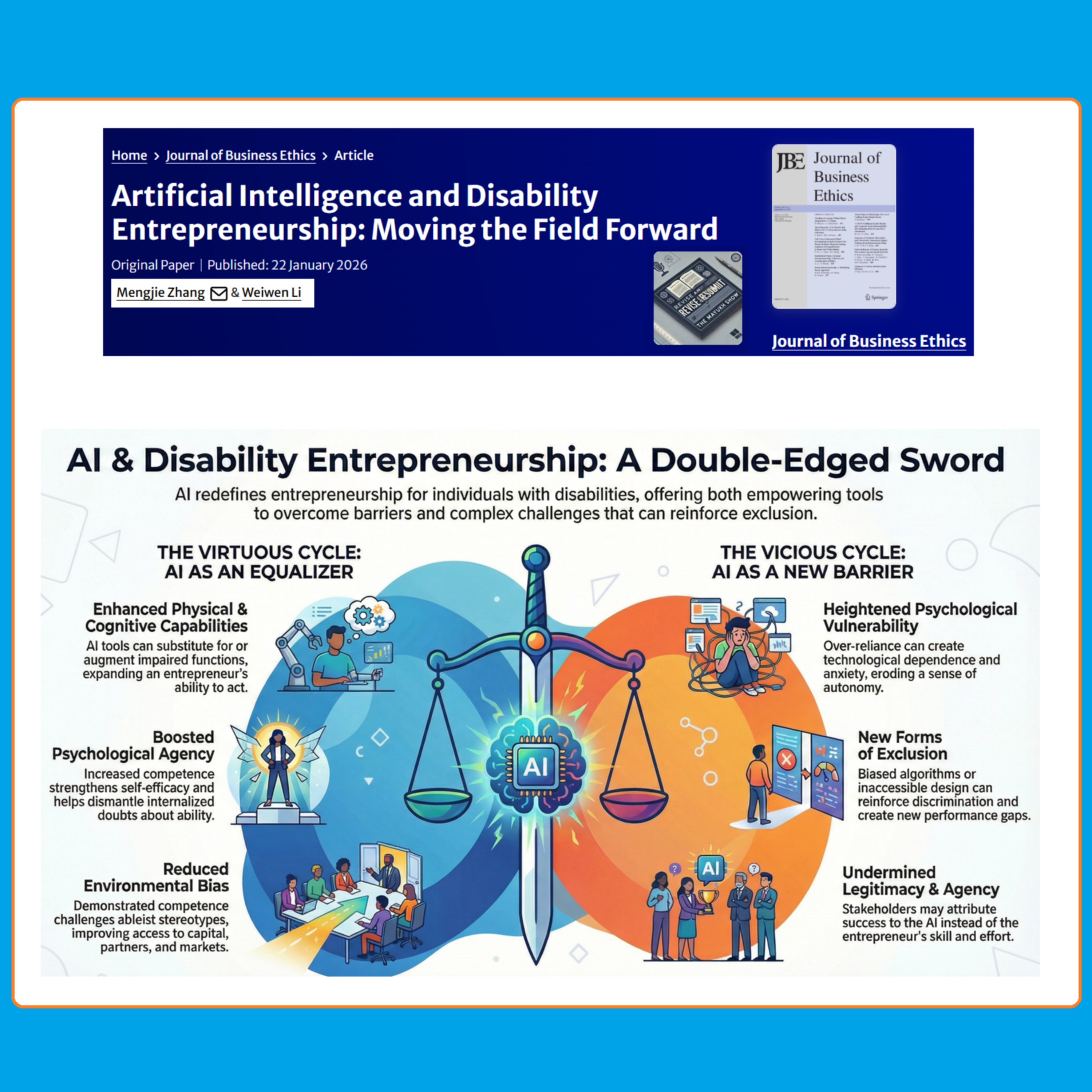
Artificial Intelligence and Disability Entrepreneurship (Zhang & Li, 2026) | FT50 JBE
Description
English Podcast starts at 00:00:00
Bengali Podcast starts at 00:16:04
Hindi Podcast starts at 00:30:34
Danish Podcast starts at 00:46:32
Reference
Zhang, M., Li, W. Artificial Intelligence and Disability Entrepreneurship: Moving the Field Forward. J Bus Ethics (2026). https://doi.org/10.1007/s10551-026-06249-0
Youtube Channel
https://www.youtube.com/@weekendresearcher
Connect over linkedin
https://www.linkedin.com/in/mayukhpsm/
You’re welcome into Revise and Resubmit 🎙️📚, the show where we take serious research and let it breathe a little, where ideas step out from behind paywalls and PDFs and stand in the human weather of real life 🌧️➡️🌤️.
Today’s episode starts with a simple, quietly radical thought: technology does not land on a level playing field. It lands on bodies. It lands on histories. It lands on the daily negotiations people make just to be heard, hired, funded, trusted, and seen 👀⚙️.
We are talking about a brand-new paper, published online on 22 January 2026, in the Journal of Business Ethics 🏛️✨. Yes, the FT50 list journal. Prestigious. Field-defining. The kind of place where your argument has to show up pressed, polished, and ready to defend itself in daylight 🧠📝.
The paper is titled Artificial Intelligence and Disability Entrepreneurship: Moving the Field Forward by Mengjie Zhang and Weiwen Li, published by Springer Nature 🔍📖.
Here’s what makes it hit with extra force: it refuses the lazy storyline where AI is just a tool that gets “used by” a marginalized group. Instead, it asks what is theoretically distinct about AI in the entrepreneurial lives of disabled people. Not as an add-on. Not as an afterthought. As a domain that can teach the rest of entrepreneurship research something it has been missing 🧩🔥.
The authors map a world where AI can expand capabilities, boost entrepreneurial self-efficacy, and maybe even crack open old ableist assumptions that have been mistaken for “market reality” 🚪💡. But they also keep the lights on in the darker rooms: dependency that starts to feel psychological, exclusion that gets redesigned in code, and a new kind of gatekeeping where access depends on whether your impairment is legible to the machine 🧱🤖.
And then comes the ethical knot you can’t unsee once you notice it: when AI helps produce the outcome, who gets credited for success, the human entrepreneur or the machine? 🏆⚖️ And if the world starts rewarding the machine-shaped version of excellence, what happens to everyone whose brilliance does not translate neatly into the interface?
If you love episodes where research feels like a mirror, subscribe to “Revise and Resubmit” on Spotify 🎧, and follow us on YouTube at “Weekend Researcher” ▶️. You can also find this show on Amazon Prime and Apple Podcast 🍎📺.
With sincere thanks to authors Mengjie Zhang and Weiwen Li, and to Springer Nature for publishing this important work 🙏📄.
Now tell me this: when AI becomes both the ladder and the judge, what does genuine inclusion actually look like for disability entrepreneurs in the years ahead? ❓👣