Episode Details
Back to Episodes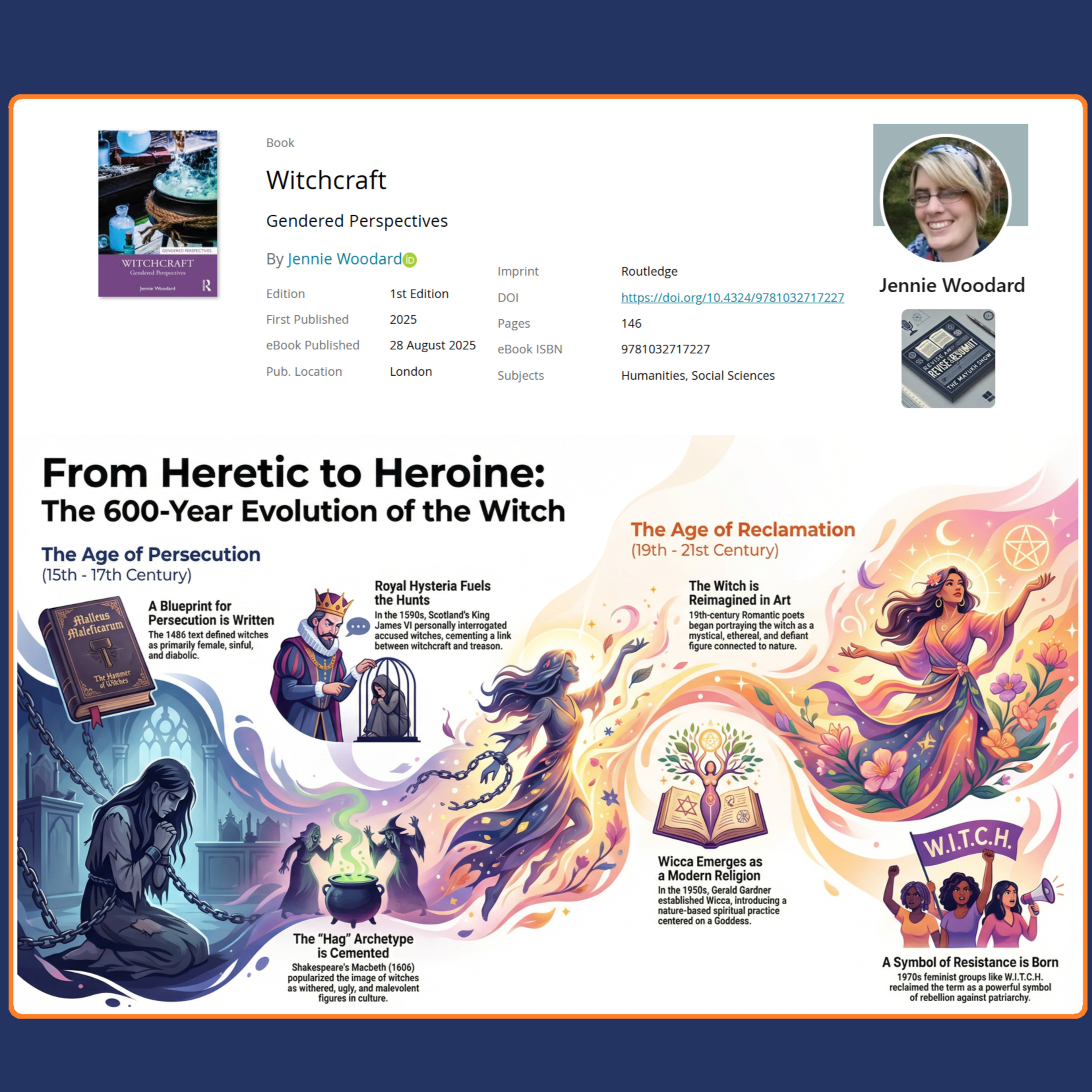
Witchcraft: Gendered Perspectives (Woodard 2025) - Weekend Book Review
Description
English Podcast starts at 00:00:00
Bengali Podcast Starts at 00:18:55
Hindi Podcast Starts at 00:34:53
Danish Podcast Starts at 00:47:58
Reference
Woodard, J. (2025). Witchcraft: Gendered Perspectives. Routledge. https://doi.org/10.4324/9781032717227
Youtube channel link
https://www.youtube.com/@weekendresearcher
Connect on linkedin
https://www.linkedin.com/in/mayukhpsm/
Welcome to Revise and Resubmit, and this is your episode, Weekend Book Review 📚✨.
Some words don’t just describe people. They assign them. They corner them. They turn a living, breathing person into a label that can be feared, mocked, punished, or sold back to you as a costume.
“Witch” is one of those words.
This weekend, I’m spending time with Witchcraft: Gendered Perspectives by Jennie Woodard, published by Routledge on 28 August 2025. Woodard is an Assistant Professor of History and Women, Gender and Sexuality Studies at the University of Maine at Augusta, and you can feel that dual training on every page: she writes like someone who knows the archive is full of bodies, and the syllabus is full of questions 🔍🕯️.
What grabbed me first is the book’s long memory. It begins in the cold machinery of Malleus Maleficarum, where misogyny gets stamped into something like “expertise,” and where witchcraft is framed as a specifically female crime. Then it moves through centuries where the “witch” keeps getting rewritten: in Scotland, England, and America’s trials; in poems and novels and screens; in the twentieth-century rise of Wicca through figures like Gerald Gardner; and later, in feminism’s complicated adoption of the witch as symbol and warning sign 🔥📖.
But the real pulse of this book is how it follows the witch into our present tense. Into the movies and television shows where she stands for the fear of being “other.” Into the online world, where TikTok and social platforms turn witchcraft into something simultaneously intimate and public, aesthetic and political, playful and serious. Woodard stays attentive to how reclamation works when it’s intersectional, when it carries social justice, ancestry, resistance to capitalist productivity, and a desire for spiritual autonomy 🌙📱.
In other words, this is not only a history of witchcraft. It’s a history of what happens when society decides certain women are too much, too strange, too loud, too knowing. And what happens when those women decide to keep the word anyway.
Before we begin, thank you to Jennie Woodard and Routledge for the work and the publication 🙏🏽📚.
If you enjoy Weekend Book Review, please subscribe to the podcast on Spotify, and subscribe to the YouTube channel Weekend Researcher 🎧▶️. You can also find this show on Amazon Prime Music and Apple Podcast 📲🎙️.
Now tell me, as we walk from the trial records to the timelines: when a culture calls someone a “witch,” what is it really afraid of, and what is that person still allowed to become?