Episode Details
Back to Episodes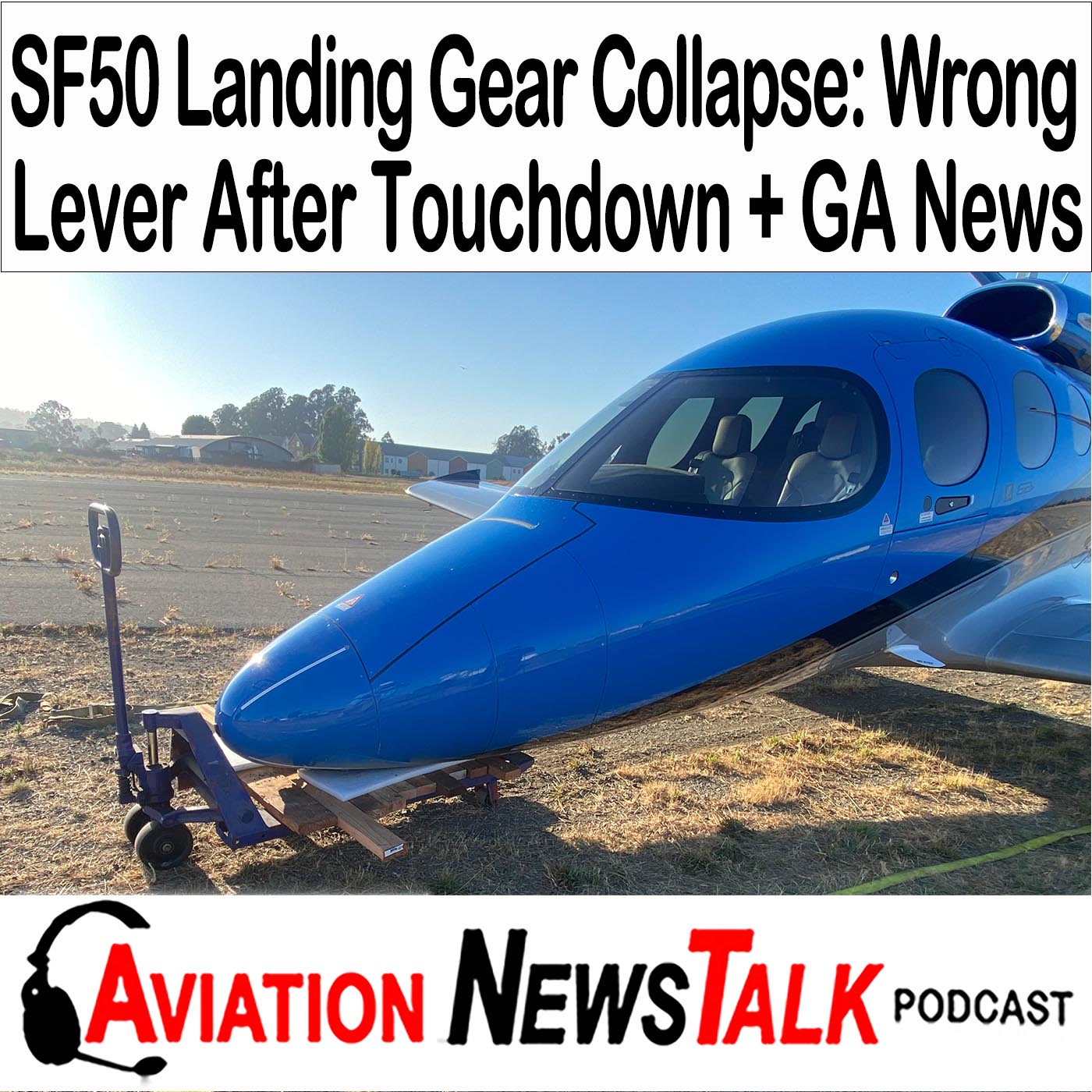
Vision Jet SF50 Landing Gear Collapse: Wrong Lever After Touchdown +GA News
Description
Max talks with Rob Mark about a classic "simple mistake with big consequences" scenario: a pilot who possibly raised the landing gear handle instead of selecting flaps up during the landing roll in a Cirrus Vision Jet. The event looks minor on the surface—no injuries and the airplane stayed on the runway—but it exposes a human-factors trap that can bite any retractable-gear pilot, especially when you're trying to be quick and efficient right after touchdown.
The discussion centers on the NTSB's final report for a Cirrus SF50 Vision Jet that landed at Watsonville Municipal Airport (Watsonville, California) on August 9, 2024. The pilot reported a normal approach and landing. Before touchdown, he had the flaps set to 100% and saw three green landing gear indications. Touchdown itself was uneventful. But during the landing roll—right about when braking began—the nose landing gear collapsed.
Max and Rob walk through what the data showed. On short final, the airplane was properly configured: flaps at 100% and the landing gear down and locked. During rollout, both weight-on-wheels switches were briefly "unloaded," and the landing gear handle was raised and then lowered. That sequence unlocked the nose gear and allowed it to collapse. The main gear also unlocked, but it re-locked before collapsing. The probable cause boiled down to an inadvertent control selection: the pilot likely moved the gear handle instead of selecting the flap switch to 0%.
From there, they unpack why this kind of error is so believable. The flap selector switch sits below the landing gear handle, and many pilots develop a post-touchdown habit of "cleaning up" quickly. Some of that comes from short-field technique: retracting flaps can put more weight on the wheels, increase braking effectiveness, and reduce stopping distance. But the exact moment you're tempted to do it is also the moment you have the least spare attention. You're still fast, directional control still matters, braking is being modulated, and you're managing the transition from flight to rollout. Add fatigue, distraction, or a slightly different cockpit flow than usual, and a wrong-control grab becomes completely plausible.
A big takeaway is that landing isn't over at touchdown. Many pilots subconsciously relax as soon as the mains touch, as if the hard part is done. In reality, the landing roll is when you still have a lot of kinetic energy and limited margin for distraction. Looking down, changing configuration, or reaching for cockpit controls before you're stabilized is how small errors turn into big repair bills. Max and Rob emphasize that "post-landing tasks" are optional until the airplane is clearly under control and slowing.
So what should pilots do differently? Their answer is intentionally boring: slow the flow down. On most runways there is no operational need to rush flap retraction during rollout. Keep your eyes outside, keep the airplane tracking straight, and let speed decay. If you choose to retract flaps on rollout, treat it like a checklist item, not a reflex. Touch the correct control deliberately, verify what you're touching, and use a short verbal callout ("flaps zero") before you move it. Better yet, tie configuration changes to safer triggers—below taxi speed, after exiting the runway, or after stopping and running the after-landing checklist—so you're not doing "extra tasks" while still managing high speed and directional control.
They also discuss building habits that are resistant to error. If your technique is "as soon as I touch down, I do X," you're training your hands to move before your brain has finished verifying the right target. Replace that with a pause that forces confirmation, or a flow that keeps critical controls physically and mentally