Episode Details
Back to Episodes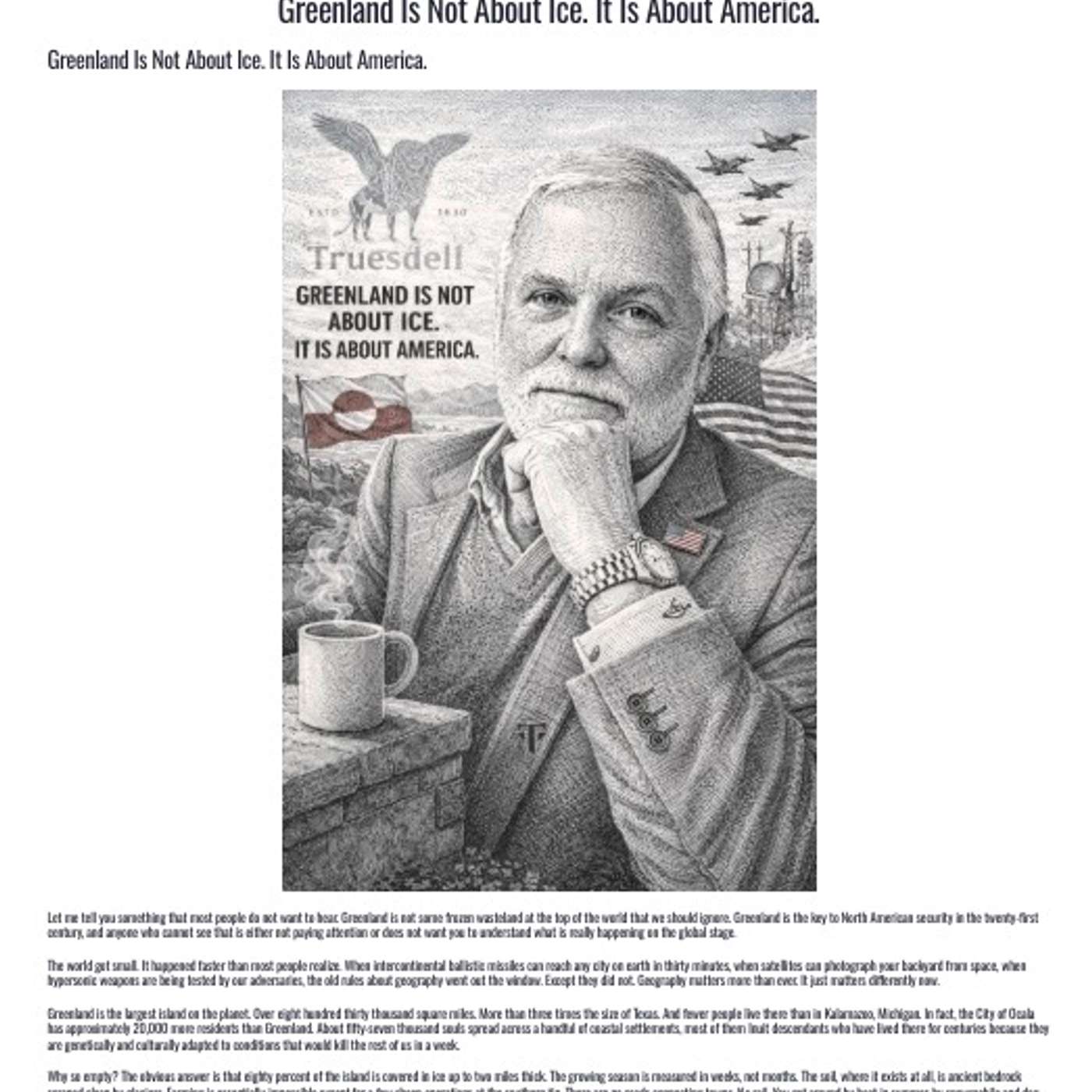
Greenland Is Not About Ice. It Is About America.
Description
Greenland Is Not About Ice. It Is About America.
Let me tell you something that most people do not want to hear. Greenland is not some frozen wasteland at the top of the world that we should ignore. Greenland is the key to North American security in the twenty-first century, and anyone who cannot see that is either not paying attention or does not want you to understand what is really happening on the global stage.
The world got small. It happened faster than most people realize. When intercontinental ballistic missiles can reach any city on earth in thirty minutes, when satellites can photograph your backyard from space, when hypersonic weapons are being tested by our adversaries, the old rules about geography went out the window. Except they did not. Geography matters more than ever. It just matters differently now.
Greenland is the largest island on the planet. Over eight hundred thirty thousand square miles. More than three times the size of Texas. And fewer people live there than in Kalamazoo, Michigan. In fact, the City of Ocala has approximately 20,000 more residents than Greenland. About fifty-seven thousand souls spread across a handful of coastal settlements, most of them Inuit descendants who have lived there for centuries because they are genetically and culturally adapted to conditions that would kill the rest of us in a week.
Why so empty? The obvious answer is that eighty percent of the island is covered in ice up to two miles thick. The growing season is measured in weeks, not months. The soil, where it exists at all, is ancient bedrock scraped clean by glaciers. Farming is essentially impossible except for a few sheep operations at the southern tip. There are no roads connecting towns. No rail. You get around by boat in summer, by snowmobile and dog sled in winter, and by helicopter or small plane year-round if you can afford it and the weather cooperates. Which it often does not.
The Vikings tried to settle Greenland a thousand years ago during a warm period when the southern coast actually looked somewhat green. Erik the Red named it Greenland as a marketing pitch to convince Icelanders to join him. They showed up, tried to farm, watched the climate turn brutal, and disappeared within a few centuries. And by the way, the Greenland climate switcheroo, was not due to Erik the Red or anything related to the endeavors of Vikings, not matter what Al Gore has to say. And so, the Inuits, the indigenous Arctic and Subarctic residents stayed because they knew how to hunt seals through breathing holes in the ice, how to build kayaks to navigate between ice floes, how to make clothing from caribou hide that actually kept the cold out. And so, the Norse, well they were farmers in a land where farming does not work. They lost.
But here is what matters now. Greenland sits between North America and Europe at the top of the North Atlantic. It is positioned directly in the path of the shortest flight routes between the continental United States and Russia. During the Cold War, we understood this perfectly. We built Thule Air Base in northwest Greenland in 1951. Today it is called Pituffik Space Base, (pronounced bee-doo-FEEK) and understanding what happens there tells you everything you need to know about why Greenland matters.
Pituffik Space Base is not some relic from the Cold War collecting dust. It is one of the most strategically critical military installations in the entire northern hemisphere. The base hosts the northernmost deep-water port in the United States military system. It operates sophisticated ballistic missile early warning radar systems that would detect any intercontinental ballistic missile launch from Russia or anywhere else coming over the polar route toward North America. That radar gives us precious minutes of warning time. In a nuclear exchange, minutes are the difference b