Episode Details
Back to Episodes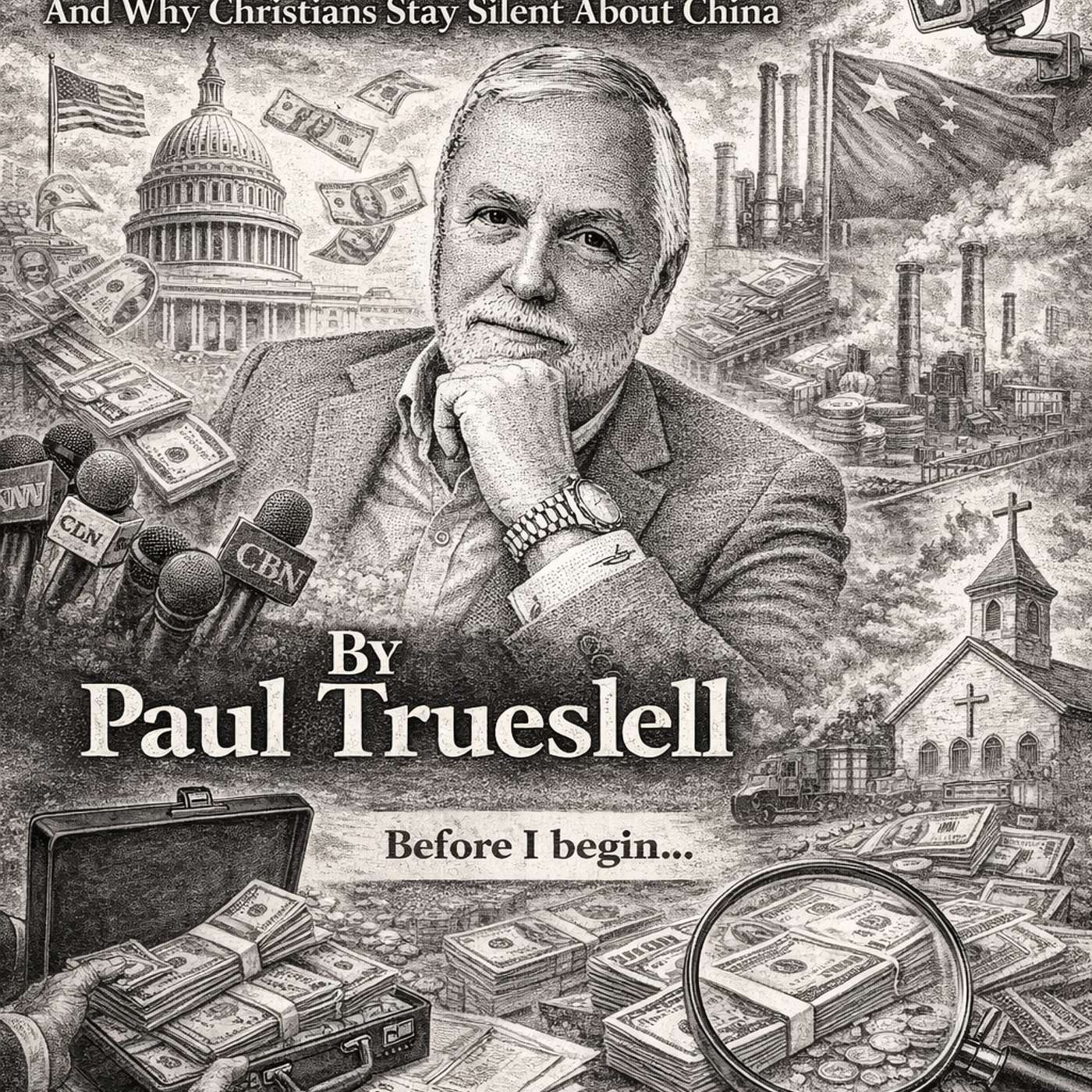
Follow the Money
Description
Follow the Money
Where Campaign Cash Really Comes From, Who Benefits from Climate Policy, and Why Christians Stay Silent About China
By Paul Truesdell
Before I begin…
Why I Do Long-Form: A Four-Minute Explanation
You know what’s funny? Every marketing guru out there tells me I’m doing it all wrong. “Paul, you need to be on TikTok. You need fifteen-second clips. You need memes. You need to hook ‘em in three seconds or they’re gone.”
And I say: Good. Let ’em go.
Here’s the thing about those short-form videos—the TikToks, the Reels, the quick-hit content. They’re designed for instant gratification. Quick dopamine hits. Scroll, laugh, scroll, react, scroll. The average user burns through two hundred videos in thirty minutes. Half of viewers bail within three seconds if they’re not immediately entertained.
That’s not a bug in the system. That’s the feature.
And it works beautifully—for a certain kind of audience. The “entertain me” crowd. The “what have you done for me lately” folks. The meme-based, short-attention-span consumer who wants answers without questions and solutions without understanding.
That’s not my type of prospect or client.
Let me tell you who I’m looking for. I work with people who are fifty-five and older, often within five years of retirement or already there. These are folks who’ve spent decades building something—careers, families, wealth, wisdom. They didn’t get there by scrolling through thirty-second clips. They got there by thinking things through. By asking hard questions. By sitting with complexity.
Long-form podcasting is my filter.
When I do a two-hour episode, I’m not trying to compete with TikTok. I’m doing the opposite. I’m saying: If you’ve got the patience to listen to this, if you’re intellectually curious enough to follow a conversation that unfolds over time, if you actually enjoy thinking deeply about money, about retirement, about how to spend the next chapter of your life—then you might be my kind of person.
The research backs this up. Long-form podcast listeners are different. They score high on what psychologists call “openness to experience”—intellectual curiosity, comfort with complex ideas, appreciation for nuance. They have what’s called a “high need for cognition”—they genuinely enjoy thinking. They’re not stressed out by three-hour conversations; they’re energized by them.
These are the people who say, “I really want to dig into this and understand it fully.” Not “just give me the bullet points.”
And here’s the beautiful irony: the completion rates on long-form podcasts are extraordinary. Seventy to ninety percent of listeners finish episodes. Even those marathon three-hour shows? Dedicated listeners stick around because the content rewards their attention.
Compare that to short-form, where you lose half your audience in three seconds.
Now, some would call that a failure. I call it efficiency.
When someone finds The Paul Truesdell Podcast and actually listens—really listens—to an episode or two, they’re self-selecting. They’re telling me something about who they are. They’re patient. They’re thoughtful. They want depth over speed. They’re not looking for entertainment; they’re looking for insight.
That’s exactly the kind of person I want to work with in my practice. Because when we sit down to talk about retirement planning, about protecting what they’ve built, about making decisions that will affect the rest of their lives—I need someone who can handle a real conversation. Not a soundbite.
The “entertain me” client? They’ll fire you the moment the market dips. The “what have you done for me lately” client? They’re always chasing the next shiny thing. But the intellectually engaged client—the one who found you through a long-form podcast and thought, “This guy thinks like I do”—that’s a relationship built on substance.
So no, I’m not going to dance on