Episode Details
Back to Episodes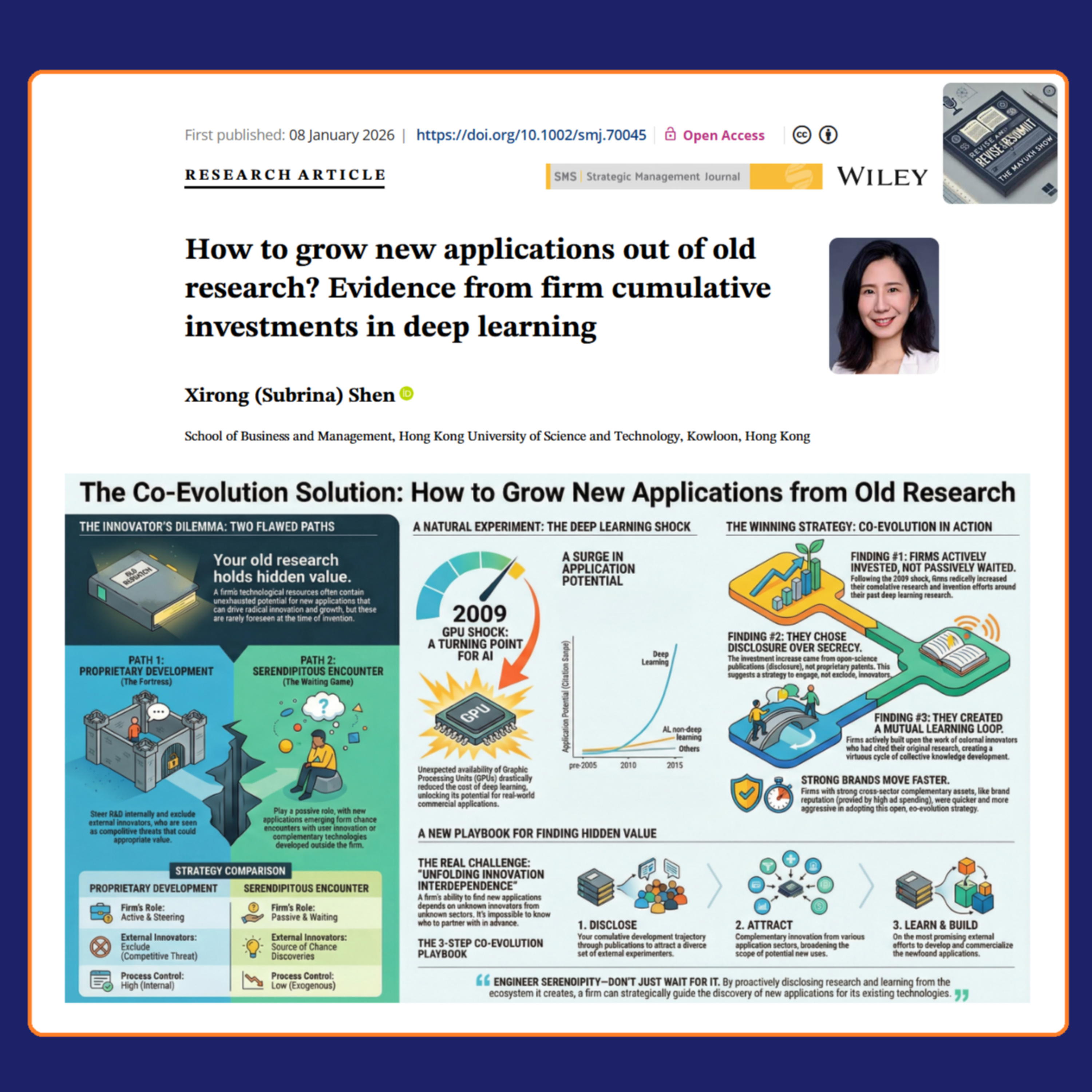
How to grow new applications out of old research? (Shen 2026) | FT50 SMJ
Description
English Podcast starts at 00:00:00
Bengali Podcast starts at 00:13:21
Hindi Podcast starts at 00:30:49
Danish Podcast starts at 00:44:57
Reference
Shen, X. (S.) (2026). How to grow new applications out of old research? Evidence from firm cumulative investments in deep learning. Strategic Management Journal, 1–35. https://doi.org/10.1002/smj.70045
Youtube Channel
https://www.youtube.com/@weekendresearcher
Connect over linkedin
https://www.linkedin.com/in/mayukhpsm/
Welcome to Revise and Resubmit 🎙️📚, the show where serious research meets real life, and where an academic paper is never just a paper. It is a breadcrumb trail. It is a confession of what we used to believe. It is a map of what we are about to build.
There is a particular kind of suspense that only innovators know. You spend years investing in something that does not yet have a name in the market. It is not a product. It is not a feature. It is a quiet, expensive conviction sitting in a lab, sitting in code, sitting in a folder called “promising” that nobody opens during budget season.
And then, one day, the world changes. Not politely. Not gradually. It changes like a light turning on.
Today’s episode sits right inside that moment of transformation, with a fascinating new study titled How to grow new applications out of old research? Evidence from firm cumulative investments in deep learning by Xirong (Subrina) Shen, published online on 08 January 2026 in the Strategic Management Journal 🏛️✨, a truly prestigious outlet and proudly part of the FT50 journal list.
This paper asks a question that feels almost personal if you have ever worked on anything uncertain. When a technology has potential for many applications, how do firms actually discover which applications are real, which are hype, and which are hiding in plain sight?
Using deep learning as the arena, the research points to a turning point that made the future suddenly affordable: the 2009 rise of GPU computing ⚡🧠. The results suggest firms did something surprisingly bold when signals of application potential went up. They did not just go inward and lock everything down. They leaned into a disclose-and-learn strategy 🔓📈: sharing cumulative development paths, inviting outside innovators into the story, watching what those outsiders built, and then learning how to co-evolve with that external ecosystem.
It is almost like the firms stopped asking, “How do we protect the treasure?” and started asking, “What if the treasure multiplies when other people touch it?” 🧪🌍
Before we dive in, a quick favor: if you enjoy episodes where research feels alive, subscribe to Revise and Resubmit on Spotify 🎧, and also catch us on YouTube at Weekend Researcher 📺. You can also listen on Amazon Prime and Apple Podcast 🍎🔥, because good ideas should travel.
And with gratitude, we thank the author Xirong (Subrina) Shen and the publisher John Wiley & Sons Ltd. 🙏📄 for making this contribution available through Strategic Management Journal.
Now here is the question I cannot stop thinking about: if the next breakthrough application of today’s “old research” will be discovered not just inside firms but out in the wild among external innovators, what should companies learn to reveal, and what should they learn to hold back? 🤔🔍