Episode Details
Back to Episodes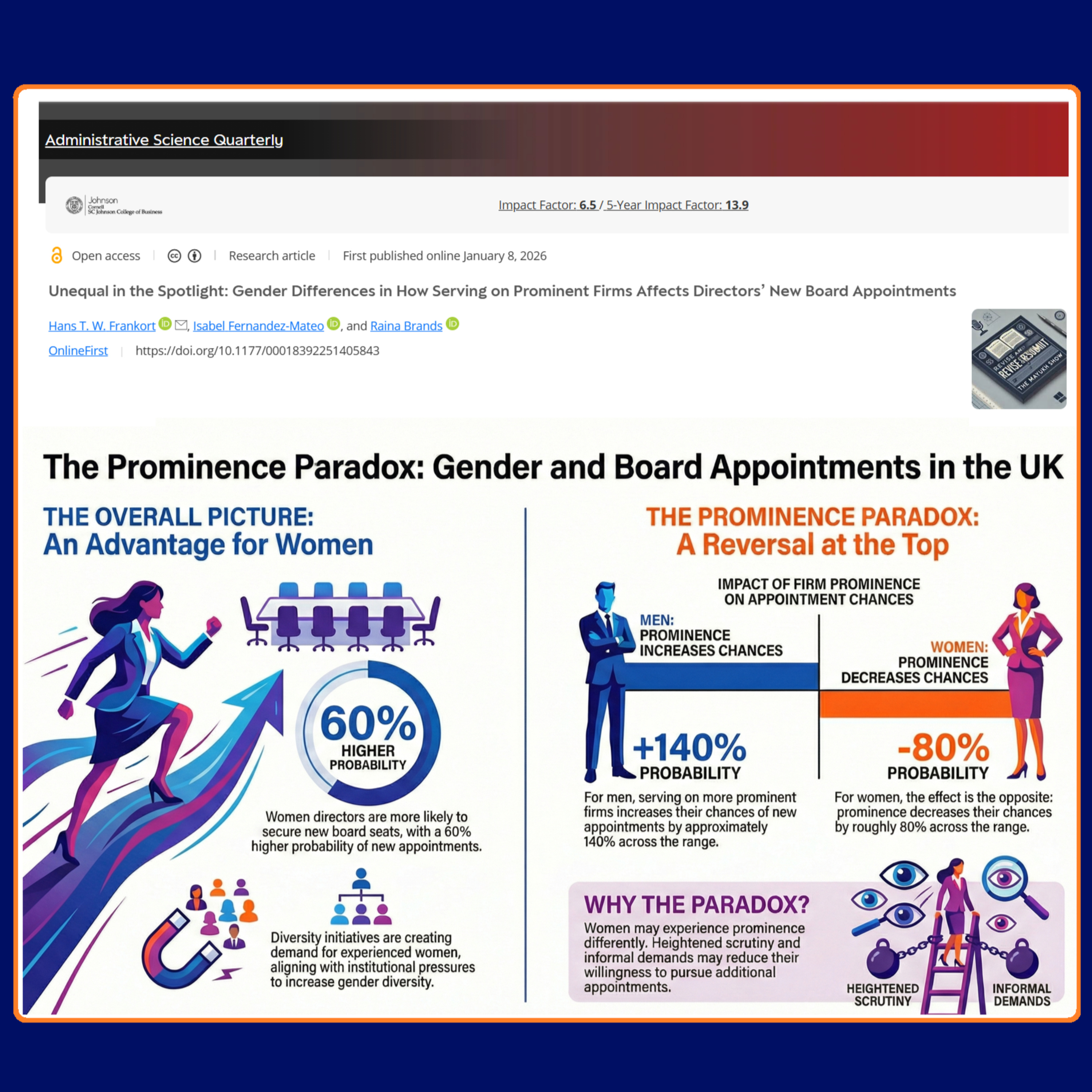
Unequal in the Spotlight (Frankort et al 2026) | FT50 ASQ
Description
English Podcast starts at 00:00:00
Bengali Podcast starts at 00:14:23
Hindi Podcast starts at 00:30:25
Danish Podcast starts at 00:46:17
Reference
Frankort, H. T. W., Fernandez-Mateo, I., & Brands, R. (2026). Unequal in the Spotlight: Gender Differences in How Serving on Prominent Firms Affects Directors’ New Board Appointments. Administrative Science Quarterly, 0(0). https://doi.org/10.1177/00018392251405843
Youtube Channel
https://www.youtube.com/@weekendresearcher
Connect over linkedin
https://www.linkedin.com/in/mayukhpsm/
🎙️ Welcome to Revise and Resubmit.
There is a particular kind of light that follows power. Not the warm kind. The bright kind. The kind that makes everything visible, including the parts of you that were never asked to be on display. In boardrooms, that light has a name: prominence. And prominence, as it turns out, does not shine on everyone the same way.
Today we step into the upper tier of corporate life, where reputations compound like interest and invitations arrive like confirmations of worth. The paper we’re unpacking is titled Unequal in the Spotlight: Gender Differences in How Serving on Prominent Firms Affects Directors’ New Board Appointments by Hans T. W. Frankort, Isabel Fernandez-Mateo, and Raina Brands, published online on 08 January 2026 in Administrative Science Quarterly, one of the most prestigious journals in management research, and proudly part of the FT50 list. 🏛️📚✨
Here is the story the data tells, and it reads like a twist you wish weren’t true. In the FTSE-100 universe from 2010 to 2017, women directors, on average, are more likely than men to land new board appointments, which fits the familiar narrative of diversity pressure creating demand. ✅👩💼📈
But then the spotlight intensifies.
As the board becomes more prominent, men benefit. Their likelihood of getting additional appointments rises, as if status turns into a louder signal and the market leans in to listen. 📣👔🚀
For women, the same prominence works differently. It starts to erode that advantage, then flips it. The more prominent the board, the less likely women are to receive or pursue another seat. Not because the usual explanations neatly account for it. The authors test demand-side stories, supply-side stories, the classic repertoire of “maybe it’s time constraints” or “maybe it’s signaling.” And still, the pattern holds.
So they offer a more unsettling possibility: that on the most prominent boards, women face greater scrutiny and heavier informal demands, the kind that do not show up in a calendar invite but still take up space in a life. 🔍⏳🎭
This episode is about that dual edge of prestige, opportunity on one side, constraint on the other. It is about what happens when you “make it” and the cost of being seen becomes part of the job description. 🎯
If you love research that changes how you see the world, subscribe to Revise and Resubmit on Spotify, and follow us on YouTube at Weekend Researcher. 🎧📺 Also, you can listen on Amazon Prime and Apple Podcast. 🍎📻
And before we begin, a sincere thank you to the authors, Hans T. W. Frankort, Isabel Fernandez-Mateo, and Raina Brands, and to SAGE Publications for publishing this work in Administrative Science Quarterly.
Now let me ask you this: when prestige turns the spotlight brighter, does it amplify your freedom, or does it quietly start writing rules for how you are allowed to exist in the room? 🤔✨