Episode Details
Back to Episodes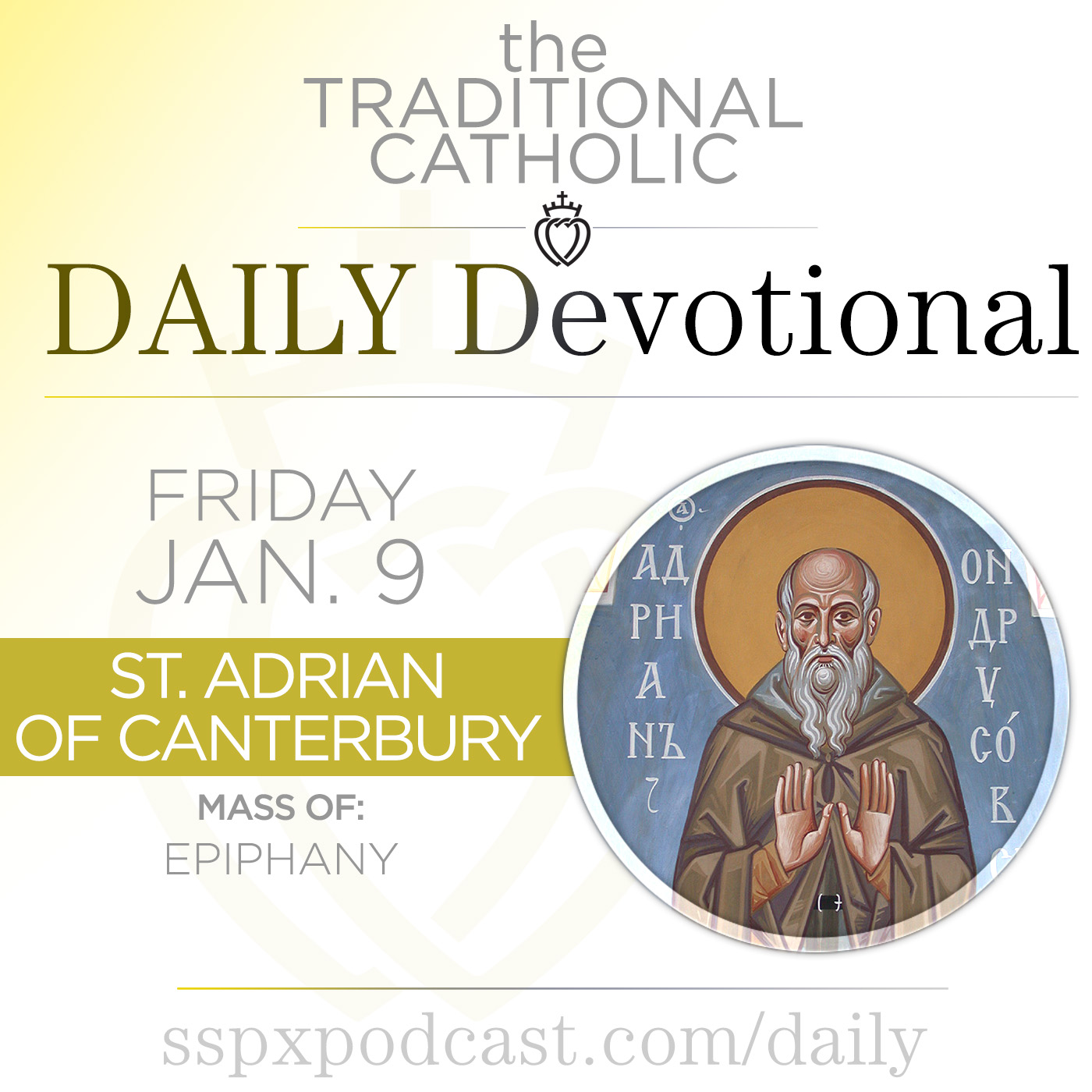
Jan 9 – Feria / S Adrian of Canterbury
Description
It’s the Feast of Feria after Epiphany, 4th Class, with the color of White. In this episode: the meditation: “The Adoration of the Magi”, today’s news from the Church: “A Year of Transition for the College of Cardinals”, a preview of this week’s episode of The Catholic Mass #33: “St. John Chrysostom on Marriage: As Christ Loved the Church”, and today’s thought from the Archbishop.
Have feedback or questions about the DD or our other shows? podcast@sspx.orgSources Used Today:
- “The Adoration of the Magi” – From Advent to Epiphany
- “A Year of Transition for the College of Cardinals” (FSSPX.news)
- “St. John Chrysostom on Marriage: As Christ Loved the Church” (SSPX Podcast)
- View on YouTube
- Listen & Subscribe on SSPXpodcast.com
- The Spiritual Life – Archbishop Lefebvre (Angelus Press)
Saint Adrian of Canterbury was one of the great hidden architects of Christian England, a scholar whose influence shaped generations without ever placing him at the center of attention. Born in North Africa in the early seventh century, Adrian was deeply formed by the classical and Christian learning of the Mediterranean world. He became abbot of a monastery near Naples, where his reputation for wisdom, discipline, and learning grew quietly. He was fluent in Greek and Latin, well versed in Scripture, theology, and the liberal arts, and known for his balanced judgment.
When Pope Vitalian sought to appoint a new Archbishop of Canterbury in 668, Adrian was his first choice. Adrian declined, believing another was better suited for the role, and instead recommended Theodore of Tarsus. Yet the pope insisted that Adrian accompany Theodore to England as his close collaborator. That decision proved decisive for the future of the English Church. When they arrived in Canterbury, Adrian became abbot of the monastery of Saint Peter and Saint Paul, later known as Saint Augustine’s Abbey, and turned it into one of the greatest centers of learning in Western Europe.
Adrian’s real gift was teaching. Bede tells us that students came from across England to study under him, learning Scripture, poetry, astronomy, computation of the calendar, and the interpretation of sacred texts. Under Adrian’s guidance, the English Church absorbed not only Roman discipline, but the richness of Greek Chri