Episode Details
Back to Episodes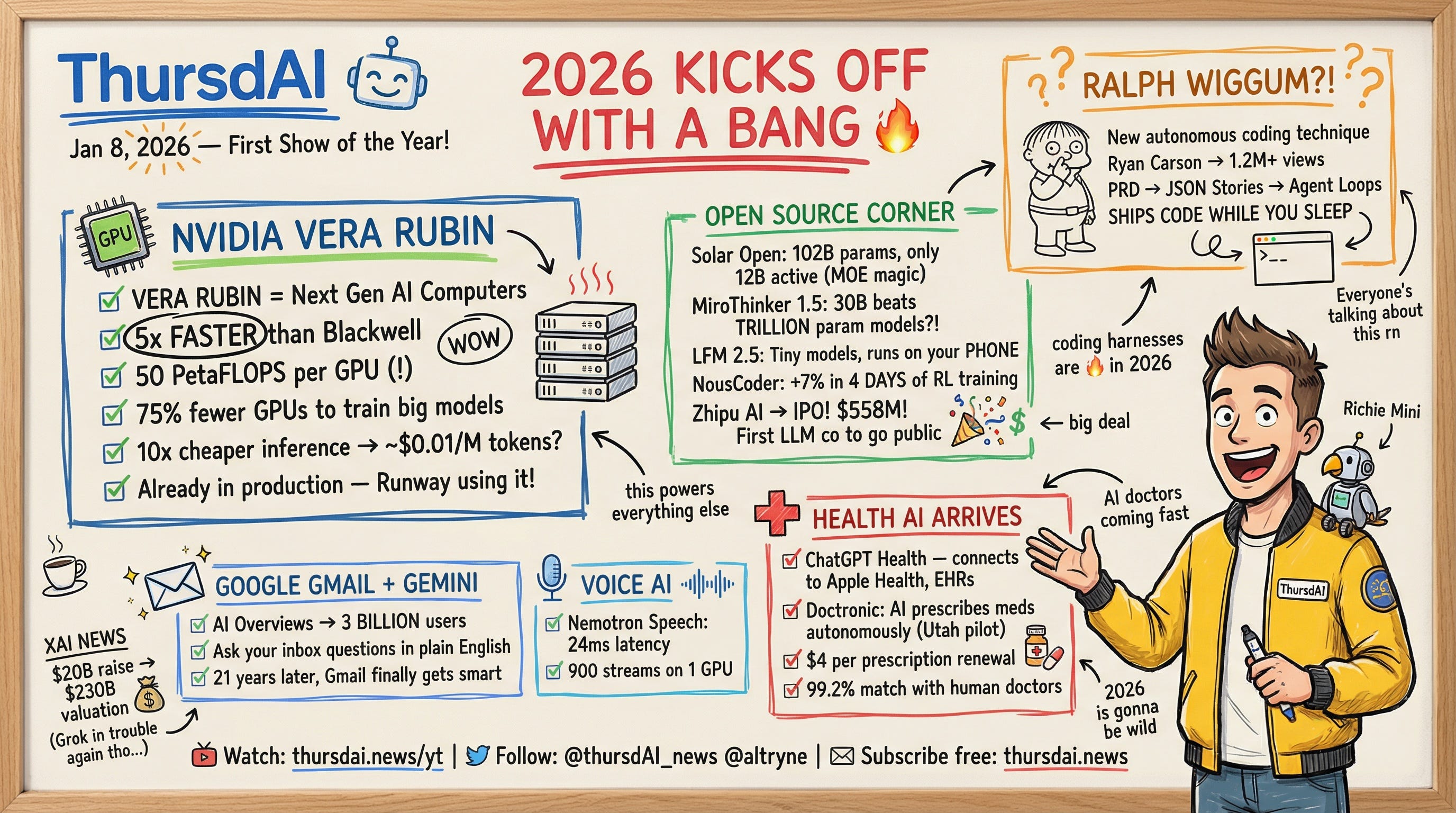
ThursdAI - Jan 8 - Vera Rubin's 5x Jump, Ralph Wiggum Goes Viral, GPT Health Launches & XAI Raises $20B Mid-Controversy
Description
Hey folks, Alex here from Weights & Biases, with your weekly AI update (and a first live show of this year!)
For the first time, we had a co-host of the show also be a guest on the show, Ryan Carson (from Amp) went supernova viral this week with an X article (1.5M views) about Ralph Wiggum (yeah, from Simpsons) and he broke down that agentic coding technique at the end of the show.
LDJ and Nisten helped cover NVIDIA’s incredible announcements during CES with their Vera Rubin upcoming platform (4-5X improvements) and we all got excited about AI medicine with ChatGPT going into Health officially!
Plus, a bunch of Open Source news, let’s get into this:
ThursdAI - Recaps of the most high signal AI weekly spaces is a reader-supported publication. To receive new posts and support my work, consider becoming a free or paid subscriber.
Open Source: The “Small” Models Are Winning
We often talk about the massive frontier models, but this week, Open Source came largely from unexpected places and focused on efficiency, agents, and specific domains.
Solar Open 100B: A Data Masterclass
Upstage released Solar Open 100B, and it’s a beast. It’s a 102B parameter Mixture-of-Experts (MoE) model, but thanks to MoE magic, it only uses about 12B active parameters during inference. This means it punches incredibly high but runs fast.
What I really appreciated here wasn’t just the weights, but the transparency. They released a technical report detailing their “Data Factory” approach. They trained on nearly 20 trillion tokens, with a huge chunk being synthetic. They also used a dynamic curriculum that adjusted the difficulty and the ratio of synthetic data as training progressed. This transparency is what pushes the whole open source community forward.
Technically, it hits 88.2 on MMLU and competes with top-tier models, especially in Korean language tasks. You can grab it on Hugging Face.
MiroThinker 1.5: The DeepSeek Moment for Agents?
We also saw MiroThinker 1.5, a 30B parameter model that is challenging the notion that you need massive scale to be smart. It uses something they call “Interactive Scaling.”
Wolfram broke this down for us: this agent forms hypotheses, searches for evidence, and then iteratively revises its answers in a time-sensitive sandbox. It effectively “thinks” before answering. The result? It beats trillion-parameter models on search benchmarks like BrowseComp. It’s significantly cheaper to run, too. This feels like the year where smaller models + clever harnesses (harnesses are the software wrapping the model) will outperform raw scale.
Liquid AI LFM 2.5: Running on Toasters (Almost)
We love Liquid AI and they are great friends of the show. They announced LFM 2.5 at CES with AMD, and these are tiny ~1B parameter models designed to run on-device. We’re talking about running capable AI on your laptop, your phone, or edge devices (or the Reachy Mini bot that I showed off during the show! I gotta try and run LFM on him!)
Probably the coolest part is the audio model. Usually, talking to an AI involves a pipeline: Speech-to-Text (ASR) -> LLM -> Text-to-Speech (TTS). Liquid’s model is end-to-end. It hears audio and speaks audio directly. We watched a demo from Maxime Labonne where the model was doing real-time interaction, interleaving text and audio. It’s incredibly fast and efficient. While it might not write a symphony for you, for on-device tasks like summarization or quick interactions, this is the future.
NousCoder-14B and Zhipu AI IPO
A quick shoutout to our friends at Nous Research who released NousCoder-14B, an open-source competitive programming model that achieved a 7% jump on LiveCodeBench accuracy in just four days of RL training on 48 NVIDIA B200 GPUs. The model was trained on 24,000 verifiable problems, and the lead researcher