Episode Details
Back to Episodes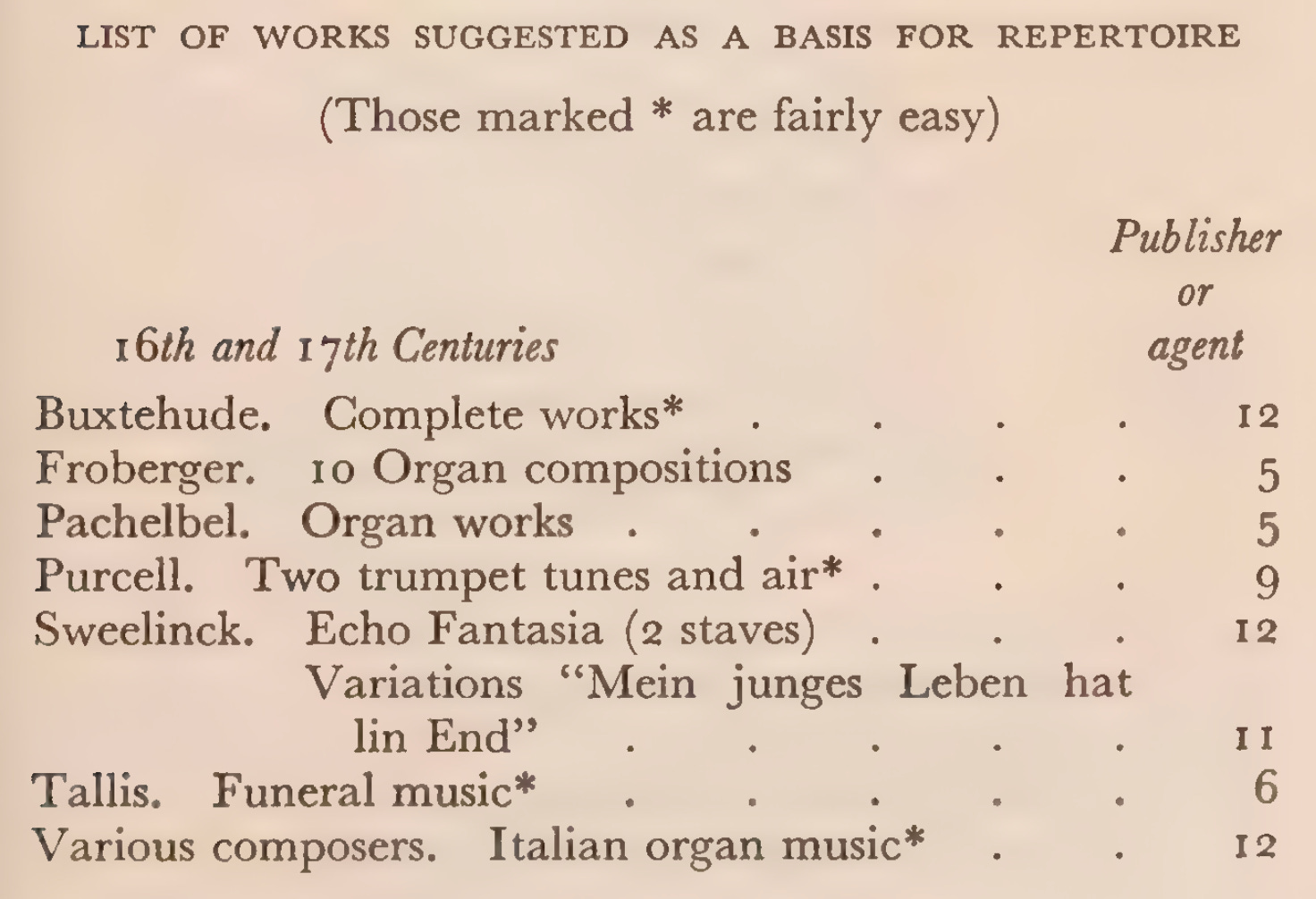
118: How to Practice! (+ Advice for Teens)
Description
Update: Just got five promo codes to download Time Guru (the cool metronome app mentioned in the episode.) Send me a message or let me know down below you’re interested and I’ll share the codes! Happy Practicing
Let’s get our good new habits in early in the year! In this episode, I read practical advice from three organists/organ method books. The organ method books are in a class of their own— highly entertaining reading.
We begin with Francis Routh’s Teach Yourself The Organ (1958.) His asterisk marking the complete works of Buxtehude as ‘fairly easy’ is representative of this amusing book:
Harold Gleason’s method book of 1962 makes up the bulk of this episode, the complete advice is pasted below.
We feature some of Fayth Freese’s excellent article from The Diapason. I recommend the full read.
And here is the advice to teens I made for the Harrison School for the Arts in Lakeland Florida. I cannot emphasize enough how music should be a joyous process at this age, never an abusive one.
From Gleason (bold type is my emphasis)
HOW TO PRACTICE:
* Make a schedule for daily practice. Devote a definite amount of time to technique, to new music, to perfecting music already studied, and to memorizing. Devote at least one hour a day to piano practice. Later the student will need to reserve time for perfecting the many skills required for playing the church service.
* Practice as if the piece were being memorized (see the section on Memorizing).
* Study the music before beginning to practice. Note the key signature, time signature, note values, fingering, pedaling, structure, special problems, and general style. If the fingering and pedaling is not given or is inadequate, it should be carefully worked out according to the principles given in the sections on Fingering and Pedaling.
* Memorize and always use the same fingering and pedaling. Incorporate the articulation, phrasing and interpretation into the practice.
* Try to avoid playing wrong notes or incorrect time values from the first time an exercise or piece is practiced. If a wrong note or rhythm is played, do not immediately correct it. Go back to the beginning of the phrase and repeat the passage correctly a number of times.
* Concentrate on the work at hand and avoid mechanical, unthinking practice and repetition. Always practice after a lesson.
* Practice slowly in the following sequence: right hand; left hand; both hands; pedal; right hand and pedal; left hand and pedal; both hands and pedal. Begin the slow practice of short sections for both hands and pedal while working on separate parts.
* When the phrases and sections of a composition have been mastered at a low tempo, play it all the way through. When this has been accomplished with complete muscular control and accuracy, the tempo may be gradually increased. Return to slow, detailed practice of sections which are not secure, and repeat this process at succeeding practice periods.
* Always practice at a steady tempo. Do not play easy places fast and difficult places slowly.
* Devote the most attention to difficult passages.
* In contrapuntal music, play one or more parts and sing another part.
* In passages of a technical nature, the practice of four-note groups in the various rhythmic patterns is h