Episode Details
Back to Episodes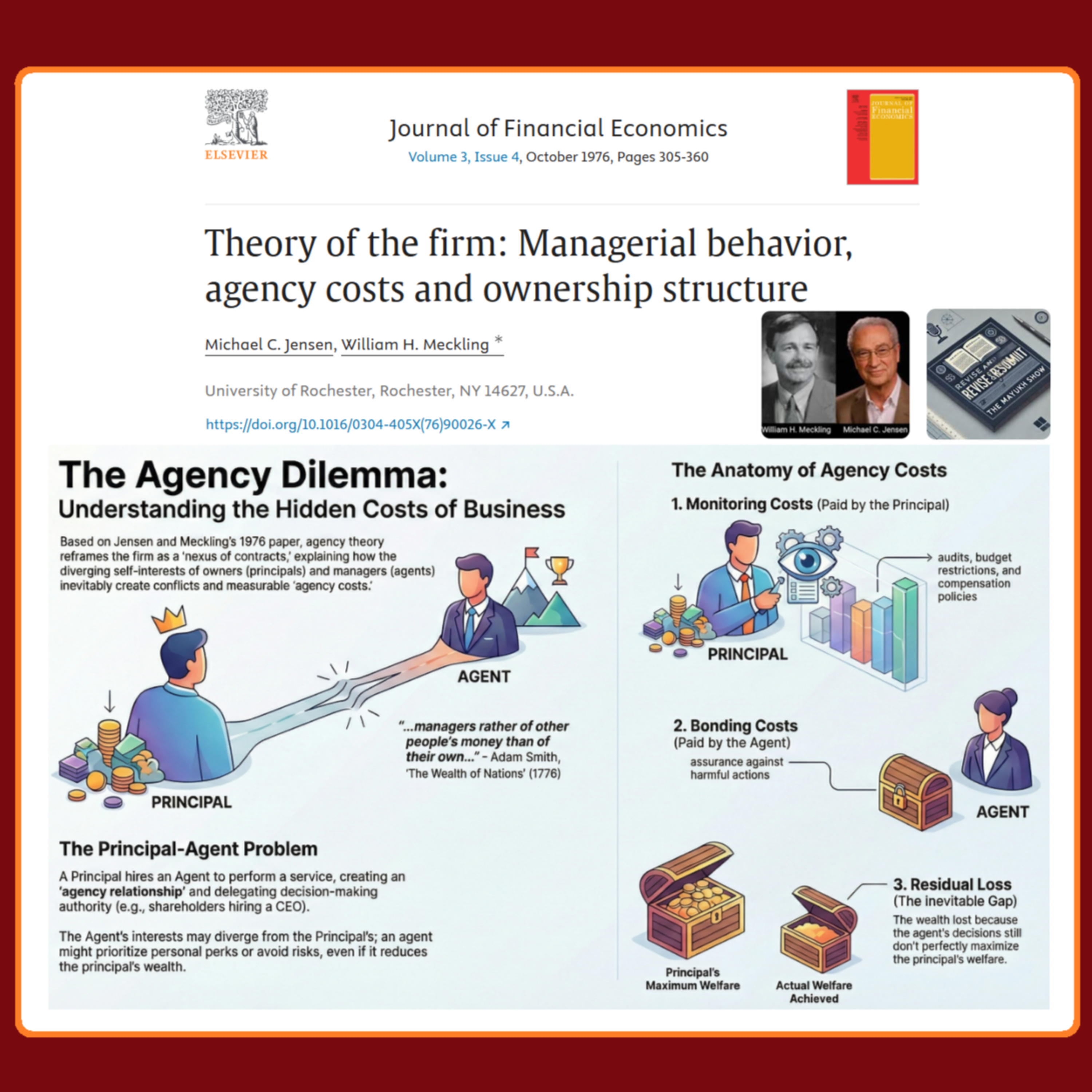
Theory of the firm (Jensen & Meckling, 1976) - Weekend Classics
Description
English Podcast starts at 00:00:00
Bengali Podcast Starts at 00:14:27
Hindi Podcast Starts at 00:30:15
Danish Podcast Starts at 00:45:21
Reference
Jensen, M. C., & Meckling, W. H. (1976). Theory of the firm: Managerial behavior, agency costs and ownership structure. Journal of Financial Economics, 3(4), 305–360. https://doi.org/10.1016/0304-405X(76)90026-X
Youtube channel link
https://www.youtube.com/@weekendresearcher
Connect on linkedin
https://www.linkedin.com/in/mayukhpsm/
🎙️ Welcome to "Revise and Resubmit", and this is your Weekend Classics episode! 🌟
Today, I am ridiculously excited to dust off one of the true OGs of modern corporate finance and firm theory. We are traveling back to October 1976 📚, into the pages of the Journal of Financial Economics (yes, an FT50 big league journal), published by North Holland Publishing Company and now hosted by Elsevier.
The paper on our reading table today is:
👉 "Theory of the firm: Managerial behavior, agency costs and ownership structure"
✍️ By Michael C. Jensen and William H. Meckling
Now, let me slow this down.
Sometimes I speak in long, rolling sentences, like a lecture hall that never seems to empty.
Then I cut it short.
One beat.
Two beats.
Because somewhere between those beats sits the real question:
What actually is a firm? 🤔
Jensen and Meckling do not treat the firm as a black box. They treat it as a nexus of contracts 💼📜. In their world, every relationship is a deal, every deal has a cost, and every cost has a story. Agency costs. Monitoring costs. Bonding costs. And that subtle, sneaky loss that creeps in when managers and owners do not quite want the same thing.
Think of the classic problem Adam Smith warned us about:
People managing other people’s money rarely watch it the way they watch their own. They get a little comfortable. A little careless. Negligence and profusion begin to whisper through the corridors of the joint stock company.
Jensen and Meckling grab that old intuition and wire it into modern finance ⚡.
They show how debt and equity are not just funding choices, but incentive technologies. They ask:
Who really bears the cost when managers chase perks instead of profits?
Why would rational people still sign up for a world full of agency problems?
And how can this messy, conflict-ridden reality still be Pareto optimal in its own strange way?
In this episode of Weekend Classics, I want to walk with you through their bold move: redefining the firm, not as a building, not as a logo, but as a shifting web of contracts, discipline, temptation, and trade-offs. 🕸️
So as you listen, I want you to keep one question simmering in the back of your mind:
👉 If the firm is just a nexus of contracts, then where exactly does responsibility live when things go wrong – in the contract, in the manager, or in the owners who chose the structure in the first place? 🧩
A huge thank you to Michael C. Jensen, William H. Meckling, and the original publisher North Holland Publishing Company (now under Elsevier) for this iconic contribution to how we think about firms, finance, and power inside organizations. 🙏
If you enjoy these deep dives into classic research, please subscribe to this podcast on Spotify and follow our YouTube channel: Weekend Researcher 📺. You can also find Revise and Resubmit on Amazon Pri