Episode Details
Back to Episodes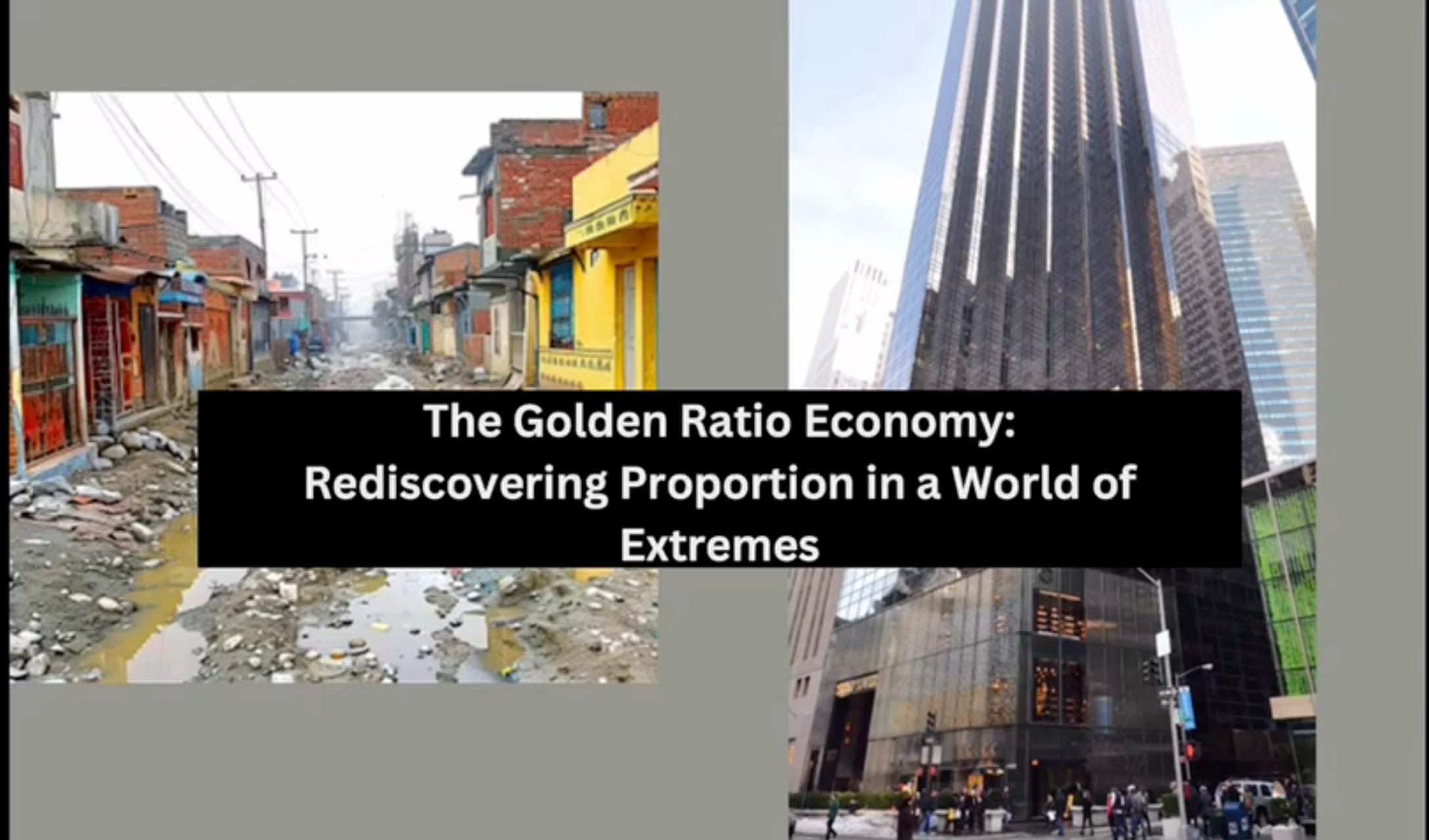
Donni Wang | The Golden Ratio Economy: Rediscovering Proportion in the World of Extremes
Description
The Golden Ratio Economy: Rediscovering Proportion in a World of Extremes
Look around.We live in a world of grotesque asymmetry, where towers of luxury rise beside deserts of deprivation—where high-end buildings stand shoulder to shoulder with impoverished slums. Take the United States as an example. Every year, the American food system produces far more than enough to feed its 330 million inhabitants, and yet over 13 million American children go to bed each night, not sure whether they will have enough to eat from one day to the next. At the very moment when these young lives most need care and protection, the first lesson they learn is poverty and fear.
In major cities, we see people sleeping on the streets—but this is not because there is a shortage of housing. On the contrary, the number of vacant homes outnumber the number of unhoused people by a ratio of 26 to 1. When we walk past those who have been displaced and battered by life, how do we look them in the eye, knowing that their suffering is entirely unnecessary?
Likewise, over the past several decades, workers’ productivity has steadily increased, yet the fruits of that labor are extracted and distributed in an extraordinarily unequal way. Today in the United States, the bottom 50 percent of the population holds just 4 percent of the nation’s wealth, while the top 1 percent commands a staggering 30 percent.
In the dark shadow of this extreme material imbalance, a spiritual crisis is quietly unfolding. Half of Americans report feeling lonely. Nearly 20 percent of young people struggle with mental health issues. Combined with environmental collapse and the rise of political extremism, our world increasingly feels like a dystopian film. More disturbing still, giant technology corporations are pushing artificial intelligence forward with little public oversight or regard for social consequences, leaving us with a deep sense that the future is slipping out of human control.
These problems are not unique to the United States. In the global wave of capital-driven development, both developed and developing countries suffer from severe imbalances—different in form and proportion, but rooted in the same logic.
So the question is unavoidable:Where does this imbalance come from? And how should we respond?
On November 29, 2025, Donni Wang, PhD from Stanford University, delivered a speech entitled “The Golden Ratio Economy: Rediscovering Proportion in the World of Extremes.” at the 2025 Economy of Francesco International Conference held in Castel Gandolfo, Italy, The talk analyzes the root causes of today’s various forms of imbalance and introduces the concept of the Golden Ratio Economy as a guiding idea and normative framework, offering a pathway and a mode of thinking for addressing contemporary challenges.
The following article is adapted from the speech.
Structural Imbalance and the Polycrisis
What we are facing today—a polycrisis spanning the social, ecological, and spiritual realms—is not caused by absolute scarcity of resources, but rather structural imbalance.
We see food waste alongside hunger, vacant housing alongside homelessness, unprecedented wealth accumulation alongside deepening poverty. These disturbing asymmetries can be traced back to a core flaw of the modern economic system: the relentless pursuit of quantified output and unlimited growth. This ultimate goal systematically ignores distributive justice and social sustainability, producing excess and deprivation at the same time.
The phenomenon we witness is not natural, nor is it something that can be fixed simply by adjusting individual policies or replacing decision-makers. It is the inevitable outcome of an economy that measures success primarily through capital accumulation.
In the United States, agricultural production is sufficient to meet domestic demand,