Episode Details
Back to Episodes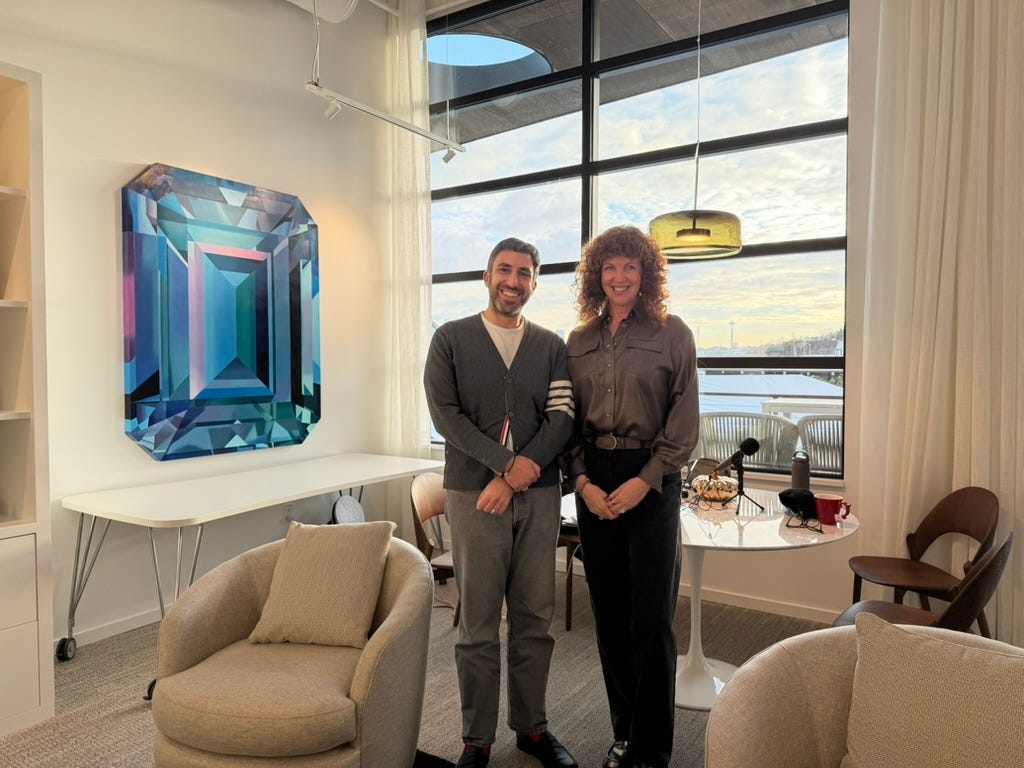
The Materialist : Monica Stephenson
Description
Marc Bridge and Monica Stephenson, Anza Gems Worldwide Headquarters, Seattle, WA
Monica Stephenson is the kind of guest who makes you see a familiar object—one you might already love—like it’s brand new. In this episode of The Materialist, we sit together in her Seattle office overlooking Lake Union and the skyline, and we follow a thread that runs from the jewelry counter in a Midwest college town all the way to artisanal gem mines in East Africa—and then back again, into the hands of the designers and collectors who ultimately give these stones a second life.
What unfolds is not just Monica’s career story (though it’s a fantastic one), but a bigger argument about what jewelry can do when it’s treated as both beauty and infrastructure: an object that sparks desire on the surface, and—if you care to go deeper—a vehicle for livelihoods, dignity, and long-term economic power.
A retailer’s education: why the “floor” matters
Monica’s origin story is refreshingly unromantic in the best way: she starts in retail in the early 1990s, selling jewelry while studying art history and fine art at the University of Iowa. That experience, she argues, isn’t a detour—it’s the foundation. Retail trains you to listen, to understand what customers actually respond to, and to translate a piece of jewelry into a reason someone chooses to bring it into their life.
It’s also where she first feels the pull of what she calls the “small sculpture” quality of jewelry—the idea that a piece can be materially precious, artistically rigorous, and emotionally immediate all at once. She remembers being captivated by the intention and artistry of emerging designers, a shift away from mass-manufactured sameness toward jewelry with a point of view. You flip a bracelet over, she says, and it’s as beautiful on the underside as it is on the top—craft as moral clarity.
There’s a personal echo too: Monica didn’t grow up in a jewelry family in the classic sense, but her father worked outside sales for a New York designer and would have merchandise spread across the kitchen table. So the objects were always there—close enough to normalize, just far enough away to remain slightly magical.
And then she says something that is both funny and true: we’re all magpies on some level. We like the shiny things. But for Monica, the “bug” goes deeper than sparkle. It’s the entire ecosystem—materials, workmanship, makers, and the people who carry the knowledge. It’s a love affair with process.
Tech, jewelry, and the limits of a “flat detail page”
From the jewelry counter, Monica’s path bends into the early internet. In the late 1990s she buys the domain for a diamond referral concept and builds what amounts to a matchmaking site connecting consumers to local retailers. It’s an early clue of what becomes a recurring theme in her work: jewelry is relational. It moves through networks of trust, story, and access.
That blend of jewelry fluency and tech curiosity leads to a once-in-a-lifetime opportunity: Amazon asks her to help launch its jewelry store in 2003. Monica becomes, in her words, “the tech translator to the jewelry industry,” straddling two worlds and learning to speak both languages.
What’s especially interesting is her reflection on why Amazon’s vision didn’t fully match the reality. Jewelry can translate to digital—today we have video, richer storytelling, and much better tools for dimensionality and nuance—but at the time, the attempt was to fit a complicated, largely non-branded category into a UPC-driven system. Watches could behave like that. Diamonds and gemstones couldn’t, at least not cleanly. Even within diamonds, there’s real variance from stone to stone, and the effort to “shoehorn” that complexity into a flat product page was harder than it looked.
When I ask what she wished the platform could have been, her answer is basically a thesis for mode