Episode Details
Back to Episodes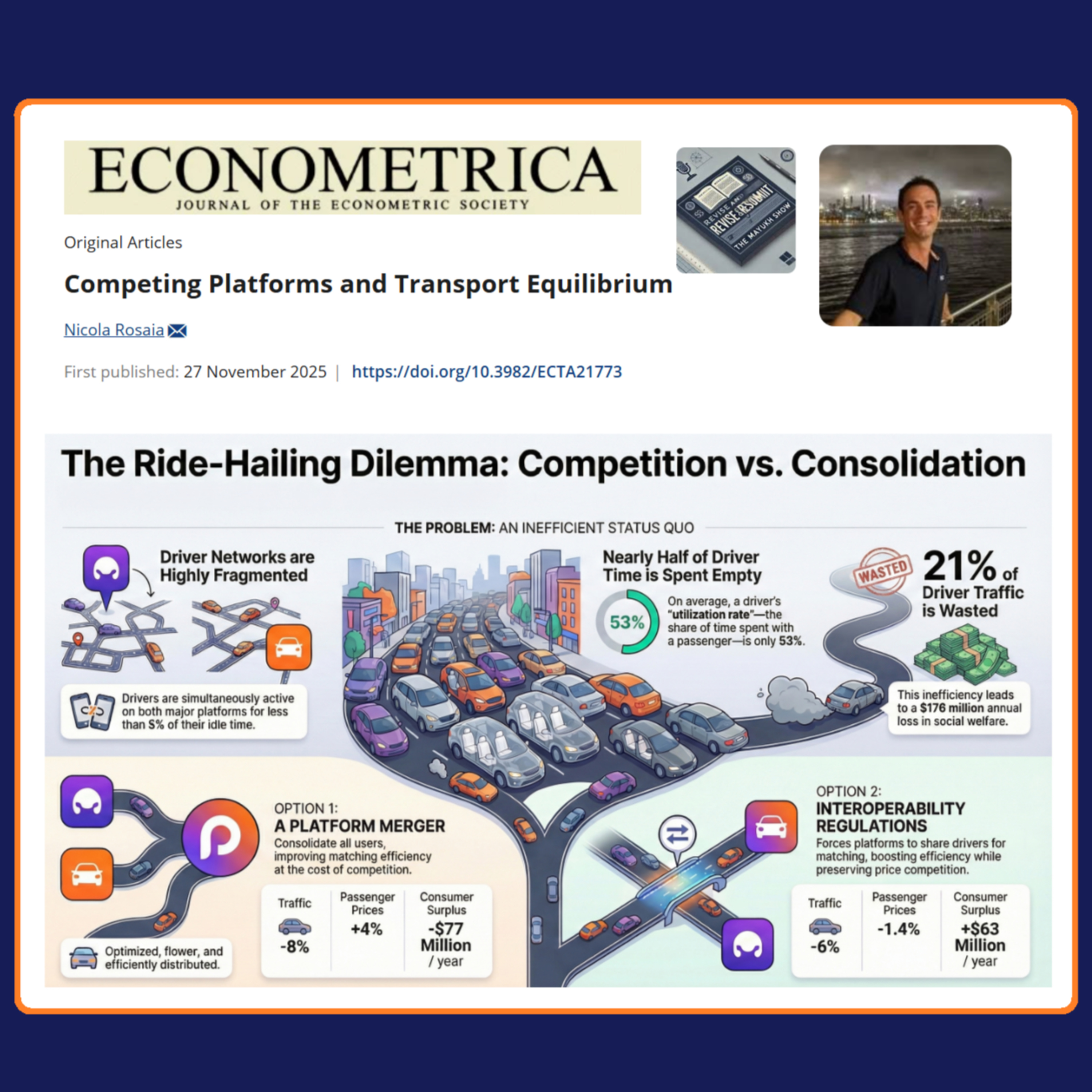
Competing Platforms and Transport Equilibrium (Rosaia 2025) | FT50 ECTA
Description
English Podcast Starts at 00:00:00
Bengali Podcast Starts at 00:18:48
Hindi Podcast Starts at 00:36:12
German Podcast Starts at 00:50:09
Reference
Rosaia, N. (2025). Competing Platforms and Transport Equilibrium. Econometrica, 93(6), 2235–2271. https://doi.org/10.3982/ecta21773
Supplement and Replication Package: https://www.econometricsociety.org/publications/econometrica/2025/11/01/Competing-Platforms-and-Transport-Equilibrium
Youtube Channel
https://www.youtube.com/@weekendresearcher
Connect over linkedin
https://www.linkedin.com/in/mayukhpsm/
Welcome to “Revise and Resubmit” 🎙️📚 — where heavyweight theory puts on headphones, gets in a cab, and rides through the real world with you.
Tonight, we’re not just hailing a ride. We’re hailing a market. 🚕📱
Two apps. One city. Millions of tiny decisions: tap here, wait there, surge now, cancel later.
On your screen, it’s a simple map with a moving car.
Underneath, it’s a battle of platforms, traffic flows, and social welfare measured in millions. 💸🌆
Our paper for this episode is
👉 “Competing Platforms and Transport Equilibrium”
by Nicola Rosaia, published in Econometrica — a prestigious FT50 journal — Volume 93, Issue 6, November 2025, from The Econometric Society and Wiley. 🏛️✨
Here’s the puzzle:
When Uber and Lyft (or any big platforms) compete, do we get efficiency… or waste?
Are we seeing smart competition, or just two half-empty networks clogging the same streets? 🚗🚗💨
Nicola Rosaia builds a spatial model of the ride-hailing market in New York City, powered by detailed data from two major platforms. Then comes the twist: by running counterfactual worlds, the paper asks, “What if we changed the rules?” 🧪
The results hit hard:
Fragmented platforms and market power together burn 176176 million dollars of social welfare every year and waste 21% of driver-generated traffic.
A platform merger would pool everyone into one big network, cutting traffic by 8%, but at a cost: prices up 4%, consumer surplus down 7777 million per year.
Interoperability regulation — letting networks talk and drivers multi-home — captures most of the efficiency: wasteful traffic down 6%, while consumer surplus rises by 6363 million a year. 📉🚦📈
So one simple tap on a ride-hailing app turns out to be anything but simple.
It’s a choice shaped by algorithms, pricing power, and who is allowed to work for whom.
Competition gives you options. Fragmentation gives you traffic. Regulation reshapes the game. ⚖️
A huge thank you to Nicola Rosaia, to The Econometric Society, to Wiley, and to the prestigious FT50 journal Econometrica for this sharp, data-rich look at how platforms move people—and money—through our cities. 🙏📖
If you enjoy this kind of deep dive into cutting-edge research, hit subscribe to
🎧 “Revise and Resubmit” on Spotify, Amazon Prime, and Apple Podcast,
and don’t forget our 🎥 YouTube channel “Weekend Researcher” for more geeky-yet-fun explorations of academic work.
So as we roll into this episode, here’s the