Episode Details
Back to Episodes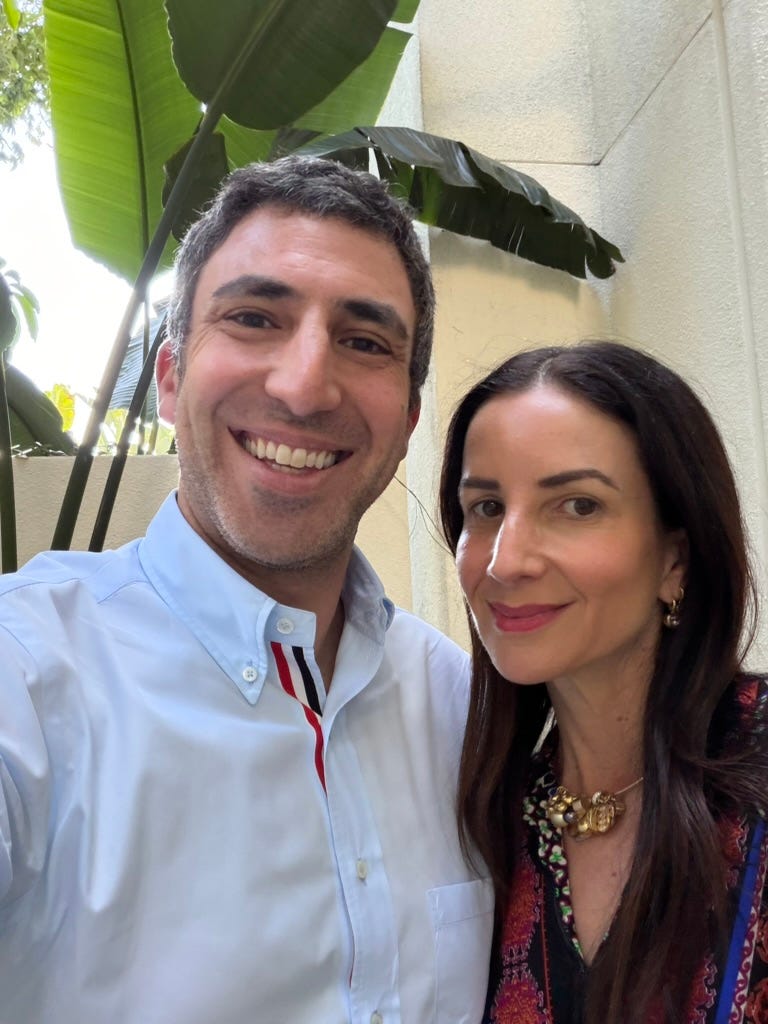
The Materialist : Randi Molofsky
Description
Marc Bridge and Randi Molofsky, The Peninsula Beverly Hills
There are people in the jewelry world who write about it, people who sell it, people who design it—and then there’s Randi Molofsky, whose superpower is weaving all of these worlds together. Randi doesn’t simply work in jewelry. She connects miners to designers, designers to retailers, and collectors to pieces that will live on their bodies and in their lives. She is a translator, mediator, curator, and—by her own admission—a sentimentalist with impeccable taste and a love of objects that carry stories.
In this episode, recorded in sun-drenched Beverly Hills, we go deep into the heart of contemporary jewelry: where it comes from, how it gets made, who gets to participate, why it costs what it costs, and how personal style—and personal history—shape the objects we choose to carry with us.
But we start at the beginning, with a young woman from a small Maryland town who loved fashion magazines and dreamt of a job at Vogue, only to discover a very different world in the pages of National Jeweler.
A Connector Before She Had the Language for It
Randi never set out to work in jewelry. She studied journalism, imagined a career in fashion media, and took an interview at a trade publication she’d never heard of. They hired her—“young, passionate, and totally green”—and that job changed everything.
As the fashion editor at National Jeweler, she was suddenly immersed in a universe she didn’t know existed:• trade shows• gem-cutting studios• retailers’ back rooms• global supply chains• and, eventually, gemstone mines in Africa
A trip to the Tanzanite mines in Tanzania was a defining moment. Standing at the foothills of Kilimanjaro, meeting miners and witnessing the challenges and humanity embedded in every stone, Randi began to understand jewelry not as a product but as a global system of craft, risk, beauty, and meaning.
That perspective—ground-level humanity fused with aesthetic sensitivity—is what shapes her work today.
The Jewelry World’s Great Misunderstanding
“There’s nothing harder,” Randi says, “than helping a consumer understand where the value in jewelry actually comes from.”
We live in a world where you can buy diamonds at Costco. The average consumer sees sparkle, price, maybe the four C’s—not the miners, cutters, alloy-makers, bench jewelers, or the hands the piece passes through before it lands in a box on a dresser.
Randi argues that jewelry suffers from an education gap. We romanticize the final object but rarely discuss its life before us. One of her goals—whether mentoring designers or advising retailers—is to bridge that gap:
Jewelry is not a commodity. It is a collaboration between earth, craft, culture, and the deeply personal taste of its wearer.
The Case for Uniqueness in a Saturated Market
Randi’s agency, For Future Reference, works with emerging independent designers to shape their identity, build collections, manage wholesale, and navigate a retail landscape that has become simultaneously more crowded and more challenging.
She tells every would-be jewelry designer the same thing:
“Don’t do it.”
Not because she doesn’t love this world—she does—but because the cost of entry is enormous, the margins volatile, and the competition intense. Designers fail not for lack of vision, but for lack of support. Randi’s work is to be that support: part strategist, part editor, part therapist, part guardian.
She looks for designers whose pieces form their own vocabulary—work that is visually identifiable, that tells a story only its creator could tell. “Authenticity,”