Episode Details
Back to Episodes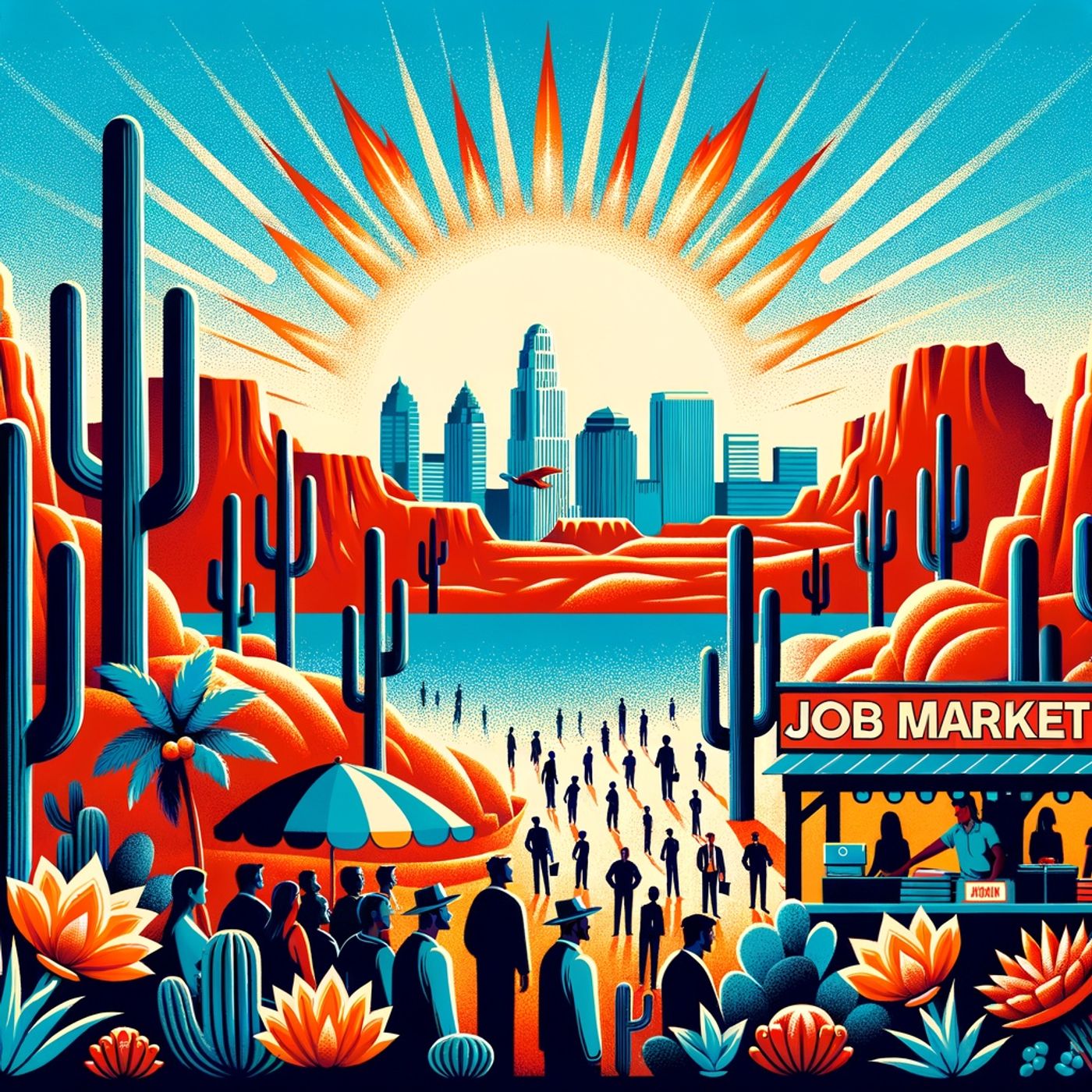
Phoenix's Evolving Job Market: Balancing Growth, Challenges, and Opportunities
Published 2 months, 3 weeks ago
Description
Phoenix’s job market remains one of the Southwest’s most dynamic, powered by rapid population growth, large-scale industrial investment, and a diversifying economy, though some office and retail segments are softening. The U.S. Bureau of Labor Statistics reports that metro Phoenix nonfarm employment continues to post modest year‑over‑year gains, with Arizona’s statewide unemployment rate hovering around the low‑4% range in 2025, indicating a labor market that is cooling from the pandemic boom yet still relatively tight by historical standards. The Greater Phoenix Economic Council forecasts roughly a 13% rise in regional employment over the coming decade, underscoring long‑term labor demand. According to the Phoenix Business Journal and CoStar analyses, job growth has been strongest in healthcare, industrial and logistics, and advanced manufacturing, while traditional office‑using sectors have seen weaker hiring and elevated vacancy, with about one‑fifth of office space sitting empty and ripe for conversion or reuse. Major industries now include aerospace and defense, semiconductors, logistics and warehousing, construction, real estate, healthcare, biosciences, tourism, and a growing tech and AI services niche; large anchors range from Honeywell and TSMC to major hospital systems and construction firms. New investment is reshaping the landscape: the Taiwan Semiconductor Manufacturing Company campus in north Phoenix—described by city economic development officials as the region’s largest economic initiative—continues to drive high‑wage engineering, supplier, and construction jobs, while Glendale’s Aldea Exchange and other modern industrial parks described by Bisnow are expanding logistics and light manufacturing capacity. The Phoenix Bioscience Core in downtown Phoenix highlights the rise of life sciences and research employment, and startup ecosystem research from Allwork and others shows Phoenix leading large U.S. cities in startup density and growth. Seasonally, hiring tends to peak in winter and early spring tied to tourism, construction, and in‑migration, easing somewhat during the hottest summer months, with commuting increasingly shaped by suburban growth in places like Mesa, Buckeye, and Queen Creek and longer cross‑metro drives. Local and state initiatives stress workforce training, land‑use flexibility, and infrastructure; however, experts cited by the Arizona Capitol Times warn that gaps in education, housing affordability, childcare, and transportation could constrain future labor supply if not addressed. Some data—such as neighborhood‑level wage growth, detailed commuting mode shares, and the latest monthly metro unemployment rate—lag by a few months or are only available in technical releases, so listeners should assume slight delays between conditions on the ground and published statistics. For a snapshot of current demand, listeners can find openings such as a process engineer position at TSMC’s Phoenix fab, a registered nurse role with a major Phoenix health system, and a project manager job with a leading local construction firm, all advertised in recent regional listings. Key findings: Phoenix’s job market is still expanding, led by industrial, healthcare, bioscience, and advanced manufacturing; office and some retail segments are under pressure but creating opportunities for redevelopment; population inflows and megaprojects are sustaining labor demand, while long‑term growth will depend on tackling housing, education, and infrastructure constraints so that more residents can access emerging high‑skill jobs. Thank you for tuning in, and remember to subscribe. This has been a quiet please production, for more check out quiet please dot ai.
For more http://www.quietplease.ai
Get the best deals https://amzn.to/3ODvOta
This content was created in partnership and with the hel
For more http://www.quietplease.ai
Get the best deals https://amzn.to/3ODvOta
This content was created in partnership and with the hel