Episode Details
Back to Episodes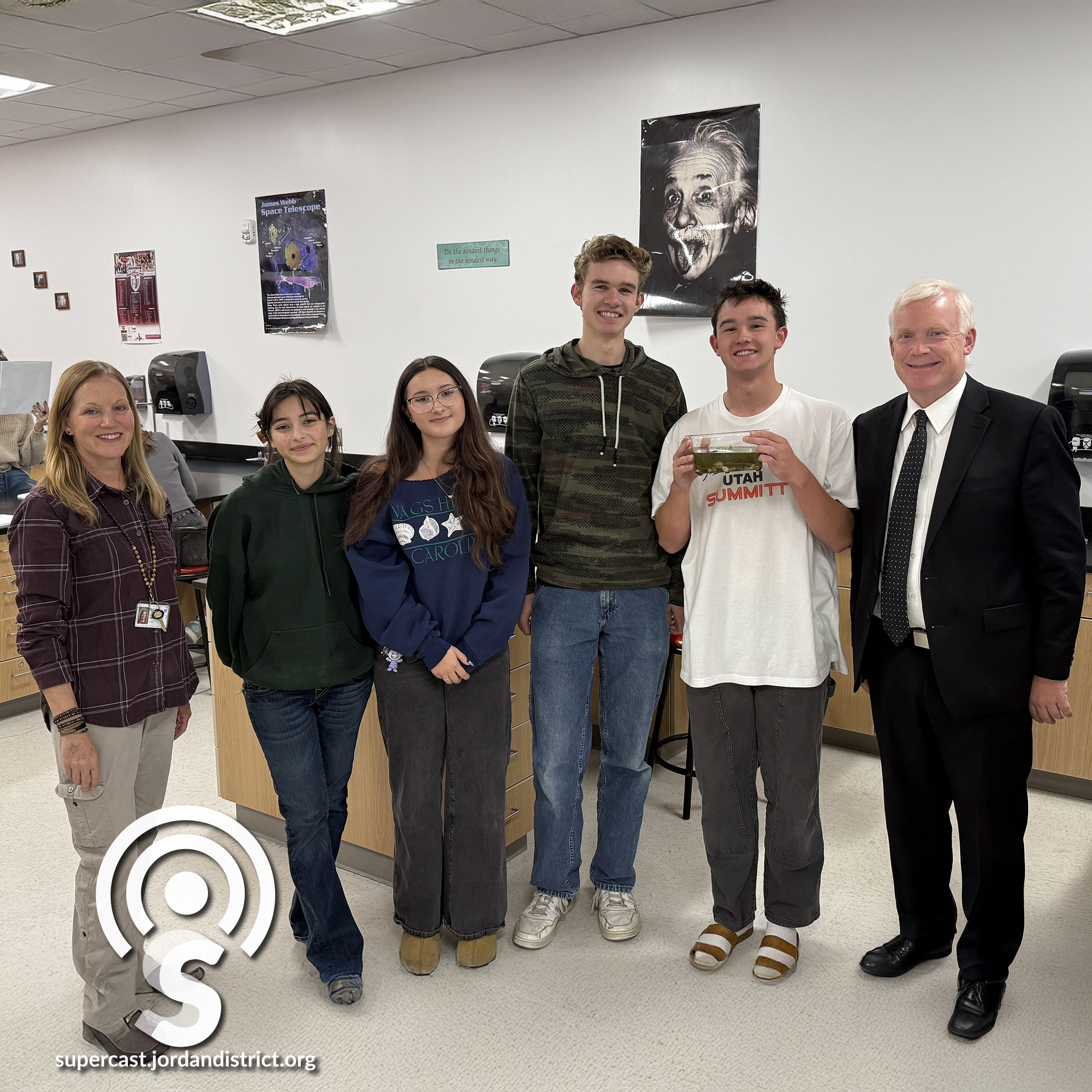
Snails Help Students Fast Track Their Knowledge in AP Environmental Science Class
Description
They are less than an inch long, weigh mere grams, and move incredibly slow with average speeds of 0.03 miles per hour. We are talking about snails, a soft-bodied mollusk called the Gastropoda.
On this episode of the Supercast, we take you to an Advanced Placement (AP) Environmental Science class at Mountain Ridge High School where small snails are having a big impact on students studying the ecosystem. Find out the role snails are playing in the AP course, and how the class is capitalizing on the snail-based learning.
Audio Transcription
Anthony Godfrey:
I heard that Miss Craig has described your particular project here as being healthy and gross at the same time.
Chase Barlow:
Yeah so basically she's talking about the fact that our tank is thriving a lot like we have a lot of activity going on in there and if you just look at it it's it's not a very clear water it's very murky and kind of gross. It doesn't smell very good either.
Anthony Godfrey:
Hello and welcome to the Supercast. I'm your host Superintendent Anthony Godfrey. They are less than an inch long, weigh mere grams, and move incredibly slowly with average speeds of 0.03 miles per hour. We are talking about snails, a soft-bodied mollusk in a class called gastrocato. On this episode of the Supercast we take you to an advanced placement biology class at Mountain Ridge High School where small snails are having a big impact on students studying the ecosystem. Find out the role snails are playing in the AP course and how the class is capitalizing on the snail-based learning.
(music)
Anthony Godfrey:
We're talking now with Miss Craig here at Mountain Ridge High School about her AP environmental science class. Thanks for taking a few minutes with us.
Ms. Craig:
Yeah of course anytime, thanks for coming out.
Anthony Godfrey:
Tell us about the project that has been going on and what's happening today with students.
Ms. Craig:
So in AP environmental science we're learning about the biogeochemical cycles. So things like carbon and nitrogen and phosphorus and water cycles and we started this project six weeks ago. So each group got a little aquatic habitat and each group got between six and eight snails depending on the group. They've just been monitoring the nutrients, keeping track of dissolved oxygen, trying to keep their snail habitats as healthy as possible for the last six weeks.
Anthony Godfrey:
So they've had to test hypotheses and figure out how exactly to do that.
Ms. Craig:
Yes. So each group after the two-week period after we collected some baseline data each group made a modification to their tank so they changed something that would impact the nutrient cycle and then we continued to collect data for four more weeks so that they could see how that change impacted the lifestyle of the snails.
Anthony Godfrey:
The only cycle that I really caught was the water cycle.
Ms. Craig:
Yes.
Anthony Godfrey:
So all of these different cycles — The phosphorus cycle, was that one of them as well?
Ms. Craig:
Yes.
Anthony Godfrey:
So all of these cycles are aspects of environmental science that they'll be tested on as part of the AP test.
Ms. Craig:
Exactly. Yep.
Anthony Godfrey:
So tell me about some of those other cycles. The water cycle I'm familiar with but tell me about some of the others.
Ms. Craig:
So nitrogen and phosphorus are critical nutrients that every living thing needs in order to be able to survive. It's part of your DNA, it's used in cellular functions. So we're measuring those critical nutrients. We're measuring dissolved oxygen levels as well which can help us keep track of the rate of photosynthesis and respiration rates, and how well the quality of overall quality o