Episode Details
Back to Episodes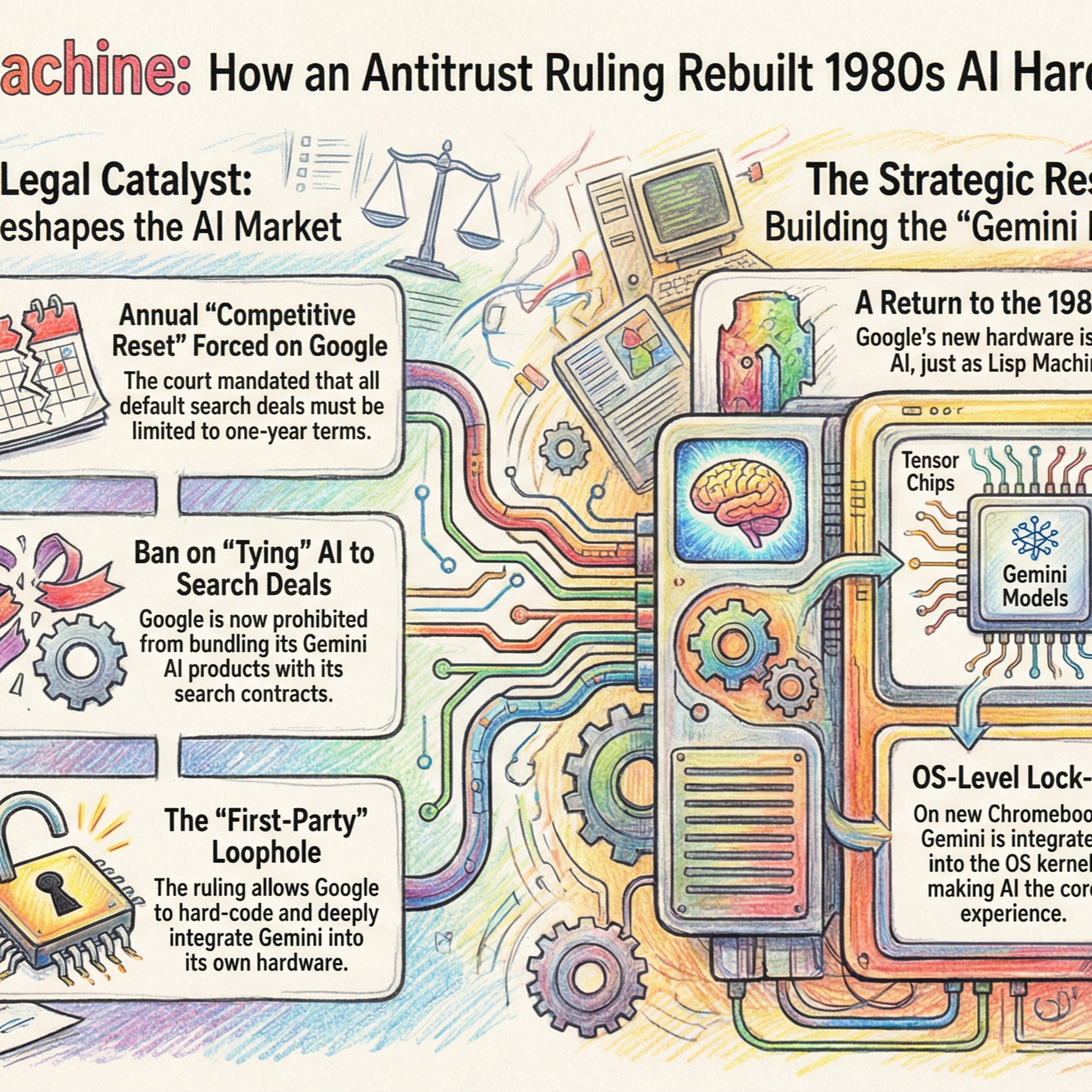
Google v/s DOJ - unintended consequences - how the remedies likely force google into reincarnating the LISP machine of the eighties - aka The Gemini Machine
Description
The U.S. District Court found Google liable for maintaining its monopoly through exclusionary distribution agreements for search services and search advertising. This victory for antitrust enforcement, however, carries the risk of significant unintended architectural consequences, potentially shifting market power rather than distributing it.
The legal finding established that Google used both explicit and de facto exclusive dealing arrangements. While agreements with major partners were found to be explicitly or effectively exclusive, securing Google as the preloaded default search engine, the ultimate source of Google’s monopoly power was the de facto lack of competition. Rivals could not realistically afford to pay the large sums necessary to displace Google, nor could they guarantee quality or monetization, leaving Google as the financially inevitable, albeit legally constrained, choice.
In December 2025, the court imposed remedies intended to dismantle this arrangement, mandating an annual competitive reset by limiting all exclusive search default agreements (such as those with Apple and Samsung) to a single year and explicitly banning the coupling, or tying, of Google’s generative AI products (Gemini) with lucrative search revenue deals.
This legal intervention, aimed at opening the general purpose market, inadvertently provided Google with a legal "Safe Harbor": the court’s ruling rejected banning self-preferencing on first-party devices. The inability to guarantee distribution of its search product and AI models on popular third-party hardware (due to the one-year contract limit and the ban on tying its AI) has created a "volatility trap" for Google.
In response, Google is accelerating a profound architectural pivot toward vertical integration, essentially reincarnating the specialized Lisp Machine era of the 1980s. In that historical parallel, specialized hardware designed to run the AI language Lisp was eventually defeated by powerful, general-purpose processors. Today, the court’s decision is forcing Google to commit deeply to proprietary, Inference-Native devices, creating what can be called the "Gemini Machine".
Devices like the Pixel 10 (featuring the specialized Tensor G5 chip) and its extended reality platforms are now being designed with hardware physically optimized to run the Gemini model locally. This deep integration goes beyond applications: Gemini is integrated directly into the operating system kernel, turning the machine's memory into a large context window where the AI constantly "sees" all user activity.
This strategy allows Google to bypass regulatory constraints. In future interfaces, like augmented reality glasses, the traditional notion of a "default search engine" disappears, replaced by a singular AI voice agent that simply answers a question when prompted. This proprietary, closed ecosystem, where the AI is the computing substrate rather than a downloadable app, sidesteps the court's mandated annual competitive search auction.
The final outcome of the remedy may thus be market bifurcation: the open market (e.g., Apple and Samsung phones) will become neutral, general-purpose platforms, forcing users to manually choose AI models yearly, while Google's own devices become highly specialized, vertically controlled "Gemini Machines" where the AI experience is exclusive and tightly controlled.
#Antitrust #GoogleDOJ #GeminiMachine #VerticalIntegration #UnintendedConsequences #AIStrategy #ClosedEcosystem #LispMachine #TechRegulation #SearchMonopoly