Episode Details
Back to Episodes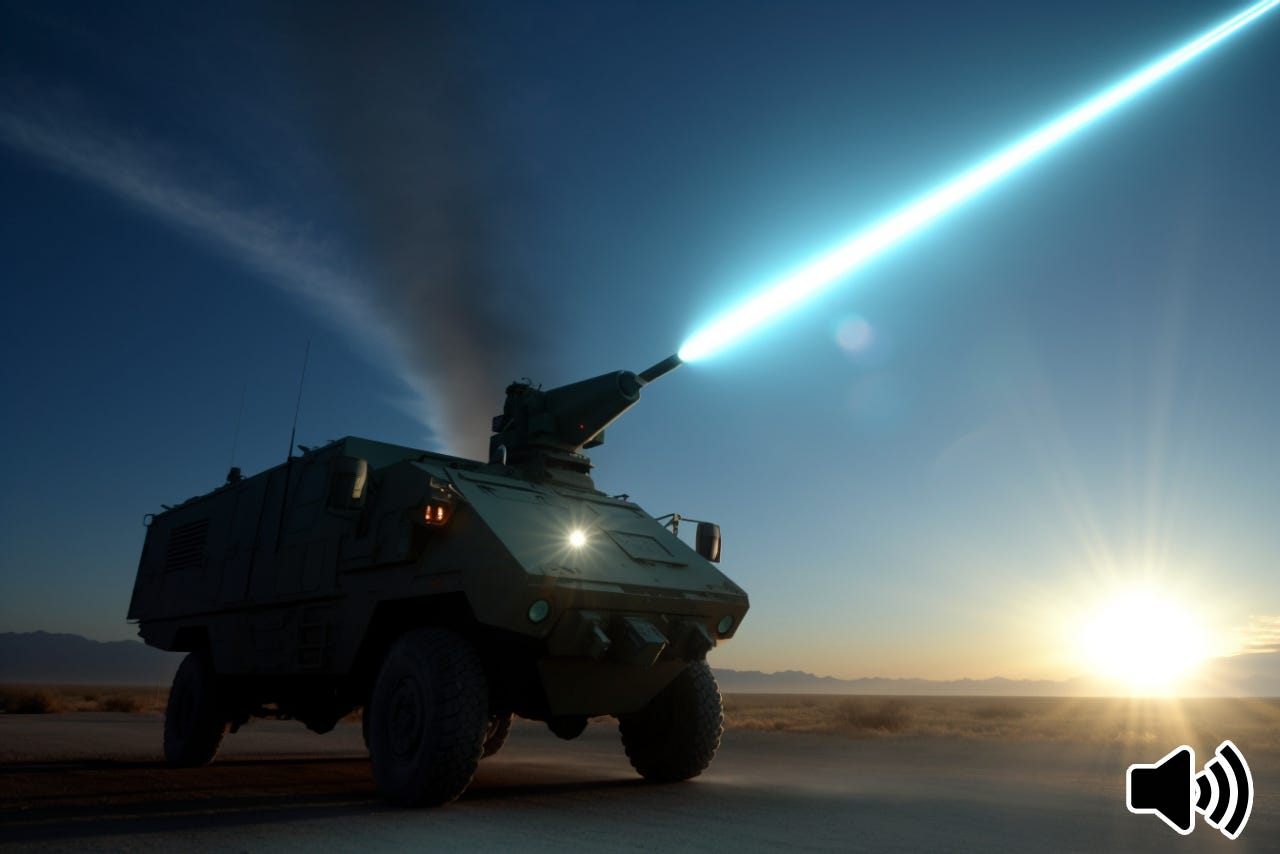
Israel's Iron Beam & The Dawn Of A Nuclear Weapons-Free Future
Description
In the shadowed corridors of modern warfare, where drones swarm like locusts and missiles arc across borders with impersonal precision, a quiet revolution is unfolding. Israel’s Iron Beam, a high-powered laser defense system, stands poised to redefine the rules of engagement.
As we stand on the precipice of its full deployment by December 30, 2025, this technology—born from urgency and ingenuity—offers not just a shield against immediate threats, but a beacon of hope for a world long haunted by the specter of nuclear annihilation. Developed over more than a decade by Rafael Advanced Defense Systems and Elbit Systems, Iron Beam represents Israel’s audacious leap into directed-energy weapons, transforming science fiction into frontline reality.
The system’s journey has been one of relentless iteration, spurred by the brutal lessons of conflict. Unveiled in conceptual form years ago, Iron Beam accelerated after the October 7, 2023, Hamas assault, which unleashed thousands of rockets and drones, overwhelming traditional defenses. By September 2025, prototypes had already proven their mettle in combat, intercepting at least 40 Hezbollah drones in October 2024— a feat that saved civilian lives and safeguarded critical infrastructure without firing a single costly missile.
Brig. Gen. (res.) Danny Gold, head of the Israel Defense Ministry’s Directorate of Defense Research & Development (MAFAT), proclaimed, “Israel is the first country in the world to present a massive operational laser capability for intercepting threats.”
At its core, Iron Beam is a ground-based, 100-kilowatt fiber laser, capable of zapping rockets, mortars, and UAVs at ranges up to 10 kilometers—at the speed of light, no less. Each interception costs a mere half-dollar, akin to “turning on the lights,” as Defense Ministry Director-General Amir Baram aptly put it. This contrasts starkly with the $50,000 price tag of an Iron Dome interceptor, addressing the ammunition shortages exposed during the 12-day Iran-Israel War in June 2025, when nearly 600 Iranian missiles and over 1,000 drones tested Israel’s multilayered defenses to their limits.
What elevates Iron Beam beyond tactical brilliance is its seamless integration into Israel’s existing arsenal. It doesn’t replace Iron Dome, David’s Sling, or Arrow; it augments them.
Upon detecting an incoming threat, shared radar and command systems decide in seconds whether to deploy a laser zap or a kinetic missile, optimizing for cost and efficacy. Variants like Lite Beam (10 kW for vehicle mounting) and Iron Beam M (50 kW for trucks) promise mobile protection, extending this “unlimited magazine” to ground forces.
Of course, challenges remain—lasers falter in adverse weather, and are untested in full-spectrum barrages like October 7—but comprehensive trials, including those validated in 2025, affirm its reliability. As Gold noted at a Tel Aviv defense summit, “The Iron Beam laser system is expected to fundamentally change the rules of engagement on the battlefield.”
For Israel, besieged on multiple fronts, this isn’t just defense; it’s survival elevated to strategic supremacy.
Across the Atlantic, the United States mirrors this ambition with its own directed-energy pursuits, underscoring a transatlantic synergy vital to global security. The US Army’s Indirect Fire Protection Capability-High Energy Laser (IFPC-HEL) prototype program, overseen by the Rapid Capabilities & Critical Technologies Office, is the closest analog to Iron Beam. Awarded a $221 million contract to Lockheed Martin in 2023, IFPC-HEL aims to neutralize rockets, art