Episode Details
Back to Episodes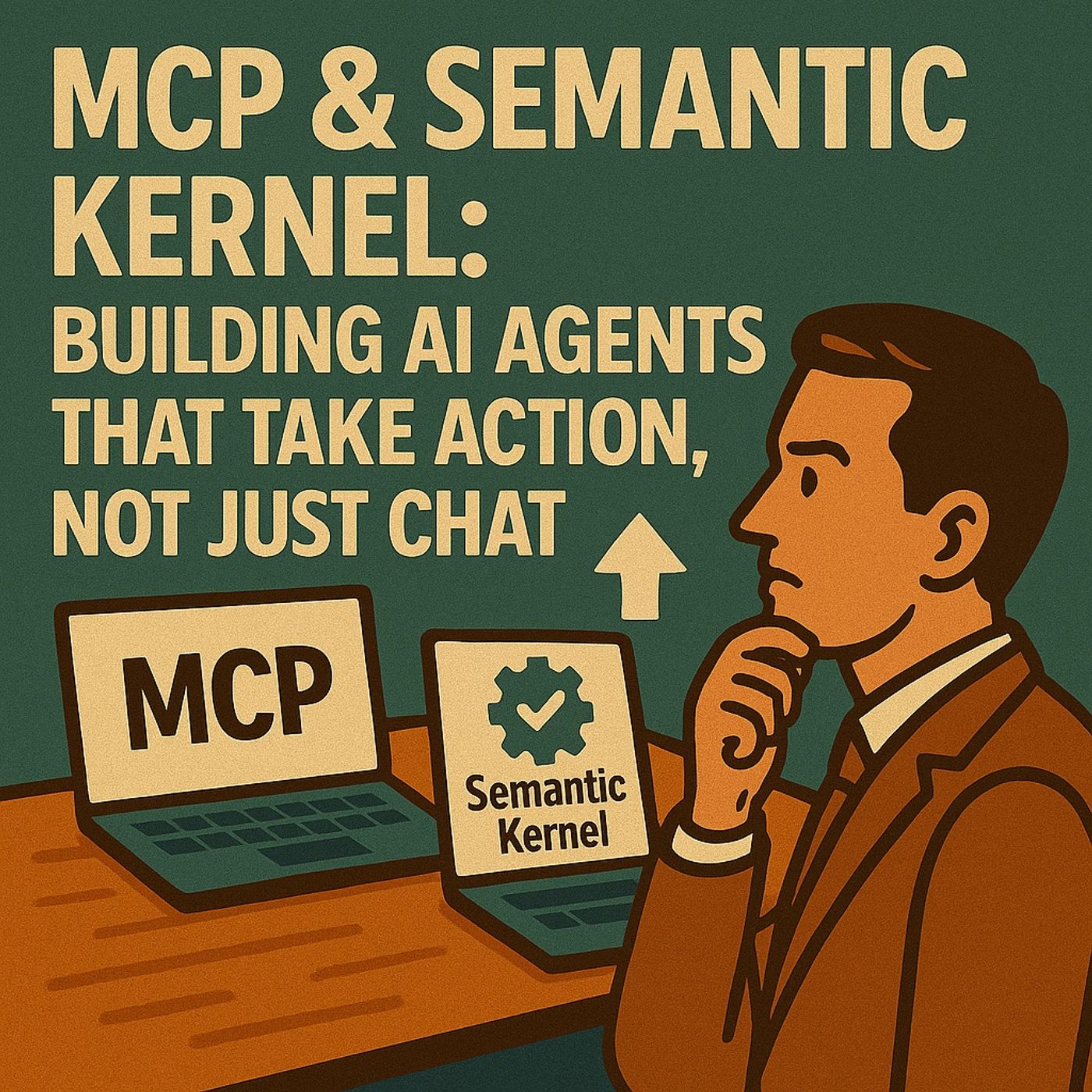
MCP & Semantic Kernel: Building AI Agents That Take Action, Not Just Chat
Published 2 months, 3 weeks ago
Description
(00:00:00) Transforming AI from Talker to Worker
(00:00:40) The Shift from Q&A to Action
(00:01:50) The Three Ingredients of AI Orchestration
(00:04:30) The Six Parts of a Capable IT OPS Agent
(00:10:08) Microsoft Stack: The Containment Field
(00:16:45) Blueprint I: SK Planner + Graph via MCP
(00:22:32) Blueprint II: Azure Open AI Tool Calling with Managed Identity
(00:27:40) Blueprint III: Incident Autoremediation and IT OPS
(00:35:28) The Power of Guardrails and Responsibility
(00:41:48) Key Takeaways and Future Directions
Ah! You’re wasting AI on small talk. Pure power trapped in chit-chat.
In this episode, we break open the containment field and show you how to turn AI from a polite conversationalist into a fully-acting IT Operations agent—one that plans, executes, verifies, and stays inside governance at all times. You’ll learn exactly how modern enterprise teams are using Semantic Kernel, MCP, and Azure OpenAI tool-calling with Managed Identity to auto-remediate incidents, reduce MTTR, eliminate hundreds of service desk tickets, and create predictable, auditable workflows. This isn’t theory—it’s the blueprint. 🎯 Episode Focus — From Answering to Acting Traditional chatbots whisper advice. Acting agents do the work.
We explore the shift from static Q&A loops to a closed-loop cycle: Intention → Plan → Tool Use → Result → Self-Check → Next Step Learn why this pattern unlocks automation in Microsoft environments without sacrificing safety, compliance, or observability. Micro-Story: A real SRE team wired an agent to monitor high CPU alerts, correlate with deployments, drain faulty nodes, roll back the slot, and post an incident summary—all before the human even rolled out of bed.
Not magic. Orchestration. 🔌 Why Microsoft Shops Win Big: MCP + SK + Managed Identity Three components snap together and give you enterprise-grade capability: 🔧 MCP (Model Context Protocol): The Wiring
(00:00:40) The Shift from Q&A to Action
(00:01:50) The Three Ingredients of AI Orchestration
(00:04:30) The Six Parts of a Capable IT OPS Agent
(00:10:08) Microsoft Stack: The Containment Field
(00:16:45) Blueprint I: SK Planner + Graph via MCP
(00:22:32) Blueprint II: Azure Open AI Tool Calling with Managed Identity
(00:27:40) Blueprint III: Incident Autoremediation and IT OPS
(00:35:28) The Power of Guardrails and Responsibility
(00:41:48) Key Takeaways and Future Directions
Ah! You’re wasting AI on small talk. Pure power trapped in chit-chat.
In this episode, we break open the containment field and show you how to turn AI from a polite conversationalist into a fully-acting IT Operations agent—one that plans, executes, verifies, and stays inside governance at all times. You’ll learn exactly how modern enterprise teams are using Semantic Kernel, MCP, and Azure OpenAI tool-calling with Managed Identity to auto-remediate incidents, reduce MTTR, eliminate hundreds of service desk tickets, and create predictable, auditable workflows. This isn’t theory—it’s the blueprint. 🎯 Episode Focus — From Answering to Acting Traditional chatbots whisper advice. Acting agents do the work.
We explore the shift from static Q&A loops to a closed-loop cycle: Intention → Plan → Tool Use → Result → Self-Check → Next Step Learn why this pattern unlocks automation in Microsoft environments without sacrificing safety, compliance, or observability. Micro-Story: A real SRE team wired an agent to monitor high CPU alerts, correlate with deployments, drain faulty nodes, roll back the slot, and post an incident summary—all before the human even rolled out of bed.
Not magic. Orchestration. 🔌 Why Microsoft Shops Win Big: MCP + SK + Managed Identity Three components snap together and give you enterprise-grade capability: 🔧 MCP (Model Context Protocol): The Wiring
- Tools describe themselves with standards and schemas
- Microsoft Graph, Intune, Service Health, internal APIs become discoverable
- No brittle plugins or secret adapters
- Add new capabilities without redeploying anything
- Turns MCP tools into callable kernel functions
- Handles planning: sequential, parallel, or graph-shaped tasks
- Auto-builds JSON schemas models expect
- Removes the need for hand-crafted payloads
- Model decides what, identity decides what’s allowed
- Tokens are never exposed
- Each action is access-controlled at the tool boundary
- High-risk actions require approval tokens
- Persona — SRE temperament encoded (cautious, concise, safety-first).
- Memory — Short-term context + durable environmental facts.
- Planner — Decomposes tasks into safe, verifiable steps.
- Tools — MCP-exposed actuators and sensors.
- Policy — Identity controls, approvals, guardrails.
- Verifier — Post-action checks: metrics, probes, risk state.
- AppInsightsQuery
- GraphServiceHealth
- GraphChangeLog
- DrainSubsetByBuild
- RollbackSlot
- PostIncidentNote
- Assess: Query metrics, deployments, health advisories (parallel).
- Decide: Pick the narrowest safe fix—e